

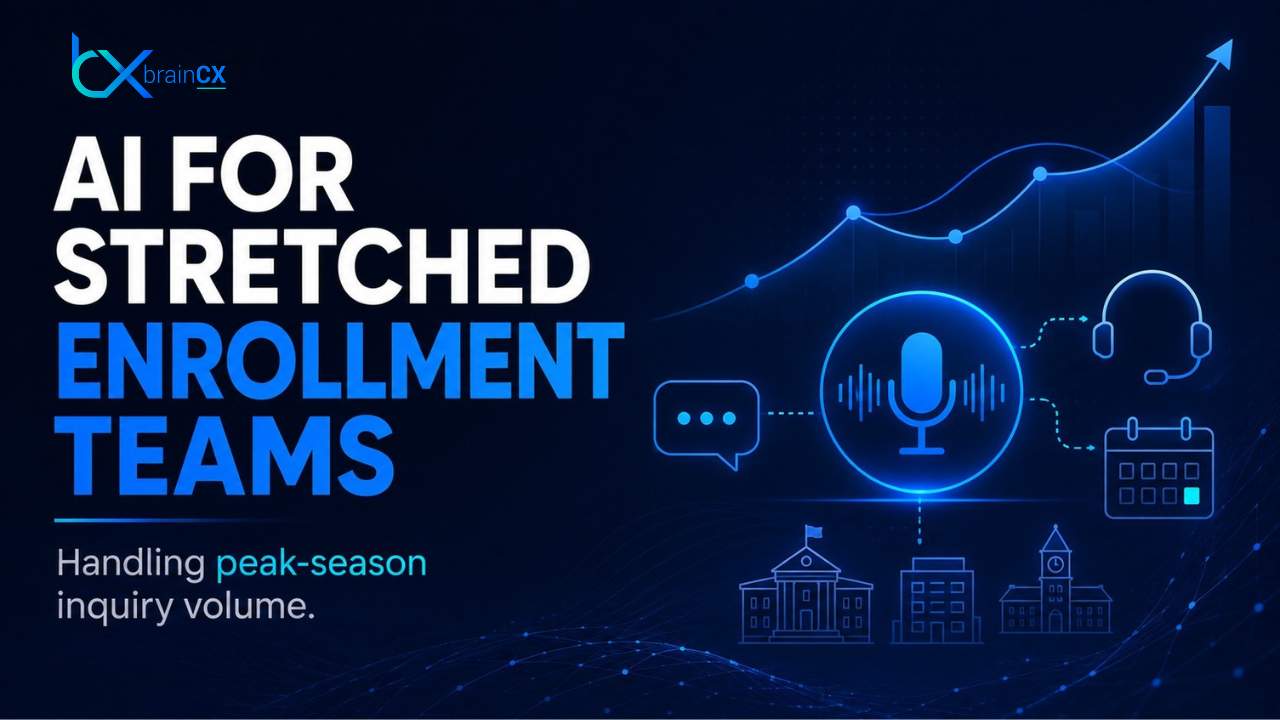
Enrollment call centers are staffed against a curve, and the curve moved.
The 2026-27 FAFSA launched on September 24, 2025, the earliest release in the program’s history, ahead of the Department of Education’s own October 1 target. Volume followed immediately. More than 5 million submissions were completed by December 2025, close to a 150% increase over the same point the prior year, and roughly 1.6 million high school seniors had filed by January 2026, a 52% increase over the previous graduating class at the same point.
That is good news for access and a genuine problem for staffing. A team that hired seasonal help for a January through March crunch spent the fall understaffed against a spike that arrived four months early, and then paid for temps during the trough.
The peak is now less predictable, not earlier
Three cycles of moving launch dates have broken the assumption that peak season is a fixed window you can plan headcount around.
The consequence of getting it wrong is documented. A BestColleges survey found that one in four students said issues with the 2024-25 FAFSA rollout affected their ability to stay enrolled in their current program. Reporting on that cycle attributed part of the damage to understaffed call centers and delayed manual verification, findings echoed in a Government Accountability Office review of the rollout.
When a student cannot get an answer about whether their aid package is real, they do not escalate. They enroll somewhere else, or nowhere.
So the operational question is not “how do we hire for peak.” It is “how do we make peak stop being a capacity event.”
Why three seasonal temps do not fix a peak
Run the arithmetic on a mid-size institution during a two-week verification crunch.
|
Line |
Value |
|---|---|
| Inbound calls, peak week | 4,200 |
| Average handle time | 7 minutes |
| Agent hours required | 490 |
| Staffed agent hours available (8 FTE) | 320 |
| Uncovered demand | 170 hours, roughly 1,460 calls |
| Typical outcome | Abandonment, voicemail, callback backlog |
Adding three temps closes part of the gap on paper. In practice it does not, for reasons every enrollment director already knows.
Ramp time exceeds the peak. A new agent needs weeks to answer verification, SAI, and contributor questions accurately. By the time they are competent, the crunch is over.
Volume is spiky within the week. Staffing to the weekly average leaves Monday and the day after a deadline notification uncovered. Staffing to the daily peak means paying for idle capacity most of the time.
The hard calls do not get easier. Temps handle the simple questions, which means your experienced staff still carry every appeal, every professional judgment case, and every parent who has already called twice.
Elasticity is the actual feature
The reason voice AI matters at peak is not cost per call. It is that capacity becomes instantaneous and unlimited in the direction you need it.
When 900 students call in a four-hour window after a document request goes out, every one of them is answered on the first ring. No queue forms, so no abandonment happens, so no callback backlog is created, so the next day is not spent digging out of the previous one. The compounding effect of not falling behind is larger than the direct labor saving, and it is the part that never shows up in a cost model.
Practically, an AI phone agent handles the volume categories that dominate peak: application and document status, deadline questions, portal and contributor invite problems, disbursement timing, next-step instructions, and appointment booking with a counselor. It writes what it captures into the CRM or SIS during the conversation, so there is no post-peak data entry debt.
Anything requiring professional judgment, an appeal, or a records disclosure goes to a human with full context attached. That escalation logic and the orchestration behind it are described in the BrainCX platform overview.
Your counselors then spend the crunch on the conversations that actually change a yield decision, which is what you hired them for.
The language problem gets worse at peak, not better
Off-peak, a bilingual staffer can absorb the multilingual queue. At peak, that person becomes a single point of failure, and the families who need the most help waiting the longest is the opposite of what an access mission looks like.
Native-language conversation removes the bottleneck rather than scheduling around it. BrainCX supports conversation in 40+ languages, either natively or through real-time interpretation. The clearest evidence for what this is worth comes from an adjacent vertical: a BrainCX behavioral health client reported a 40% lift in bookings for Spanish-speaking clients after multilingual voice AI went live, purely because the language barrier stopped being a wait.
The same mechanic applies to a financial aid line during verification season, where a parent contributor who cannot read the portal in English is the reason a student’s file stalls.
A pre-peak checklist
Work backwards from your next volume event.
- Pull last cycle’s call volume by day and hour. Not the monthly total. The hourly curve is where the abandonment lives.
- Separate abandonment by stage. In the menu, in the queue, and after transfer. Each has a different fix and a blended number hides all three.
- Rank your top 15 call reasons by volume. Usually 6 of them are 70% of the calls, and all 6 are answerable from approved content.
- Audit the content those answers depend on. Automation surfaces stale deadline and process copy at scale within a day.
- Write the escalation rules before the build. Which questions must reach a human, and what context transfers with them.
- Instrument your baseline. Answer rate by hour, abandonment by stage, first-contact resolution, speed to first response on web inquiries, and conversion by language preference.
- Give yourself the lead time. Standard deployments run 30 to 45 days from signed to live, so a decision made 90 days out is comfortable and one made 30 days out is not.
Because enrollment sits among the industries where a single mishandled call has downstream consequences, conversation design comes before automation here. The reasoning behind that sequence, and why it produces a call that does not sound like a phone tree, is on the science of human communication.
Questions enrollment leaders ask
1. Can AI answer financial aid questions accurately?
It can answer process, status, deadline, and document questions from your approved content reliably, and those are the majority of peak volume. Individual eligibility determinations, professional judgment cases, and appeals should route to staff. The line to draw is between institutional information and individual determination.
2. How does this handle FERPA?
Student record disclosures require authorized access, so the agent is configured to verify identity per your policy and to escalate anything involving record content to authorized staff. BrainCX lists FERPA as planned for higher education deployments, so confirm the specifics against your registrar’s requirements during scoping rather than assuming coverage.
3. Will this replace our enrollment counselors?
It replaces the queue, not the counselor. What changes is the mix of what reaches a person. The routine status calls stop arriving, and the conversations that survive are the ones where a counselor’s judgment moves the outcome.
4. What is realistic to expect in the first cycle?
Answered-call rate approaching 100% at peak, meaningful reduction in abandonment, and no callback backlog carried between days. Yield effects take a full cycle to attribute honestly, and any vendor promising a yield number before seeing your funnel is selling rather than modeling.
5. Does this work for bootcamps and test prep as well as degree-granting institutions?
Yes, and often better, because the cycles are shorter and speed to first contact carries more weight in a compressed decision window.
Want your peak-week capacity gap modeled against last cycle’s call data? Talk to the BrainCX team