

What does voice AI for credit unions change about member service calls?
Voice AI for credit unions answers the routine member calls that fill a branch phone line, balance and transaction questions, card activation, dispute intake, appointment booking, and lost-card reporting, and routes anything requiring judgement to a member services representative with full context. It also makes outbound fraud notification practical at a scale small institutions have never been able to staff.
The second half of that got easier on November 25, 2026.
The fraud alert exemption, and what the FCC changed
The Federal Communications Commission adopted FCC 26-67 on September 30, 2026 in CG Docket No. 02-278, and published the final rule at 91 FR 67214 on October 26, 2026. It took effect November 25, 2026.
Alongside the consent revocation changes, the Commission amended the exemption from the consent requirement for financial institutions, specifically to let them more easily alert customers to fraudulent activity on an account.
That matters disproportionately to credit unions and community banks. A large issuer has an outbound fraud operation. A credit union has a member services team that is also answering the phone, and a suspected-fraud notification competes with the inbound queue at exactly the moment speed matters most.
The exemption does not remove every obligation. It eases the consent barrier for a specific, narrow purpose, and anything that drifts from fraud notification into marketing or general servicing leaves the exemption behind. The scope has to be designed into the call flow, not assumed.
The rest of the TCPA picture
An AI-generated voice is not a separate category. FCC Declaratory Ruling 24-17, adopted February 2, 2024 in CG Docket No. 23-362, confirmed that the TCPA’s restrictions on an artificial or prerecorded voice reach AI technologies generating human voices. Prior express consent applies to covered calls, and prior express written consent applies to telemarketing.
The consent revocation changes in the same November 2026 order also apply. A caller may now scope a revocation to the category of informational robocalls it was directed at, and may designate an exclusive revocation method where that method is disclosed clearly and conspicuously in every robocall requiring consent.
For an institution running fraud alerts, payment reminders, and promotional offers off overlapping consent records, category separation is now worth real money. It is also now a prerequisite for using the narrowing at all.
The member calls that should never have reached a person
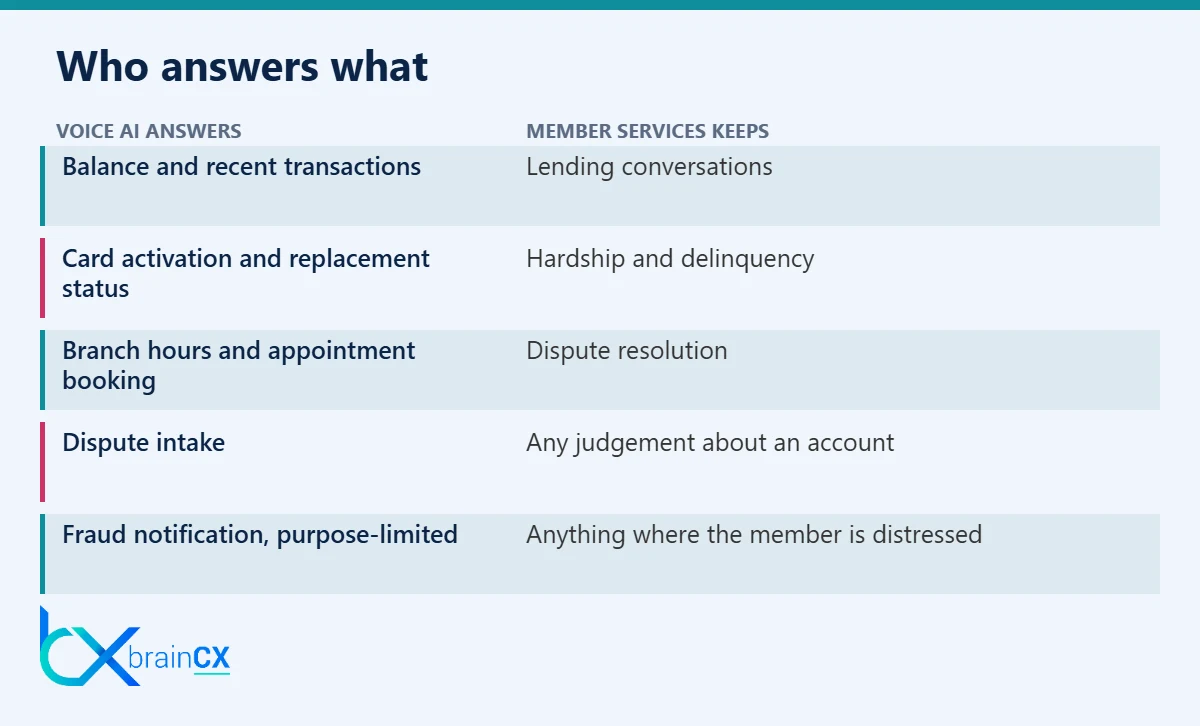
Balance and recent transactions. Card activation. Replacement card status. Branch hours and appointment booking. Routing number requests. Dispute intake, as distinct from dispute resolution.
Each is a record lookup or a structured capture. Each currently occupies a member services representative who could be handling a loan question or a hardship conversation instead.
The capture has to land in the core system during the call. A dispute intake that produces a summary someone retypes has moved the work rather than removed it, which is the same mechanic as real-time write-back in any other regulated workflow.
Volume spikes are the other argument. A data breach notification, a card reissue program, or a rate change generates a week of call volume no branch network can absorb, and peak-season coverage is the same capability under a different name. The continuity case is adjacent: a member services team that cannot reach the office still has a phone line that answers.
What stays with the representative
Lending conversations. Hardship and delinquency discussions. Anything where the member is distressed or the situation is unusual. Dispute resolution and any exercise of judgement about an account.
The agent captures context and hands over rather than making the member repeat themselves. That is the Handoff Hub pattern, and it is the part member services leaders test first.
BrainCX was built by CX operators, not AI tourists. The team behind the platform ran contact centers inside a global bank before building software for them, and the instinct that a member in financial distress never gets an automated conversation is operator instinct rather than policy language.
Where collections work is involved, a different rulebook attaches entirely, and the FDCPA and Regulation F requirements for automated calls govern frequency, disclosure, and calling hours independently of the TCPA.
Member experience is the competitive argument
Credit unions compete on service rather than rate alone. A member who cannot reach anyone has had the experience that the whole institutional model is supposed to prevent, and the hold queue is where that happens.
After-hours is the sharper version. Members call when they are not at work, and a branch-hours phone line answers none of them. A lost card at 9 p.m. on a Saturday is both a service failure and a fraud exposure.
Language coverage follows the same logic. A credit union serving a Spanish-speaking membership cannot staff bilingual service across every hour. BrainCX supports 40+ languages with real-time Spanish inside the same workflow, and the positioning holds throughout: the representative stays on the call and the AI extends their reach.
What to settle before deploying
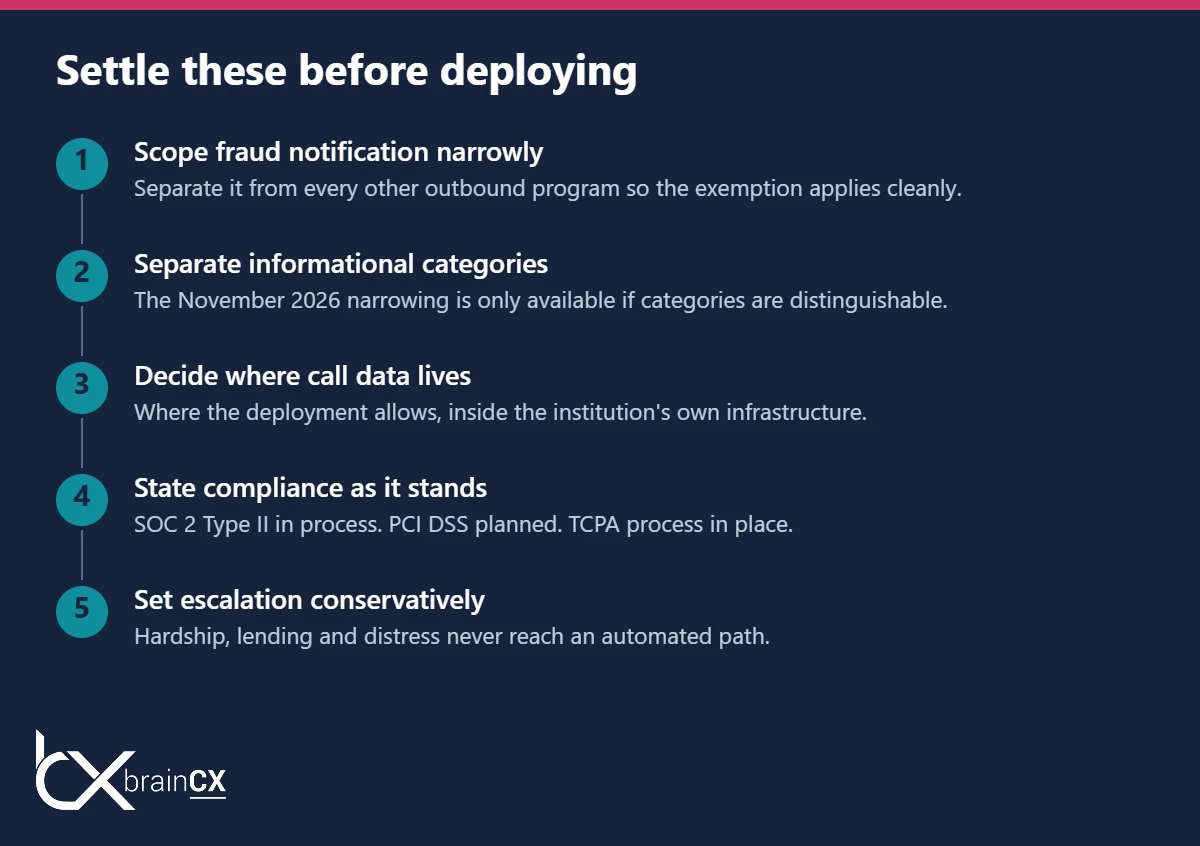
Define the fraud notification scope narrowly and separate it from every other outbound program, so the amended exemption applies cleanly.
Separate informational categories in the consent record, because the November 2026 narrowing is only available to callers who can tell their categories apart.
Decide where call data lives. Where the deployment allows, BrainCX keeps it in the client’s own infrastructure.
Confirm the compliance posture as stated rather than as implied. SOC 2 Type II is in process. TCPA process is in place. PCI DSS is planned, which matters if card data is in scope for any flow you are designing. The BrainCX platform modules and the industries the platform is built for set out where financial services sits against healthcare and education.
Then set the escalation thresholds, and set them conservatively.
Why small institutions get more out of this than large ones
A national issuer already has 24-hour coverage, an outbound fraud operation, and a contact center large enough to specialise. Automation improves its margins.
A credit union with a handful of branches has none of those, and the gap between what it wants to offer members and what it can staff is the whole competitive problem. Automation does not improve its margins so much as give it capabilities it never had: overnight coverage, immediate fraud notification, and bilingual service at every hour.
That is an unusual position in enterprise software, where the large buyer normally gets the better deal. Here the smaller institution has more to gain, because it is starting from no coverage rather than from expensive coverage.
The constraint is that a credit union cannot absorb a long implementation or a platform it has to operate itself. A managed deployment in 4 to 6 weeks, and as little as 3 in simpler environments, is the delivery model that fits, and it is the reason BrainCX is sold as a managed service rather than a platform handed over at signing.
The questions a member services leader should ask
How does the agent confirm identity, and what happens when it cannot. Authentication failure is the most common call in this category and the one most likely to produce a complaint.
What happens when a member says something that signals distress, and how quickly does a human arrive with context.
Which calls are configured never to be automated, and is that list enforced by the platform or by a prompt.
Where does call data live, who can access it, and can the institution direct deletion.
What is the compliance status, stated as certified, in process, or planned, for each framework separately rather than as a single claim.
Those five surface the difference between a platform built for a regulated environment and one adapted to it after the fact.
This article describes published federal regulations as of November 2026 and is not legal advice. Financial institution exemptions are narrow and fact-specific, and your compliance team and counsel should review any outbound calling program before it runs.
Frequently asked questions
What changed for financial institution fraud alerts on November 25, 2026?
FCC 26-67, published at 91 FR 67214, amended the exemption from the consent requirement for financial institutions so they can more readily alert customers to fraudulent account activity. The exemption remains narrow and purpose-limited.
Does voice AI for credit unions need TCPA consent?
For covered calls, yes. An AI voice is an artificial or prerecorded voice under FCC 24-17, so the same consent rules apply as to any prerecorded campaign, with narrow exemptions.
Which member calls can it handle?
Balance and transaction queries, card activation, replacement card status, appointment booking, hours and routing information, and dispute intake. Dispute resolution and lending stay with representatives.
What happens with a member in financial distress?
The call escalates to a representative with context preserved. Hardship and delinquency conversations are not automated.
Is BrainCX PCI DSS compliant?
PCI DSS is planned. SOC 2 Type II is in process. If card data is in scope for a flow, that status should be confirmed with the BrainCX team before design.
Does it cover after-hours?
Yes, and after-hours is often the strongest case, because lost-card and suspected-fraud calls arrive when branches are closed.
Why would a smaller institution benefit more than a large one?
A national issuer already has overnight coverage and a dedicated outbound fraud operation, so automation improves its margins. A credit union with a few branches gains capabilities it never had, which is a larger change than a cost saving.
How long does implementation take?
4 to 6 weeks for a managed deployment, and as little as 3 weeks in simpler environments. The managed model matters here because a small institution cannot absorb operating the platform itself.
What happens if the agent cannot verify a member’s identity?
The call routes to a representative with the attempted verification captured. Authentication failure is the most common call in this category, so the fallback path deserves as much design attention as the success path.
Does the fraud-alert exemption cover marketing calls too?
No. The amended exemption is narrow and purpose-limited to alerting customers about fraudulent account activity. Anything that drifts into marketing or general servicing falls outside it.