

A student pays a deposit in May. They mean it. Then ninety days of summer happen, and by August the decision has quietly come apart. That gap between intent and enrollment is summer melt, and it is one of the most expensive problems in enrollment management because you have already paid to recruit every student you lose.
Melt is not a dramatic reversal. It is a slow drift caused by a missed housing deadline, an unanswered question about a revised aid package, a competing offer that kept arriving after yours stopped. The fix is not more emotional counseling. It is consistent, timely follow-up across the whole summer, and that is exactly the work an admissions team never has enough hands for.
For most institutions the melt problem has been getting worse, not better, and it is arriving at the same moment the pool of graduating high school seniors begins to shrink. Every deposited student who drifts away is harder and more expensive to replace than they were even three years ago. That combination, rising melt against a falling applicant pool, is why enrollment leaders are treating the summer window as a retention problem, not only an admissions one.
How big is the melt problem, really
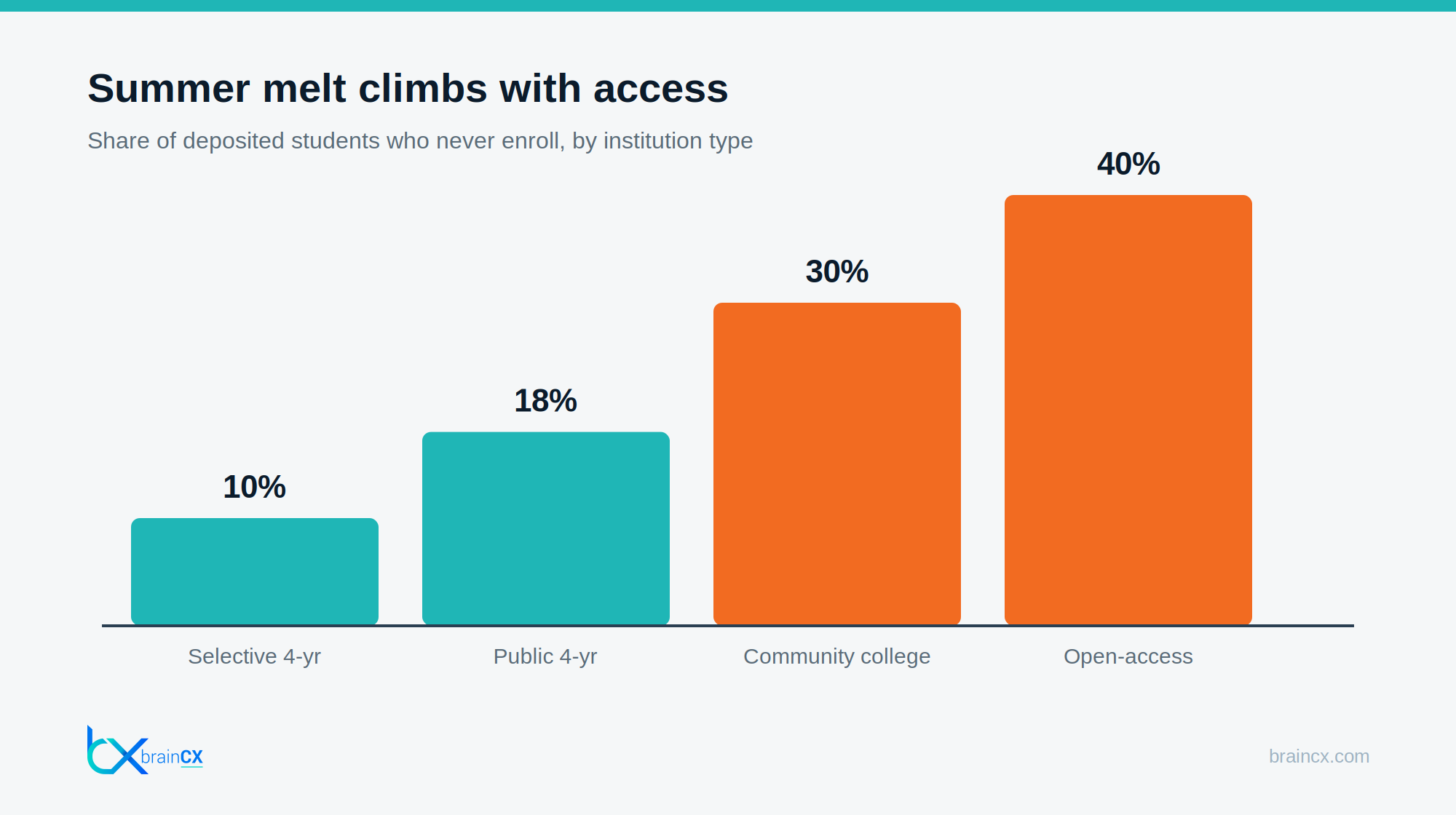
Nationally, 10 to 20 percent of college-intending students do not enroll, and melt rates run highest among first-generation and lower-income students, reaching as high as 40 percent at open-access institutions. Those figures trace back to the foundational research by Benjamin Castleman and Lindsay Page. You can read the underlying framing in their Harvard research on summer melt interventions. Losing 10 to 20 percent of a deposited class after recruitment spend is a direct revenue and capacity hit, not a rounding error.
Put a dollar figure on it. If a single enrolled student represents 30,000 to 60,000 dollars in tuition over the life of their program, a class that melts by even 12 percent is walking millions of dollars of committed revenue out the door every summer. And unlike a lead that never converted, these are students who already said yes. The marketing spend, the counselor hours, the campus visit, the financial aid packaging work, all of it is already sunk, which is what makes melt the single most effective place to intervene in the entire funnel.
The other reason melt is worth solving now: the students most likely to melt are the students institutions most want to retain. First-generation students, lower-income students, and students who would be the first in their family to navigate financial aid are overrepresented in the melt population. Closing that gap is not only a revenue play. It is an equity outcome that most enrollment leaders are actively measured on.
The proof case every enrollment leader already half-remembers
Georgia State University is the most-cited example for a reason. Working with researchers, GSU ran a randomized controlled trial of a conversational assistant that nudged admitted students through summer tasks. For students who committed by the June 1 priority deadline, the treatment group saw a 21.4 percent reduction in summer melt and a 3.3 percentage-point increase in enrollment. The peer-reviewed write-up of that trial is documented in the Harvard Business Review analysis of the Georgia State chatbot. GSU has separately reported cutting overall melt from roughly 19 percent to 9 percent.
At Georgia State’s scale, that 3.3 percentage-point lift translated to roughly 300 additional students enrolled who the data suggested would otherwise have melted away. Three hundred students is a meaningful line on any enrollment report. The mechanism was not clever marketing. It was that a tireless assistant answered the same set of procedural questions, at any hour, for every admitted student, and flagged the ones who were quietly falling off so a human could step in.
Here is the part most vendors skip. The Georgia State intervention was text-based. It worked because it was proactive and consistent, not because it was SMS. Text is easy to ignore, easy to leave on read, and it cannot carry the moments where a worried parent needs to actually talk to someone. Voice adds the channel that closes the harder cases while keeping the same proactive cadence that made the intervention work in the first place. When a family has a real objection, money, distance, a competing offer, a text thread rarely resolves it. A two-minute conversation often does.
Where students actually drift
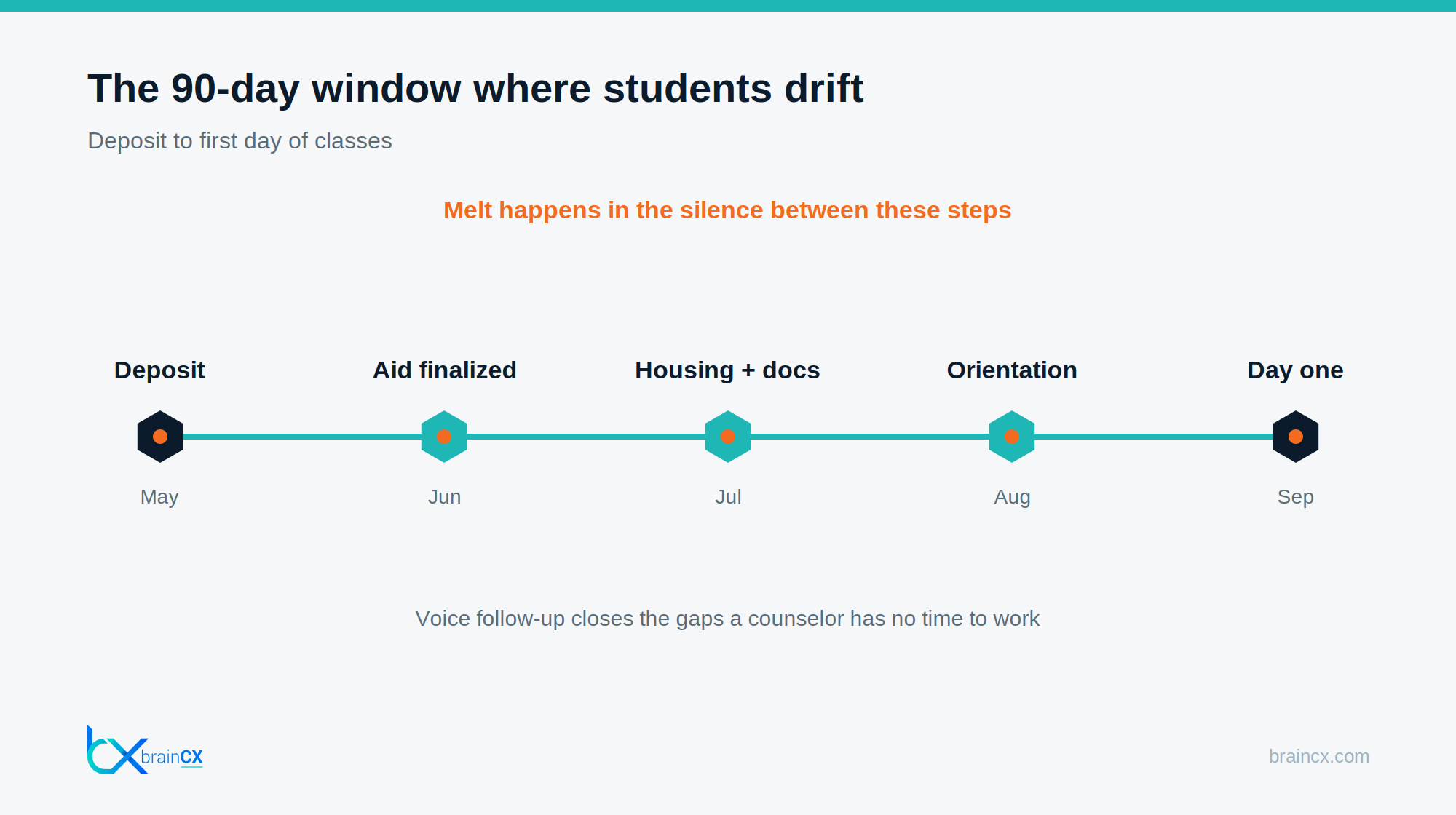
Melt does not happen at one moment. It happens in the silences between the milestones on the path from deposit to the first day of classes. Map those milestones and you can see exactly where the follow-up has to land.
- Financial anxiety resurfaces. A package that felt fine in April looks different in June against real summer income. The student starts second-guessing and nobody calls.
- Deadlines pile up quietly. Housing, orientation, immunization records, final transcripts, loan acceptance. Each one is a place to fall off.
- Competing offers keep coming. Other schools do not stop recruiting after your deposit clears.
- Questions go unanswered. A single unreturned call about aid can be the moment a first-generation student decides it is all too much.
- Momentum simply fades. With no contact for weeks at a time, the emotional commitment of deposit day cools into indifference. Silence is the enemy.
Notice what all five have in common: none of them requires a dramatic decision to reverse an enrollment. They are small frictions that compound.
The counterforce is equally simple: regular, well-timed contact that removes each friction before it becomes a reason to walk away. The problem has never been that institutions do not know what to say to admitted students. It is that no team can make that many calls, on that precise a schedule, to that many students, every summer.
What voice follow-up does between deposit and day one
A voice AI phone agent runs the summer cadence an enrollment team cannot staff. It calls deposited students on a schedule tied to real deadlines, answers the routine questions in seconds, and hands off to a human the moment a call turns sensitive. This is the same approach BrainCX documents across its voice AI for higher education admissions and enrollment work, applied to the specific window after commitment.
Deadline nudges, automatically timed
The agent knows when housing applications close and when orientation registration opens. It calls ten days out and again 48 hours before, without a counselor tracking a spreadsheet. Each nudge is a specific, actionable step, submit this form, upload this document, register for this session, not a generic reminder to stay excited. Specificity is what moves a student from intent to completion.
Objection detection and escalation
When a student says they are thinking about a gap year, or that another school offered more, the agent flags it and routes to an advisor with the full conversation attached. The counselor calls back within the hour already knowing the story. That warm handoff is handled by BrainCX Handoff Hub, so no student is left in a dead end. The agent is not trying to talk a wavering student out of their doubt. It is making sure the right human hears that doubt while there is still time to act on it.
Multilingual by default
Families who are more comfortable in another language get the same follow-up in their language, not a lower tier of service. For international and first-generation populations, that is often the difference between a returned call and a lost seat. A parent who cannot easily read an English housing-deadline email will absolutely take a clear phone call in their own language.
Celebration and momentum
Not every call is a reminder. When a student completes a milestone, registers for orientation, signs up for a first course, joins the incoming class group, a short congratulations rebuilds the momentum that deposit day created. These micro-moments are cheap to deliver at scale and they keep the emotional thread alive through the quiet weeks.
Why voice beats text-only for the hard cases
Text handles reminders. Voice handles doubt. The students most likely to melt are the ones least likely to reply to a form or a text, and most likely to have a question they will only ask out loud. A managed voice AI service rather than a self-serve tool means the calling cadence, the escalation rules, and the scripts are built and tuned for you, so the summer program runs without adding a project to your team’s plate.
There is also a data advantage that is easy to miss. Because the agent is having actual conversations, it captures why a student is wavering, not just whether they completed a task. That intelligence flows back to the enrollment team in near real time, so leadership always has a live read on the intention of the incoming class rather than discovering the melt after census. Knowing in July that forty students are wobbling on cost is a problem you can still solve. Discovering it in September is not.
How to run a summer melt program without burning out your team
The instinct when melt spikes is to ask counselors to make more calls. That does not scale, and it burns out the people you most need in August. A voice-led program flips the model: the agent carries the volume, and humans handle only the conversations that need judgment. A practical sequence looks like this.
- Start with the highest-melt segment. Deposited students who have not completed a key step in ten days. That is where the return is fastest.
- Tie every call to a deadline. Housing, aid verification, orientation, first-term registration. Timing is the whole game.
- Route objections to humans within the hour. Speed on a wavering student matters as much in melt season as it does at inquiry.
- Review the conversation data weekly. Let what students actually say reshape the script and the timing as the summer moves.
Institutions that already run outreach across several campuses will recognize the same one-to-many logic BrainCX applies to waitlist and yield calls later in the cycle: one deployment covers the whole portfolio rather than one tool per office.
Frequently asked questions
1. What is summer melt?
Summer melt is the gap between a student depositing at a college and actually enrolling for fall. Nationally it runs 10 to 20 percent, and as high as 40 percent at open-access institutions, with first-generation and lower-income students most affected.
2. Can AI actually reduce summer melt?
Yes. Georgia State University’s randomized trial of a conversational assistant showed a 21.4 percent reduction in melt and a 3.3 percentage-point enrollment lift for students who committed by the priority deadline. The mechanism is consistent, proactive follow-up on summer tasks, which a voice agent can run at scale.
3. Why use voice AI instead of text or a chatbot for melt?
Text handles reminders well but the students most likely to melt are the least likely to reply to a text and the most likely to have a question they will only ask out loud. Voice keeps the proactive cadence and adds a real conversation plus a warm handoff to a human when a call turns sensitive.
4. When should summer melt outreach start?
At deposit. The window from deposit to the first day of classes is roughly ninety days, and melt accumulates across all of it. Waiting until midsummer means missing the students who drifted in June.
5. Does a voice agent replace enrollment counselors?
No. It runs the repetitive summer follow-up and escalates the moment a student needs a person, handing the counselor full context so they can focus on the cases that need judgment.
Keep more of the class you already recruited
You spent the money to get these students to say yes. Voice follow-up between deposit and day one protects that investment, and it does it without asking your counselors to make ten thousand summer phone calls. Talk to the BrainCX solutions team about a summer melt program built for your funnel, or see how the platform fits trust-dependent industries like higher education.