


International recruitment runs on two things your domestic funnel does not demand at the same intensity: language coverage and time-zone coverage. A prospective student in Ho Chi Minh City or São Paulo inquires at midnight your time, in a language your admissions line may not speak, at a moment of real anxiety about cost, visas, and fit. Miss that window and they inquire at the next school on their list. Multilingual voice AI can help make sure the call is answered in the student’s language when it comes in.
This is where a lot of international recruitment quietly leaks. Institutions spend heavily on overseas agents, fairs, and digital campaigns to generate the inquiry, then let it sit because no one who speaks the language is awake. The generation cost is high and the follow-through is thin. Voice AI closes that gap without standing up a 24-hour multilingual call center.
One note on terminology before we go further: throughout this article, “multilingual voice” refers to the BrainCX capability that carries the conversation in the caller’s language.
Why language coverage decides international outcomes
For a domestic applicant, English-only service is an inconvenience at worst. For an international family, it can be the whole decision. The people who most influence an international enrollment (parents, and sometimes extended family) are often far less comfortable in English than the student. A clear phone conversation in the family’s language does more to build trust than any brochure.
- Parents are decision-makers. International tuition is a major family investment. The family needs to feel served, and that means their language.
- Trust is built by voice. A real conversation reassures in a way that text and email cannot, especially across a language barrier.
- Nuance survives. Questions about visas, funding, and program fit are too important to lose in a translation gap.
Why time-zone coverage matters just as much
The second half of the problem is timing. Your peak inquiry hours from Asia, Africa, and Latin America land in the middle of your night. A voice agent answers at 3 a.m. local time exactly as well as at 3 p.m., which means the inquiry gets a real conversation while the student’s interest is at its peak. That around-the-clock, first-contact speed is the same principle behind the BrainCX approach to voice AI for higher education admissions, applied across time zones instead of just across a business day.
The cost of the inquiry you already paid for
International recruitment is among the most expensive lead generation in higher education. Overseas agents, recruitment fairs, regional representatives, and international digital campaigns all carry a real cost. When one of those hard-won inquiries lands outside business hours in a language your line does not cover, and it sits until someone gets to it days later, you have paid full price for a lead and then let it cool to nothing. Multilingual voice AI protects that spend by making sure every inquiry gets an immediate, in-language conversation, which is the difference between a generation budget that converts and one that leaks.
There is a compounding effect, too. International students talk to each other, and to the agents and counselors back home who steered them. A recruitment operation that is known for answering quickly and in-language builds a reputation that feeds the next cycle. Poor follow-through does the opposite: it quietly tells a whole network that your institution is hard to reach.
What multilingual voice AI does in a recruitment funnel
Answers the first inquiry instantly, in-language
When an international prospect submits a form or calls in, the agent responds within seconds in their language, answers the first wave of questions about programs, requirements, and deadlines, and captures the details that route the lead correctly. First contact is the moment that frames the entire relationship, and here it happens immediately rather than after a multi-day, English-only email chain.
Handles the repetitive international questions
Application requirements, English-proficiency test policies, transcript evaluation, intake timelines, and general funding questions are asked by nearly every international applicant. The agent handles them accurately and consistently, freeing your international team for the high-value conversations.
Escalates to human counselors with context
Anything requiring judgment (a specific visa situation, a complex credential evaluation, a scholarship discussion) routes to a human counselor with the conversation attached. The warm handoff in the BrainCX platform means the student does not start over, and the counselor is not translating on the fly. Note that immigration and visa advising is a regulated area; the agent provides general information and routes anything requiring designated-official expertise to the right person.
Follows up so leads do not go cold
International decision cycles are long and easy to lose to silence. The agent runs the follow-up cadence in-language, keeping applicants engaged through the months between first inquiry and enrollment.
Compliance and trust in international outreach
Outreach to international prospects still has to respect calling norms and data handling, and families that are already cautious about sending a student abroad notice how their information is treated. A serious deployment captures consent, respects local contact expectations, and logs every conversation so there is a record of what was said. That discipline is not overhead; with an international family weighing a major decision, visible care about privacy and process is itself a trust signal that helps the enrollment.
It also matters that the agent knows the edges of its role. General questions about programs, requirements, and timelines are fair game. Anything that shades into regulated immigration or visa advising is handed to the appropriate designated official. An agent that stays firmly inside the informational lane, and routes the rest to a person, is both safer and more credible.
Native conversation, not a translation layer
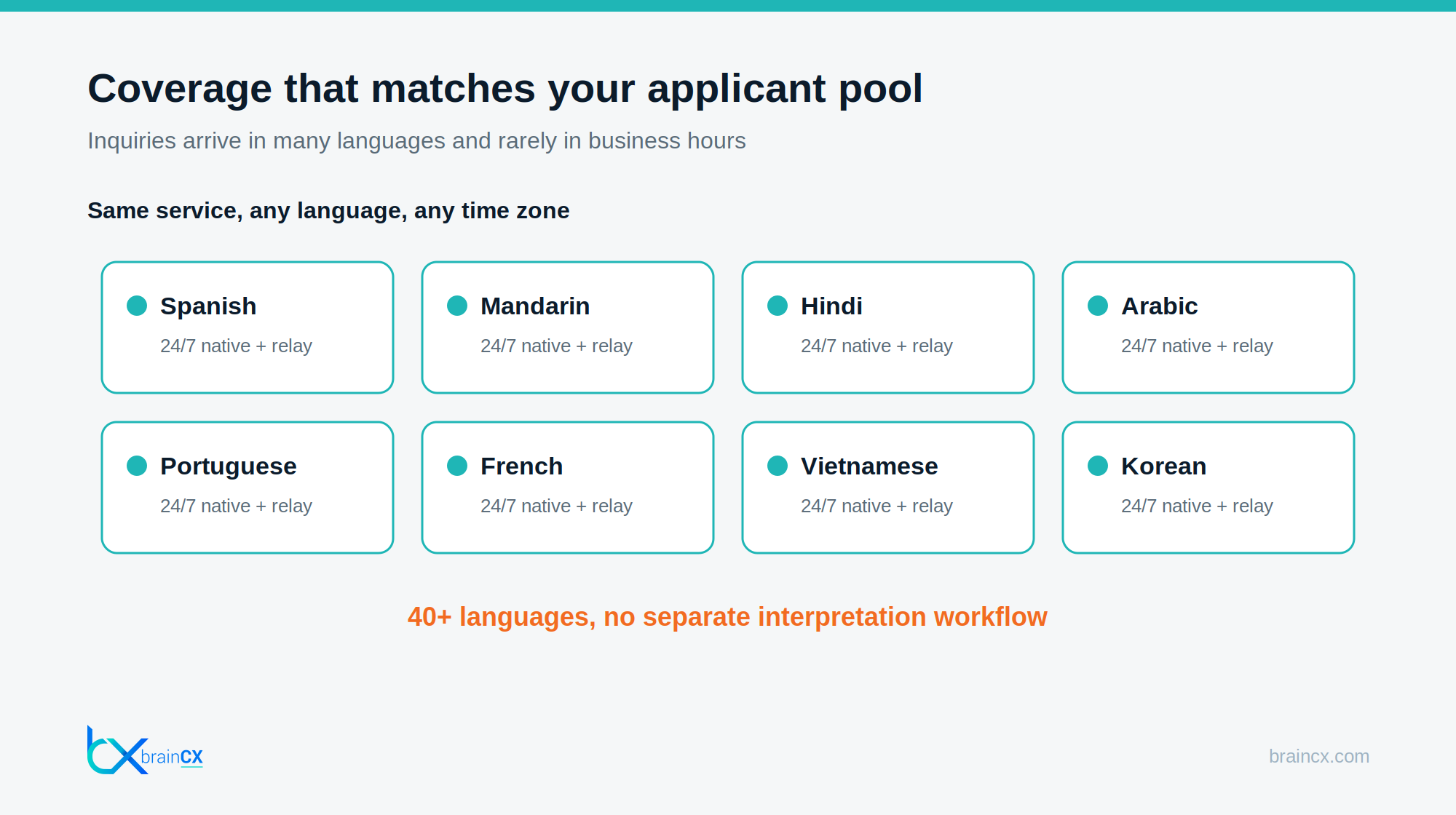
There is a real difference between a system that translates and a system that converses. Translation adds latency and strips nuance. A voice agent built for multilingual conversation responds naturally in the target language, which is what makes a family trust it. BrainCX supports 40-plus languages, delivered as native conversation or real-time relay depending on the deployment, without forcing your team into a separate interpretation workflow for every call.
This matters most in the emotional moments. A parent worried about sending their child abroad is reassured by a warm, fluent conversation, not by a stilted, laggy translation that signals they are a second-class inquiry. The quality of the language experience is the quality of the first impression.
A practical way to roll it out
You do not have to switch on forty languages and every market at once. The sensible path is to start with the two or three origin countries that drive the most inquiries and the most enrollment, prove the in-language, around-the-clock response there, and expand from that base. Pick the markets where you are already spending on generation but losing leads to slow or English-only follow-up, because that is where the recovered enrollments show up fastest.
From there, layer in the follow-up cadence and the past-applicant re-engagement, and connect the agent to the systems your international team already uses so every conversation is captured against the record. Within a cycle or two you have a multilingual, time-zone-proof front door for international recruitment that your recruiters feed and your counselors close, with the repetitive first-contact work handled in between.
Where this fits with your existing team and tools
Multilingual voice AI is not a replacement for your international recruiters or your overseas agents. It is the layer that makes sure every inquiry they generate actually gets answered, fast and in-language, so their effort converts instead of leaking. Whether you run this as a fully managed program or configure it yourself is the managed versus self-serve decision every institution weighs. For a 24-hour multilingual operation, a managed approach may make more sense when your team does not want to own the setup, tuning, and ongoing maintenance.
Frequently asked questions
1. How many languages can the voice AI support?
BrainCX supports 40-plus languages, delivered as native-language conversation or real-time relay depending on the deployment, covering the major international student origin markets.
2. Is it real translation or native conversation?
It is built to converse in the target language rather than bolt on a translation layer, which reduces latency and preserves nuance. That difference is what builds trust with families across a language barrier.
3. Can it handle time-zone coverage for overseas inquiries?
Yes. A voice agent answers at any hour, so peak inquiry times from Asia, Africa, and Latin America get an immediate, in-language conversation instead of waiting for your business day.
4. Does it replace our international recruiters?
No. It answers and qualifies inquiries fast and in-language, then escalates anything requiring judgment to a human counselor with full context, so recruiters focus on high-value conversations.
5. Can it advise on visas and immigration?
It provides general information and routes anything requiring designated-official or regulated immigration expertise to the appropriate human, since visa advising is a regulated area.
Answer every international inquiry, in every language
Stop letting hard-won international inquiries leak because no one who speaks the language is awake. Talk to the BrainCX solutions team about a multilingual recruitment deployment, or explore how BrainCX serves trust-dependent industries.