

What changes for TCPA consent revocation on November 25, 2026?
On November 25, 2026, a caller may treat an opt-out as applying only to the category of informational robocalls it was aimed at, and may name one exclusive method for revoking consent. The TCPA consent revocation rules published at 91 FR 67214 replace the broader “revoke all” requirement for informational calls. Telemarketing keeps the old standard.
That is the whole change in three sentences. The operational consequences take longer to work through, and most contact centers have eleven days.
The order, and where to read it
The Federal Communications Commission adopted FCC 26-67 on September 30, 2026, in CG Docket No. 02-278. The Commission published the final rule in the Federal Register on October 26, 2026, at 91 FR 67214, under the title “Enhancing the Ability of Consumers To Control the Robocalls.” The ordering clause set the effective date at thirty days after publication, which lands on November 25, 2026.
That date supersedes the January 31, 2027 effective date that had applied to the “revoke all” portion of 47 CFR 64.1200(a)(10). The Commission declined industry requests for a twelve-month implementation window.
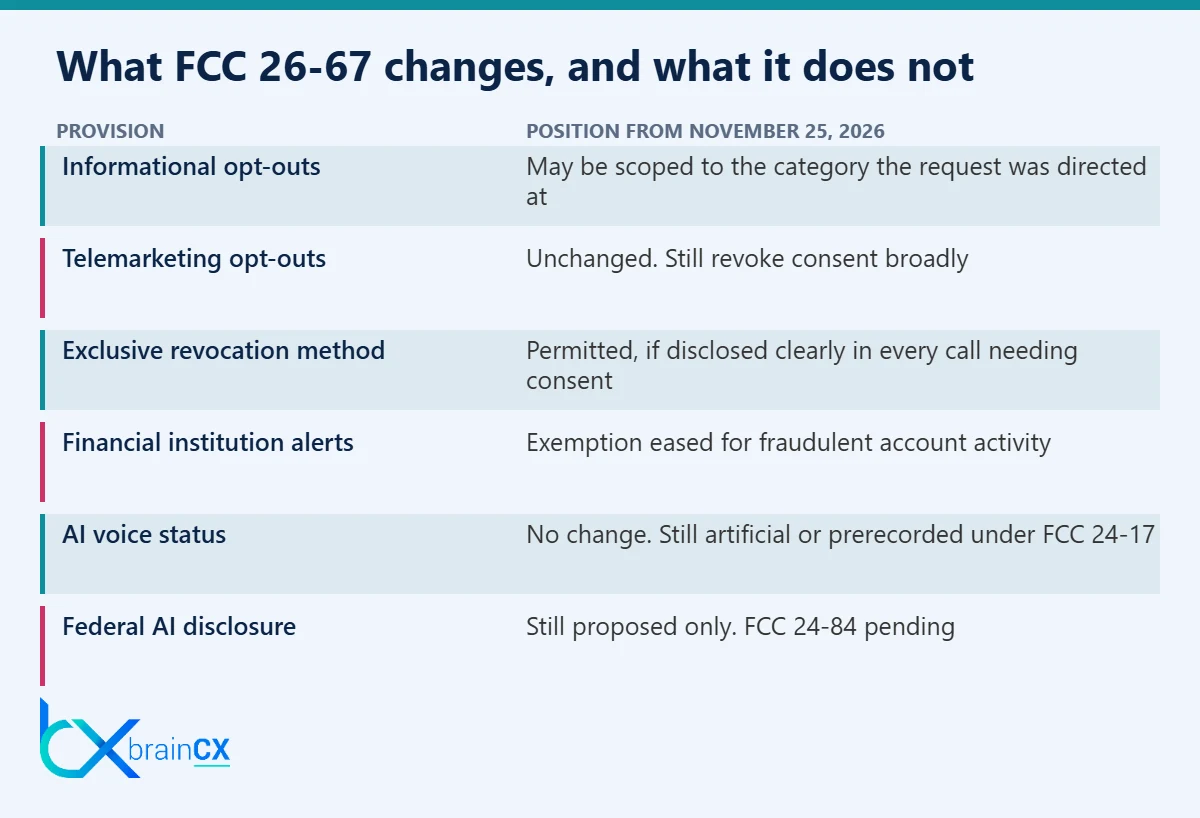
Three substantive changes sit inside the order. Callers may read a revocation as covering only the specific category of informational robocalls to which it was directed. Callers may designate an exclusive means of revoking consent, provided that method is disclosed clearly and conspicuously in every robocall requiring consent. The exemption for financial institutions was amended so banks and credit unions can more readily reach customers about fraudulent account activity.
The Commission also delegated authority to its Consumer and Governmental Affairs Bureau, in consultation with the Enforcement Bureau, to review the robocall rules going forward.
Why this lands on voice AI teams specifically
An AI-generated voice is not a separate legal category. The FCC settled that in Declaratory Ruling FCC 24-17, adopted February 2, 2024 and released February 8, 2024 in CG Docket No. 23-362, which confirmed that the TCPA’s restrictions on an “artificial or prerecorded voice” reach current AI technologies that generate human voices, as the Commission’s own announcement of the ruling set out. Prior express consent is required for calls covered by the statute, and prior express written consent is required when the call is telemarketing.
So every consent and revocation obligation that applies to a prerecorded campaign applies identically to an AI voice agent. There is no AI exemption, and there is no AI prohibition either.
What there is not, yet, is a federal AI disclosure mandate. The Commission’s AI disclosure proposal, FCC 24-84, remains pending; the 2026 Unified Agenda published in August 2026 lists the proceeding under long-term actions with its next action undetermined. Several states impose their own disclosure requirements for automated calls, so the states you dial into still matter.
The part that is easy to get wrong
Category-specific revocation is permissive, not automatic. The order allows a caller to narrow an opt-out to its category; it does not narrow anything on its own. A contact center that keeps treating every opt-out as global stays compliant and simply gives up the flexibility.
The exclusive-method option carries a disclosure condition that is doing real work. Naming one revocation channel only holds if that channel is disclosed clearly and conspicuously in every robocall that requires consent. A designation buried in a terms page and absent from the call script is not a designation.
And the narrowing reaches informational calls only. The Commission was explicit that the modification affects informational traffic; a revocation made in response to a call containing an advertisement still revokes consent broadly. Mixed programs that run appointment reminders and promotional outreach from the same consent record need to know which is which before November 25.
What a voice platform has to be able to do
Revocation handling is an architecture question before it is a policy question. The call has to recognise a revocation spoken in any phrasing a caller might use, classify the campaign category it arrived against, write that revocation back to the system of record immediately, and suppress future calls in the right scope. None of that works if the revocation lands in a call summary a human reads the next morning.
This is the same real-time write-back problem that shows up in patient intake and eligibility capture, and it has the same answer: the data has to move during the call, not after it. A platform that updates the chart or the CRM while the conversation is still open can honour a revocation in seconds. One that does not is relying on a person to transcribe a legal obligation.
Category classification is the newer requirement. If a health system runs appointment reminders, billing notices, and service updates, those are three informational categories, and after November 25 an opt-out from one can be scoped to one. That only holds if the platform knows which campaign the call belonged to at the moment the caller said stop.
BrainCX was built by CX operators, not AI tourists. The people who designed this ran contact centers under TCPA exposure before they built software for them, which is why revocation handling sits in the platform rather than in a compliance checklist bolted alongside it. BrainCX’s compliance and governance controls and TCPA disclosure practices are documented rather than described.
What to check before the 25th
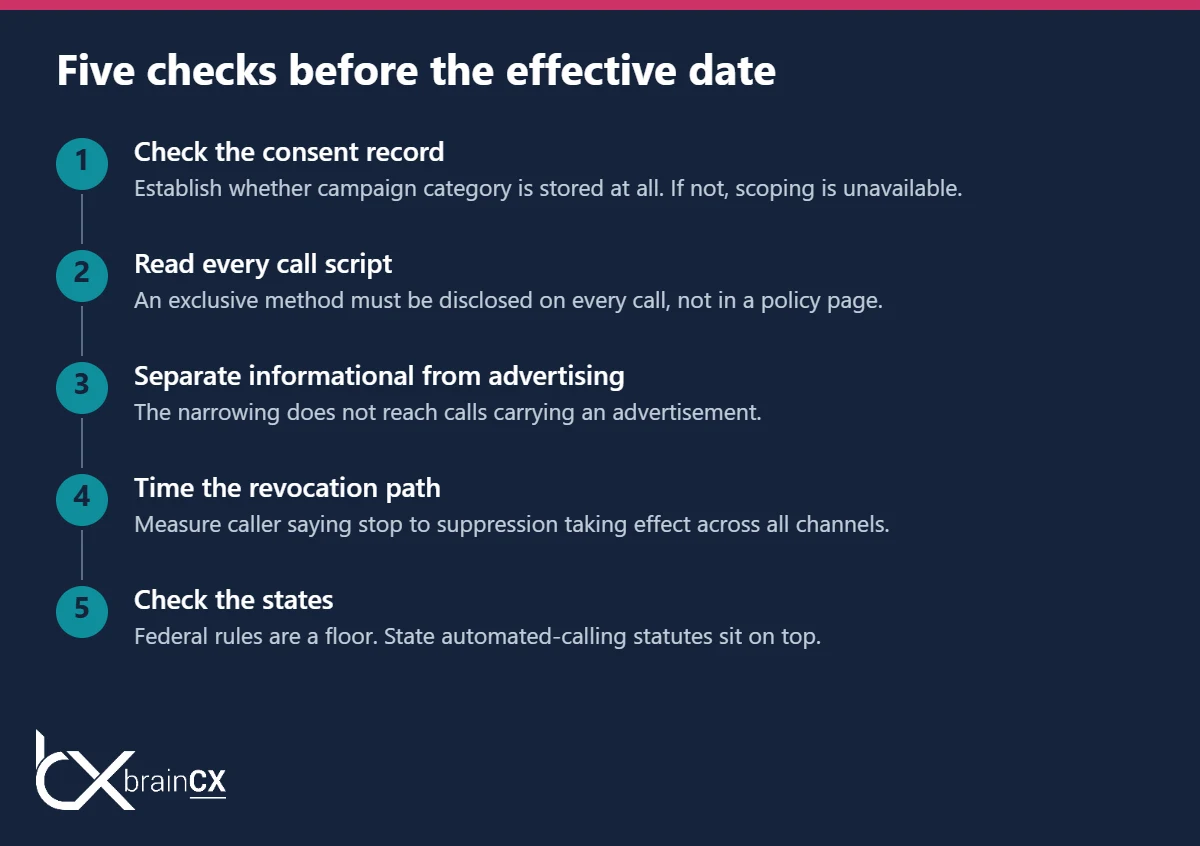
Pull the consent record and establish whether it stores campaign category at all. Many do not, and that single gap decides whether category-specific revocation is available to you.
Read the call scripts for every program that requires consent. If you intend to designate an exclusive revocation method, the disclosure has to be in those scripts, on every call, not in a policy document.
Separate informational traffic from anything carrying an advertisement. The narrowing does not apply to the second group, and a program that blends them inherits the stricter rule.
Time the revocation path end to end. Measure how long it takes from a caller saying stop to the suppression taking effect across every channel. If that number is measured in hours, the architecture is the problem.
Then check the states. Federal rules set a floor, and state automated-calling statutes sit on top of it.
Where this sits against the other FCC proceeding
This is a final rule with a date. The onshoring proposal the Commission adopted on March 26, 2026 as FCC 26-16, in CG Docket No. 26-52, is not. That proceeding remains open, and the 30% offshore ceiling and sensitive-data handling limits inside it are proposals that bind nobody today, as our earlier coverage of that NPRM set out.
Keeping those straight matters when a board asks what is actually required. One has an effective date in eleven days. The other has a comment record.
The FNPRM nobody has diarised
The same order carries a Further Notice of Proposed Rulemaking, and its comment deadline is November 25, 2026, the identical date. Reply comments are due December 28, 2026.
Among the questions on the table is whether callers using category-specific revocation should be required to offer consumers a one-step method to revoke consent to all future robocalls. That proposal, if adopted, would partially reverse the flexibility the order just granted.
Which is the practical reason not to build a revocation architecture that only works under the current scoping rules. An organisation that can scope revocations by category can also honour a global revocation; one that has hard-coded category-only handling will be rebuilding. Comment deadlines are also the moment when contact center operators have standing to say something, and most of the record on these proceedings is written by carriers and trade associations rather than by the people who answer the calls.
What good looks like after the 25th
A revocation request recognised in natural speech rather than only as a keypress or a specific phrase. Callers say stop calling me, take me off your list, and I don’t want these any more, and all three are reasonable methods.
A category tag attached to the call at the moment of revocation, so the scope decision is made on evidence rather than reconstructed later.
A suppression that propagates across every channel the organisation uses, not just the one the revocation arrived on.
An audit record showing what was said, when it was honoured, and in what scope. This is the artefact that resolves a complaint, and reconstructing it from call recordings after the fact is expensive.
A disclosure in the script, if an exclusive method is being designated, that a reasonable listener would actually catch.
This article describes published rules as of November 2026 and is not legal advice. Confirm your own obligations with counsel before changing how your contact center captures or honours consent.
Frequently asked questions
Does the TCPA consent revocation rule apply to AI voice agents?
Yes. FCC 24-17 confirmed in February 2024 that AI technologies generating human voices fall within the TCPA’s “artificial or prerecorded voice” restrictions, so AI voice calls carry the same consent and revocation obligations as any other covered call.
What is the effective date?
November 25, 2026, thirty days after the rule was published in the Federal Register at 91 FR 67214 on October 26, 2026.
Does an opt-out now apply to only one type of call?
It may, for informational robocalls, at the caller’s option. The rule permits a caller to scope a revocation to the category it was directed at. Revocations made in response to telemarketing calls still revoke consent broadly.
Can we require consumers to opt out through one specific channel?
The order allows a caller to designate one or more FCC-approved exclusive revocation methods, but only where that method is disclosed clearly and conspicuously in every robocall that requires consent.
Is there a federal requirement to disclose that a caller is AI?
Not as of November 2026. The Commission’s AI disclosure proposal, FCC 24-84, is still pending with no final rule. State disclosure laws may apply.
What happened to the January 31, 2027 date?
The amended 47 CFR 64.1200(a)(10) takes effect November 25, 2026 and supersedes the delayed January 31, 2027 effective date that had applied to the “revoke all” provision.