


Community colleges and multi-campus systems face high enrollment and student-services call volume, often with lean teams. Open-access admissions means high inquiry volume, diverse student needs, and the highest melt rates in higher education. Multiple campuses mean similar problems can happen across several locations at once, often with separate phone lines and separate teams handling the same types of questions. This is the setting where voice AI pays off fastest, because one deployment can serve the whole system instead of one tool per campus.
The strategic idea is simple: deploy once, cover everywhere. A single voice AI program, tuned to the system’s programs and policies, can answer enrollment and student-services calls across every campus, in every language your students speak, at any hour. That is a fundamentally better economic and service model than staffing each location to its own peak.
What this means for enrollment and retention
The payoff of systemwide voice coverage is not just shorter hold times; it shows up in the numbers community college leaders are measured on. Faster inquiry response lifts enrollment yield from a high-volume, price-sensitive applicant pool. Reliable follow-up cuts into the melt that hits open-access institutions hardest. And after-hours coverage captures working students who would otherwise have given up when they hit a closed office. Each of those is a direct enrollment or retention gain, delivered at every campus at once rather than at whichever location happened to have the staff.
Because the program runs consistently across the system, leadership can also get a clearer picture of what students are calling about across campuses. That visibility can turn anecdote into data, showing where a confusing process, repeated question, or staffing gap may be creating friction for students. The system office can then address the issue once and apply the fix more broadly. The call center becomes a useful source of insight into the student experience, not just a place where calls are handled.
Why community colleges feel the call load hardest
The community college model concentrates exactly the pressures that overwhelm a phone line. Understanding them is how you see where automation helps most.
- Open access means volume. No admissions funnel filters the inquiries. Everyone can apply, and many call with questions.
- Students need flexible hours. Many work full time and can only call evenings or weekends, exactly when offices are closed.
- Melt is highest here. Open-access institutions see the largest gap between intent and enrollment, so follow-up matters most and is hardest to staff.
- Language diversity is the norm. A community college often serves a wider range of home languages than a selective four-year, and English-only phone service leaves students behind.
The one-to-many model, made concrete
Instead of each campus buying, building, and staffing its own solution, the system deploys one voice AI program and extends it across every location. The knowledge base reflects each campus’s specifics, but the infrastructure, the tuning, and the escalation design are shared.
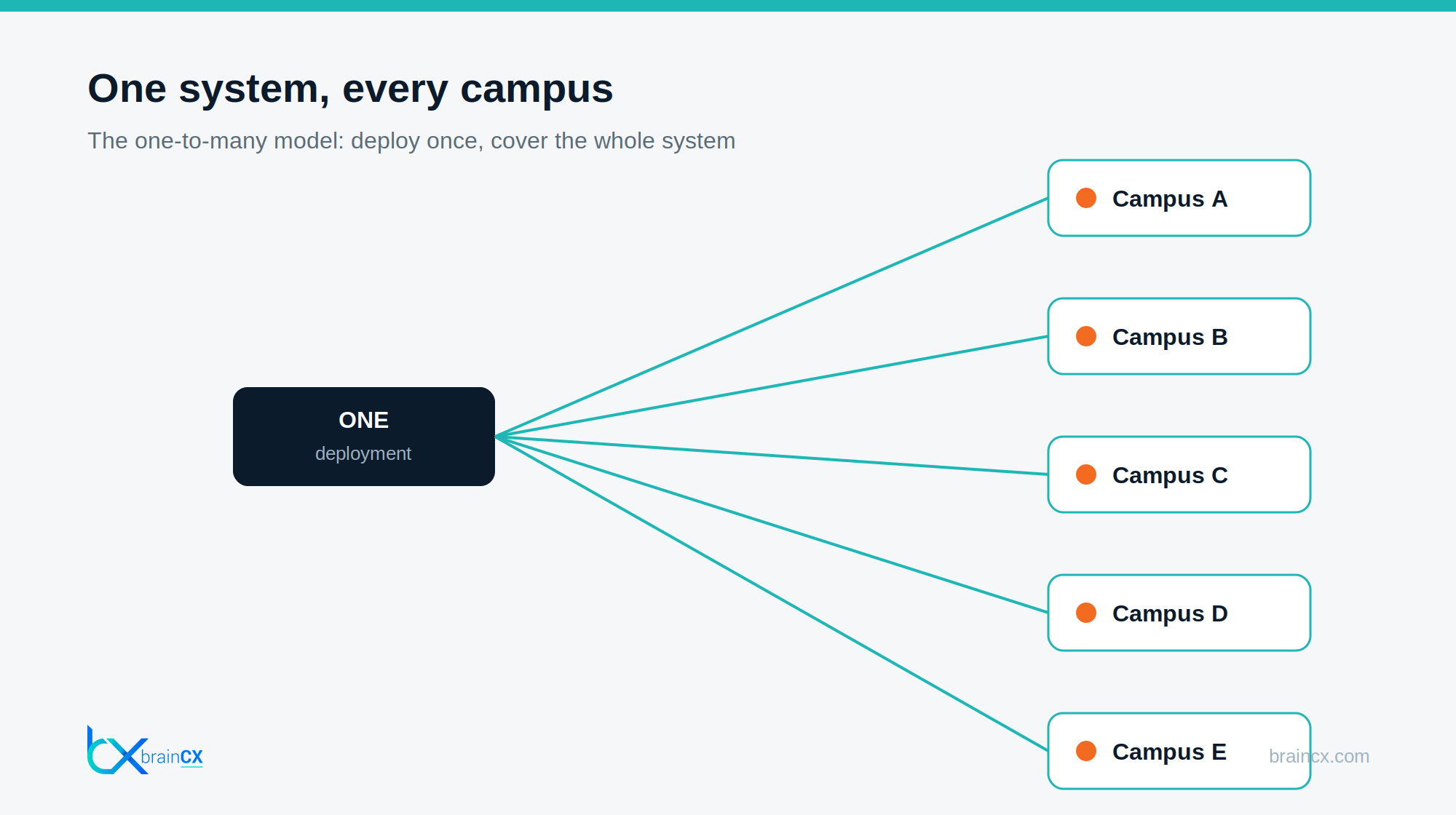
- Consistent service everywhere. Every campus delivers the same fast, accurate call experience, not a patchwork that varies by location.
- Central control, local detail. The system office manages one program while each campus’s programs and deadlines are reflected accurately.
- Better economics. One deployment across many campuses is far more cost-effective than a tool and a team per location.
There is real evidence that community college systems buy AI at exactly this scale. The California Community Colleges, the largest higher education system in the country, entered a systemwide partnership to make AI assistants available across all 116 campuses to 2.1 million students, as reported by Axios. That deployment is a classroom learning assistant rather than a voice call system, so it is a different product category, but it demonstrates the buying pattern that matters here: these systems adopt AI centrally and roll it out across every campus at once. The one-to-many motion is how community college systems already prefer to buy.
How a system rollout actually works
A systemwide deployment does not mean flipping a switch across a dozen campuses at once. The sensible path is to prove it at one or two campuses first, ideally the ones with the heaviest call load or the worst after-hours coverage, then extend the same program across the system once the flows and escalation rules are validated. Because the infrastructure is shared, each additional campus is largely a matter of adding that campus’s programs, deadlines, and routing rules, not standing up a new system from scratch.
That sequencing gives the system office a clean way to measure impact before committing everywhere, and it gives each campus a deployment already de-risked by the ones before it. It also fits how these systems are governed: a central office can own the program and the standards while individual campuses keep the local detail accurate. The result is consistency where you want it, which is the student experience, and local control where you need it, which is the campus-specific information.
What a voice agent handles across a system
Enrollment and admissions calls
Application status, registration help, deadline questions, and inquiry follow-up, handled the same way at every campus. The speed-to-lead discipline behind voice AI for higher education admissions applies across the whole system at once.
Student services calls
Financial aid process questions, account and portal help, scheduling, and the general student-services volume that buries open-access institutions. The full approach is covered in how to automate a student call center without losing the human touch, and it scales cleanly from one campus to many.
After-hours and overflow
For students who work full time, after-hours coverage is not a nice-to-have; it is the only time they can call. A voice agent answers evenings and weekends across every campus, capturing calls that would otherwise be missed entirely.
Multilingual coverage
Serving a linguistically diverse student body in their own languages, at every campus, without a separate interpretation workflow per location. For community colleges, this is often the single biggest equity improvement a voice deployment delivers.
The equity case, not just the efficiency case
For community colleges, the argument for voice AI is as much about access as economics. The students these institutions serve are disproportionately working adults, first-generation students, and non-native English speakers, exactly the students least served by a nine-to-five, English-only phone line. When the office is closed at the hour they can call, or when no one on the line speaks their language, the barrier is not a minor inconvenience; it is often the reason they never enroll or never come back after a setback.
Around-the-clock, multilingual coverage removes those barriers uniformly across every campus. A student working a night shift gets the same answer at 10 p.m. that a daytime caller gets at noon, in the language they are most comfortable in. Framed honestly, this is where the technology does the most good in the community college setting: it widens access to help for precisely the students who have historically had the least of it, and it does so consistently across an entire system rather than only at the best-resourced campus.
Keeping the human touch across every campus
Scaling across a system does not mean removing people; it means giving them more time for the conversations that need them most. The agent handles routine call volume across campuses and escalates anything sensitive to local staff with full context, so a student at any location reaches a real person when they need one. This is the BrainCX position applied at system scale: give your staff more capacity, not fewer roles. The escalation and handoff design is the same whether you run one campus or a dozen, which is something every institution should ask a vendor to explain clearly. We cover that in what enrollment leaders should ask a voice AI vendor.
Frequently asked questions
1. Why is voice AI a good fit for community colleges?
Open-access admissions creates high call volume, students often need evening and weekend hours, melt rates are the highest in higher education, and student bodies are linguistically diverse. Voice AI addresses all four, and one deployment can serve an entire multi-campus system.
2. What is the one-to-many model?
Instead of each campus buying and staffing its own solution, the system deploys one voice AI program and extends it across every campus. Infrastructure and tuning are shared while each campus’s specifics are reflected, which is far more cost-effective.
3. Do community college systems actually buy AI at system scale?
Yes. The California Community Colleges, the largest system in the country, made AI assistants available across all 116 campuses to 2.1 million students. That example is a classroom tool rather than voice, but it shows the central, systemwide buying pattern.
4. Does a voice agent replace campus staff?
No. It carries the repetitive call volume at every campus and escalates sensitive calls to local staff with full context, so students still reach a real person when they need one.
5. Can it serve students in multiple languages across campuses?
Yes. It provides multilingual coverage at every campus without a separate interpretation workflow per location, which is often the biggest equity gain for a diverse student body.
Deploy once, serve every campus
Community colleges and multi-campus systems get the most from voice AI because one deployment covers the whole system. Talk to the BrainCX solutions team about a system-wide deployment, or see the full BrainCX AI phone agent platform.