


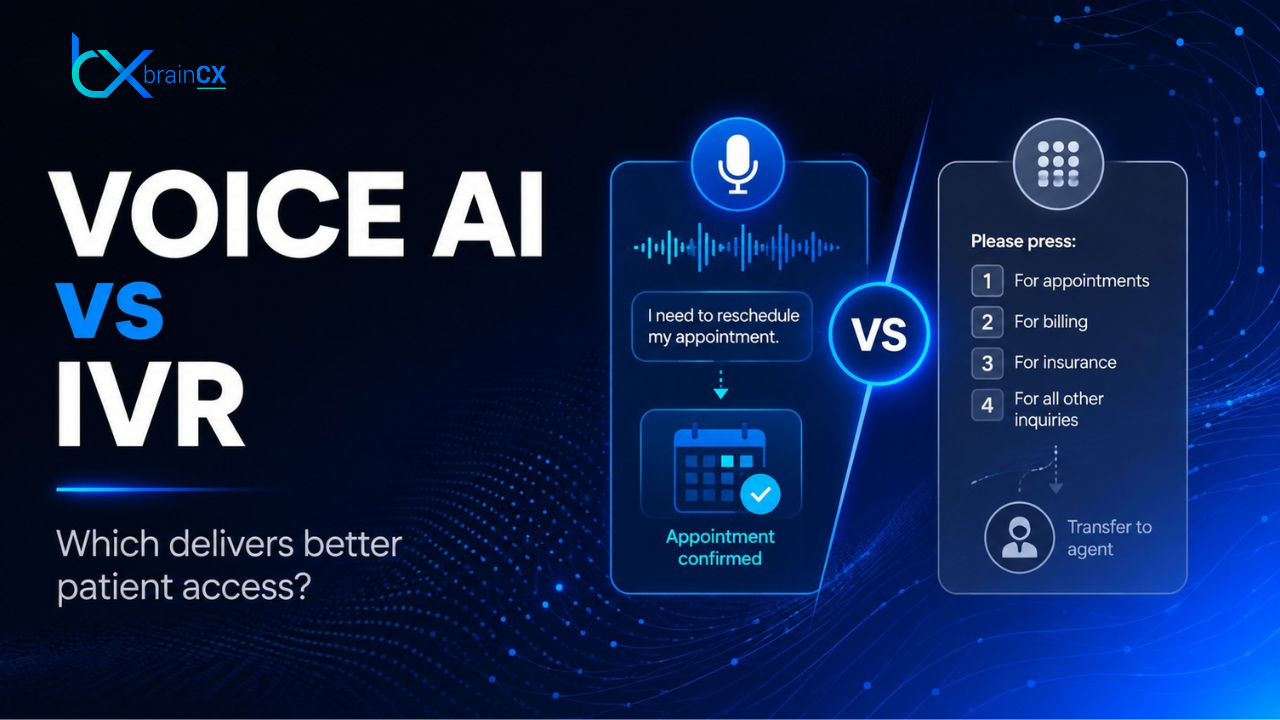
The short answer: an IVR routes calls using a fixed menu the caller navigates. Voice AI holds a conversation, understands why the person called, and completes the task. IVR moves a patient toward a queue. Voice AI books the appointment, answers the question, or transfers with context. For patient access, the operational difference shows up in three numbers: abandonment rate, containment rate, and how many callers reach the right place on the first attempt.
Now the longer version, because the decision is less binary than most vendor comparisons make it sound.
What IVR was designed to do, and why it worked
Interactive voice response was a routing technology built for a world with expensive telephony and cheap patience. Its job was to keep a switchboard operator from having to ask every caller which department they wanted. Judged against that job, IVR was a genuine advance, and the people who deployed it were not fools.
The teams at BrainCX spent decades deploying these systems inside contact centers at Apple, JPMorgan Chase, Liberty Latin America, Spirit Airlines, and India’s first publicly traded BPO before building anything AI. That history is the reason the company’s view of the platform starts from conversation outcomes rather than code frameworks. An engineer sees a phone tree as a routing graph to optimize. An operator who has read the transcripts knows the phone tree is where the patient gave up.
The failure was the design assumption. It expired, and nobody updated the technology built on top of it.
What changed in the caller, not the technology
IVR asks the caller to translate their problem into your org chart. That works when the caller’s problem maps cleanly onto a department name. Patient access calls almost never do.
A patient calling a multi-site health group has a compound intent. They need a follow-up moved. They want to know if the new location takes their insurance. They are not sure the referral is still valid. There is no menu option for that.
So they guess, get routed wrong, and start over. Or they hang up.
The data on menu depth is blunt about the consequence. Reporting on NICE’s 2026 CX research found that systems with more than ten menu levels see abandonment rates between 30% and 50%
The number that should worry a patient access leader is the zero-out rate: how often callers immediately press 0 to escape the menu. A high zero-out rate is the caller telling you, in the only language your system understands, that your menu options do not match the reasons people are calling.
Eight differences that matter for patient access
|
Dimension |
Touch-tone IVR |
Voice AI phone agent |
|---|---|---|
| Caller input | Keypad selections from a fixed list | Natural speech, any phrasing |
| Intent handling | One intent per branch | Compound intent in a single utterance |
| Task completion | Routes to a queue | Books, reschedules, verifies, answers |
| System interaction | Read-only lookups at best | Writes to scheduling and intake during the call |
| Wrong turns | Caller restarts the menu | Agent re-asks and self-corrects |
| Language | Separate branch, often a callback | Native-language conversation or live relay |
| Escalation | Cold transfer, patient repeats everything | Warm transfer with full context |
| Change management | Reprogram the tree | Update the knowledge and policy layer |
Two aggregate figures frame the size of the shift. BrainCX health system clients have seen call abandonment drop by up to 40% after deployment.
Where IVR still wins
An honest comparison has to include this section, and most do not.
Keep the IVR for high-volume, single-intent, security-sensitive flows where the caller already knows exactly what they want and the input is numeric. Account balance by ID number. Prescription refill by Rx number. Automated payment by card entry, where PCI scope makes keypad entry the cleaner containment path. These are cheap, fast, and callers do not resent them, because there is no translation step.
The failure pattern is using that same architecture for anything conversational. A patient explaining a scheduling conflict is not doing data entry.
What does not change when you switch
Three things carry over unchanged, and pretending otherwise is how deployments disappoint.
Your compliance obligations. A voice AI handling patient access is a business associate. It needs a signed BAA, encryption in transit and at rest, and a defensible answer on data retention. Nothing about conversational technology relaxes that.
Your escalation staffing. Containment reduces agent volume; it does not eliminate the need for agents. The calls that reach your team will be harder on average, because the routine ones stopped arriving. Plan for skill. Headcount is not the constraint.
Your knowledge quality. An agent grounded in outdated content will confidently tell patients the wrong hours. Voice AI does not fix a content governance problem; it exposes it faster and at higher volume.
A migration path that does not blow up your call flows
Nobody should rip out a working phone system in one weekend. The sequence that works looks like this.
- Instrument the current system first. Pull zero-out rate, IVR-stage abandonment, misroute rate, and first-call resolution separately. Most groups report one blended abandonment number, which hides three different problems happening at three different points and makes it impossible to prove improvement later.
- Move one call type. Scheduling and rescheduling is the usual first choice because volume is high, intent is conversational, and the value is measurable in filled slots. Leave payments and refills on the IVR.
- Run the two in parallel behind the same number. The voice agent answers, handles what it owns, and hands the rest to the existing tree. Patients experience one phone line, and you experience a reversible change.
- Expand by evidence, not by enthusiasm. Add the next call type when containment and CSAT on the first one hold for a full cycle, including a peak week.
Deployment on this pattern typically runs live in 4-6 weeks, and the orchestration layer that governs turn-taking, policy, and escalation across those flows is described in the BrainCX platform overview. Because patient access sits in one of the industries where a mishandled call has real consequences, the escalation design gets specified before the automation is built, not after.
Questions patient access leaders ask
Is conversational IVR the same thing as voice AI?
Not quite. Conversational IVR usually means speech-based intent recognition bolted onto an existing routing tree, so the caller speaks instead of pressing but the system still only routes. A voice AI phone agent completes tasks and writes to your systems. Conversational IVR is a better front door. Voice AI is a different building.
1. Will replacing our IVR break our telephony contracts?
Generally no. Voice AI sits as a layer on top of existing telephony and CCaaS platforms rather than replacing the carrier relationship. BrainCX runs on top of established telephony and contact center infrastructure for exactly this reason.
2. How does voice AI handle a patient in distress?
Escalation signals trigger immediate routing to a human with full conversation context. The design principle is that the agent recognizes what it should not handle. In behavioral health and clinical contexts specifically, the agent captures context and routes to licensed staff. It does not triage independently.
3. Do patients notice they are talking to AI?
Less than 1% of callers ever asked if they were speaking with AI. Zero asked to be transferred to a human because of it.
4. What should we measure in the first 90 days?
Zero-out rate on the retained IVR flows, containment on the migrated flow, abandonment at each stage, first-call resolution, and slot fill rate if scheduling was the pilot. Baseline all five before go-live or the comparison will be an argument rather than a measurement.