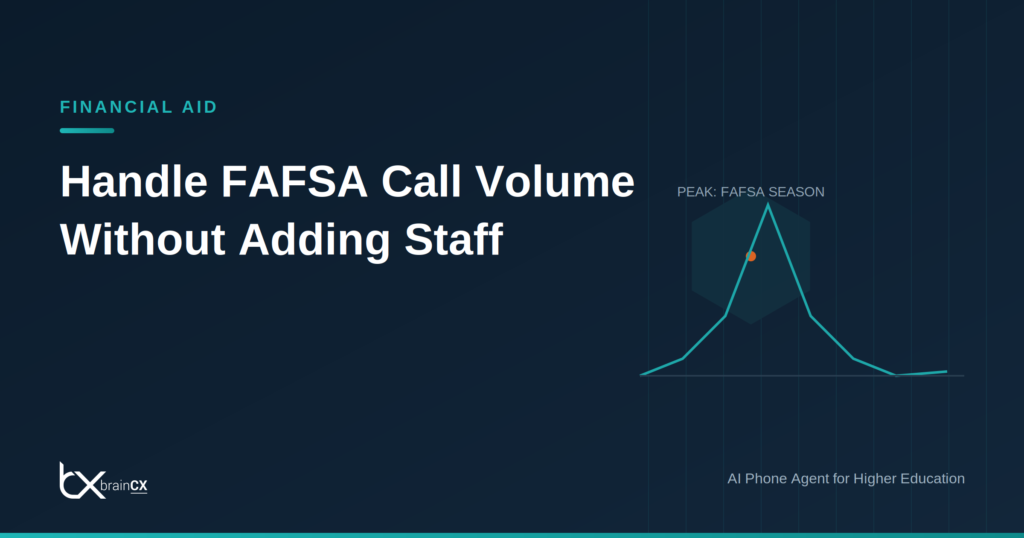

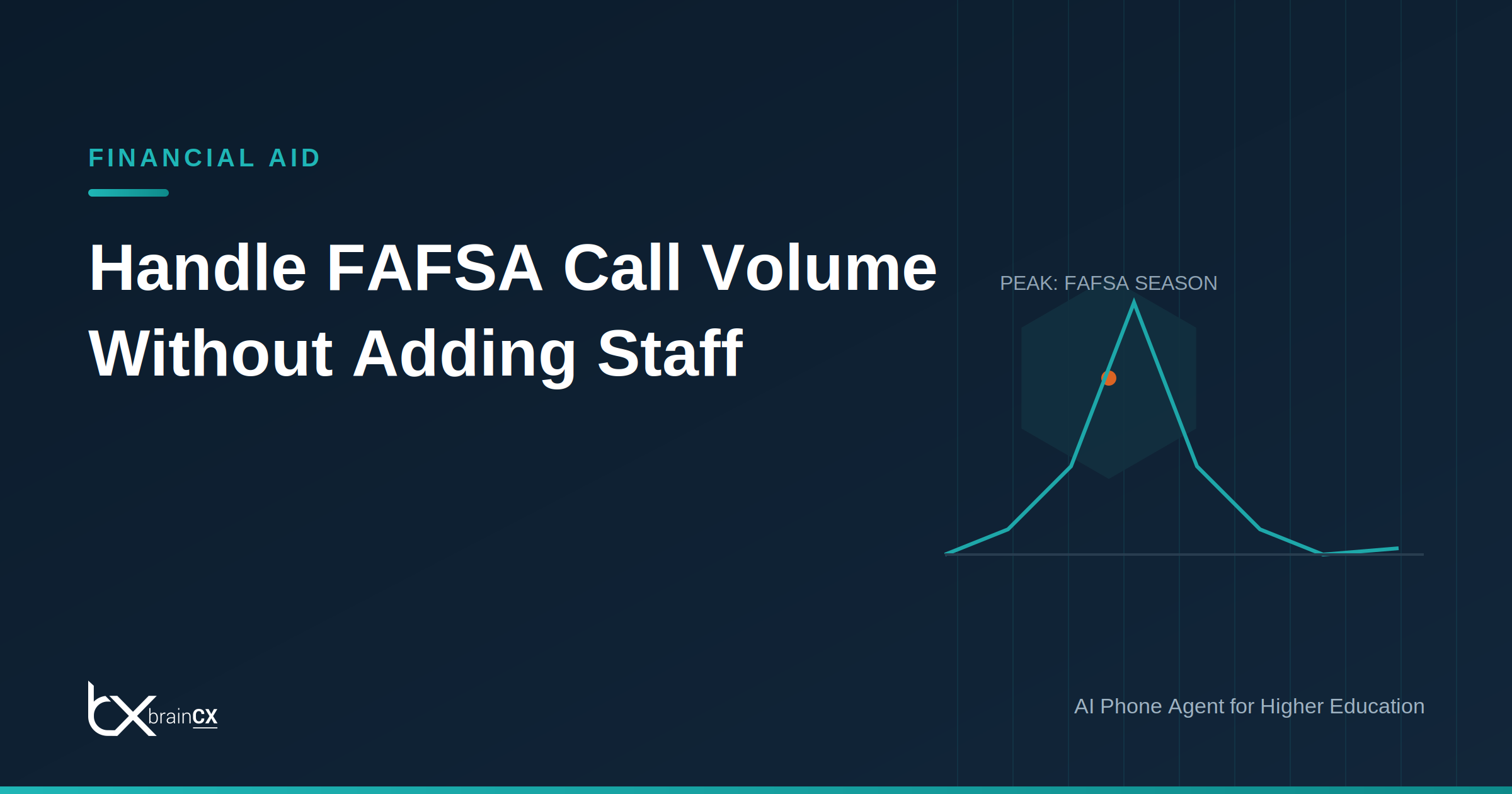
Every aid office knows the shape of the year. Volume is flat for months, then FAFSA season arrives and the phones do not stop. Families call about the same handful of things, where their form stands, what documents are missing, when the deadline is, and every one of those calls lands on staff who are also trying to process files and run verification. Hiring for a seasonal spike does not pencil out, so the calls queue.
The answer is not to replace your financial aid counselors. It is to take the repeatable, procedural volume off their plate so the people with Title IV expertise spend their time on the work that actually needs them. Done right, that shift shortens hold times for families, shortens processing backlogs for staff, and removes the seasonal scramble to hire and train temporary help who leave the moment the peak passes.
It is worth being honest about why this problem is so stubborn. Aid questions are emotionally loaded. They arrive in a compressed window, and they cannot be deferred.
A family that cannot get an answer about their package this week may simply give up on enrolling. The pressure is not operational alone. Unanswered aid calls are one of the quietest drivers of enrollment loss, which means the aid office phone queue is a revenue problem wearing an operations costume.
Where the FAFSA-season volume actually comes from
Most peak-season aid calls are procedural and repetitive. That is good news, because procedural and repetitive is exactly what a voice AI phone agent handles well. Break the volume down and the pattern is clear.
- Status checks. “Did you get my form? Where is my application?” answered in seconds, any hour.
- Missing documents. The agent tells the family exactly what is outstanding and how to submit it, then follows up if it does not arrive.
- Deadlines and process. FAFSA steps, verification requirements, what happens next, stated consistently every time.
- Award-letter walkthroughs. Plain-language explanation of what a package includes and what the family needs to do to accept it.
- After-hours and overflow. The calls that arrive when the office is closed or the queue is already full, which are the ones most likely to end in a family giving up.
A large majority of peak-season call volume falls into those five buckets, and none of them requires professional judgment. They require accurate, consistent, patient answers delivered fast. That is a workload profile almost purpose-built for automation, provided the automation is accurate about your specific process and knows when to stop.
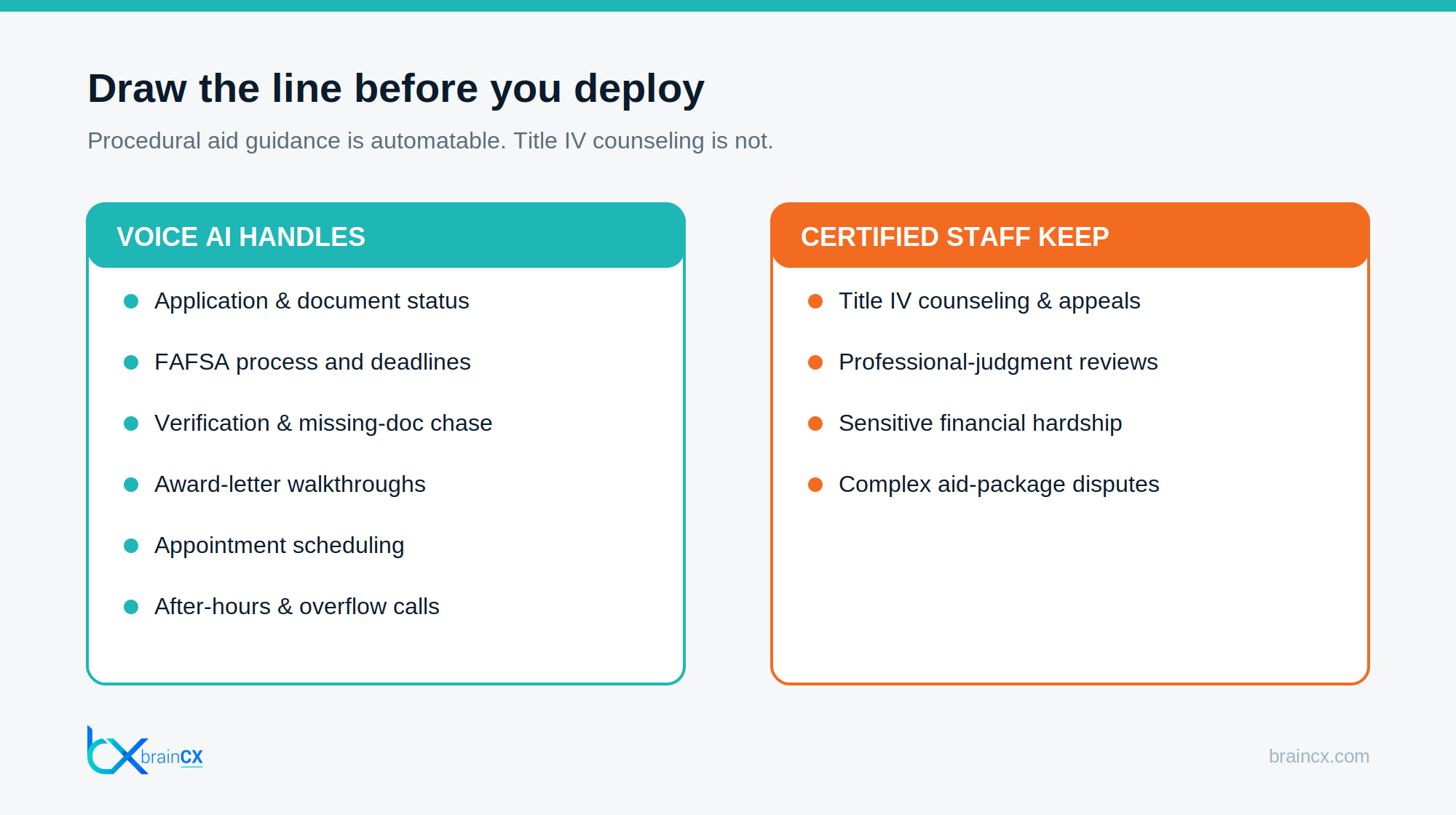
The line you must not cross: procedural help, not Title IV counseling
This is the part that matters most for a compliance-first buyer. A voice agent should provide procedural and informational financial-aid guidance only: the FAFSA process, document requirements, deadlines, and verification status. It must never cross into the Title IV-regulated counseling and professional-judgment decisions that require certified financial-aid staff. Drawing that line explicitly is not a limitation to apologize for. It is the design choice that makes the deployment defensible.
In practice the boundary is easy to describe and easy to enforce. If a question can be answered from published policy, a deadline calendar, or a checklist, the agent handles it. If a question involves discretion, an appeal, a professional-judgment adjustment, a special-circumstances review, or anything that changes a student’s award, it goes to a certified counselor. The agent is built to recognize those triggers and hand off rather than improvise. An automated system that tries to counsel on aid is a compliance risk. One that knows precisely where its authority ends is an asset.
For the authoritative boundary of what aid offices can and cannot delegate, the U.S. Department of Education’s Federal Student Aid Handbook is the reference procurement and compliance teams will check. Anchoring your deployment to that boundary from day one is what turns a security review from a hurdle into a formality.
Calling hours, consent, and TCPA in aid outreach
Outbound aid outreach is still outbound calling, which means it lives under the same rules as any other regulated campaign: calling-hour restrictions, do-not-call handling, opt-out on request, and consent capture at the start of the call. BrainCX operates TCPA-compliant outbound by design, and its Compliance and Governance controls log every call with a recording and transcript against the student record. That audit trail is what an aid director needs when a family disputes what was said.
These rules are especially load-bearing in aid outreach because the same families get contacted repeatedly across a multi-week cadence, verification reminders, document chases, deadline nudges. A campaign that respects calling hours, honors opt-outs immediately, and documents consent is not legally safer alone. It is more effective, because families trust an outreach program that behaves predictably. Every call logged with a transcript also means that if a question ever arises about what a family was told, the answer is on record rather than in dispute.
What the agent does during peak season
Answers the routine, instantly
Status, documents, deadlines, and award-letter basics get handled the moment the family calls, in 40+ languages, with no hold music. The domain tuning that makes this accurate is described in the BrainCX Knowledge Fusion product, which understands aid terminology out of the box rather than guessing. Multilingual coverage matters more in aid than almost anywhere else, because the families most likely to need help navigating FAFSA are often the ones least served by English-only phone trees.
Escalates the moment judgment is needed
A hardship case, a professional-judgment appeal, or a complex package dispute is routed straight to a certified counselor with the full conversation attached. No family gets stuck, and no counselor walks into a call cold. The handoff carries the context, so the family never has to repeat their story, which is exactly the friction that makes people abandon aid processes.
Follows up so nothing stalls
Missing a verification document is one of the most common reasons an aid file freezes, and a frozen file in peak season can quietly turn into a melted student by fall. The agent calls back proactively, which keeps files moving through the exact window when speed matters most. Proactive follow-up is where automation earns its keep, because it does the persistent, unglamorous chasing that a stretched staff simply cannot get to.
Captures the data leadership needs
Because every interaction is logged and summarized, the aid office gets a live view of what families are calling about, which documents are most commonly missing, and where the process is generating the most confusion. That intelligence lets you fix the upstream cause, a confusing letter, an unclear deadline, instead of answering the same call ten thousand times.
What this frees your counselors to do
The point of taking procedural volume off the phones is not headcount reduction. It is redeployment. When the routine status and document calls are handled, your certified staff can spend the peak weeks on the work that actually needs a human: professional-judgment reviews, appeals, special-circumstances cases, and the sensitive conversations with families facing genuine hardship. Those are the interactions where an experienced counselor changes an outcome, and they are exactly the ones that get squeezed out when everyone is buried in status checks.
Why this pairs with your melt strategy
Aid confusion is one of the biggest drivers of summer attrition, so an aid office that answers every call feeds directly into keeping students enrolled. The same families who cannot get an aid answer in March are the ones who quietly disappear by August. If you are building a summer program, read how voice follow-up stops summer melt between deposit and day one and connect the two workflows, because the aid queue and the melt problem are the same students at different moments.
Frequently asked questions
1. Can AI handle financial aid calls without violating compliance?
Yes, within a clear boundary. A voice agent should handle procedural and informational guidance only: FAFSA process, documents, deadlines, and verification status. Title IV counseling and professional-judgment decisions stay with certified staff. Drawing that line is what keeps the deployment compliant.
2. Does a voice agent replace financial aid counselors?
No. It absorbs the repetitive status, document, and deadline calls during peak season and escalates anything requiring judgment to a certified counselor with full context, so staff focus on the work only they can do.
3. Is outbound aid outreach TCPA-compliant?
It can be, when built correctly. That means calling-hour restrictions, do-not-call handling, opt-out on request, and consent capture at call start, with every call recorded and logged. BrainCX runs TCPA-compliant outbound by design.
4. What languages can the agent support during FAFSA season?
BrainCX supports 40+ languages with native-language conversation or real-time relay, so families who are more comfortable in another language get the same level of service.
5. Will automating aid calls reduce my staff headcount?
That is not the goal. The point is redeployment: routine volume goes to the agent, and certified counselors spend peak season on appeals, professional-judgment reviews, and hardship cases that need a human.
Get through FAFSA season without a seasonal hiring scramble
Take the procedural volume off your counselors and keep the Title IV work where it belongs. Talk to the BrainCX solutions team about a peak-season aid deployment, or see the full BrainCX AI phone agent platform.