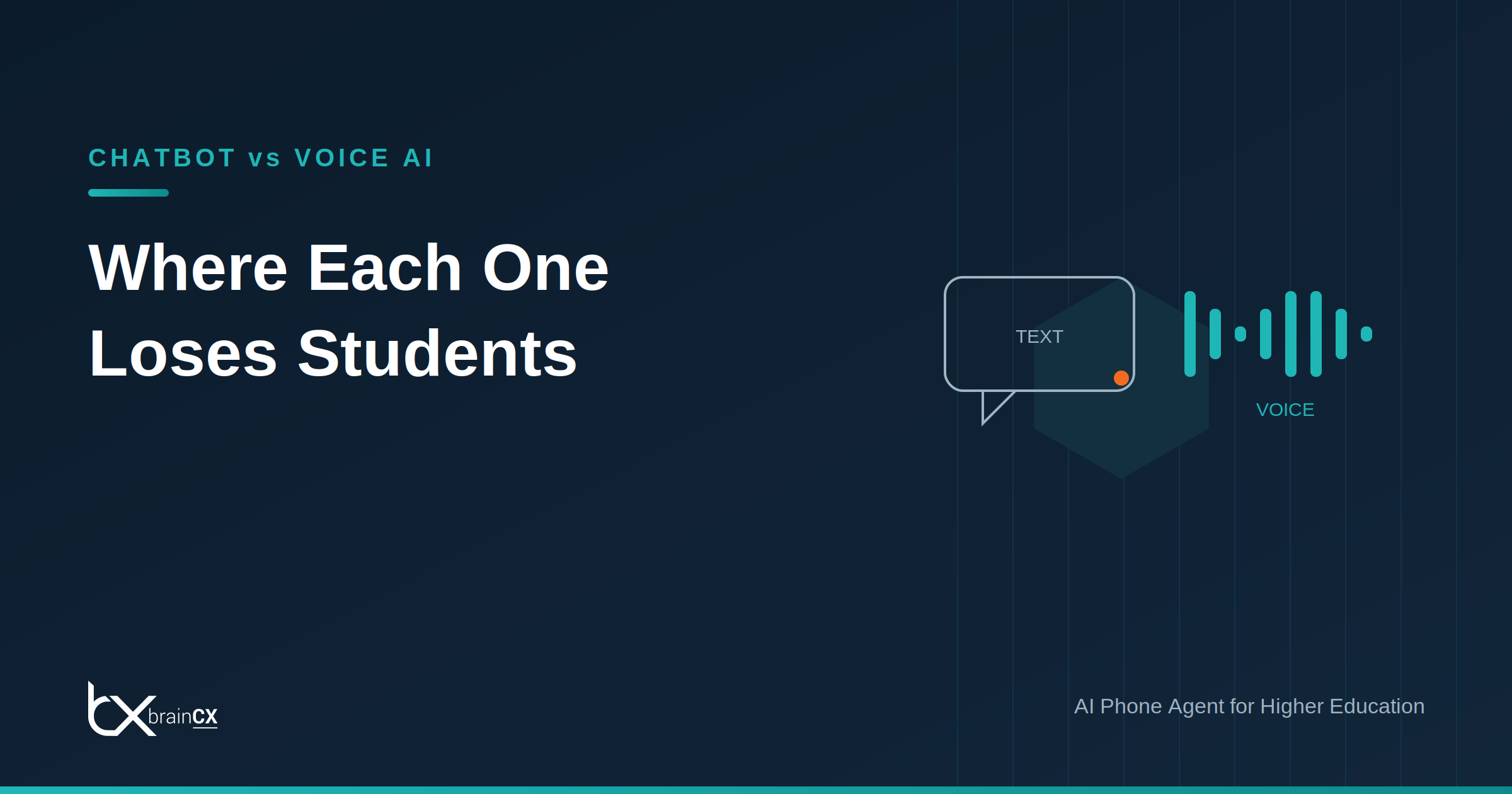
Almost every article you will find on this question is written by a chatbot vendor, and it reaches the same convenient conclusion: you need a chatbot. This one is written by an operator, and the honest answer is that text and voice fail in different places. Knowing where each one loses students is how you decide what to actually deploy.
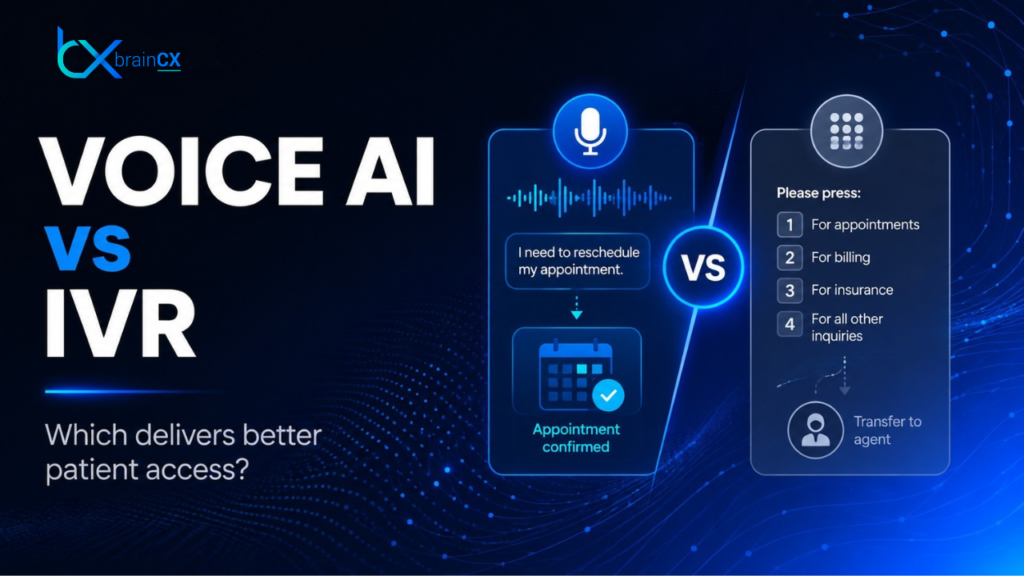
A chatbot is a text program on your website. A voice AI phone agent handles inbound and outbound phone calls conversationally. Both use natural language, but they meet students at completely different moments in the funnel, and treating them as interchangeable is how enrollment teams end up with a tool that answers the easy questions and misses the students who were about to walk away.
This is not an argument that voice is universally better than text. It is an argument for matching the channel to the moment. Get that match right and you cover the whole funnel. Get it wrong and you will have a responsive FAQ box while your hardest-to-reach applicants quietly enroll somewhere else.
Where the chatbot loses students
Chatbots are genuinely useful for one job: instant answers to routine questions from someone already on your site. They lose students at the edges of that job, and those edges are where enrollment is won or lost.
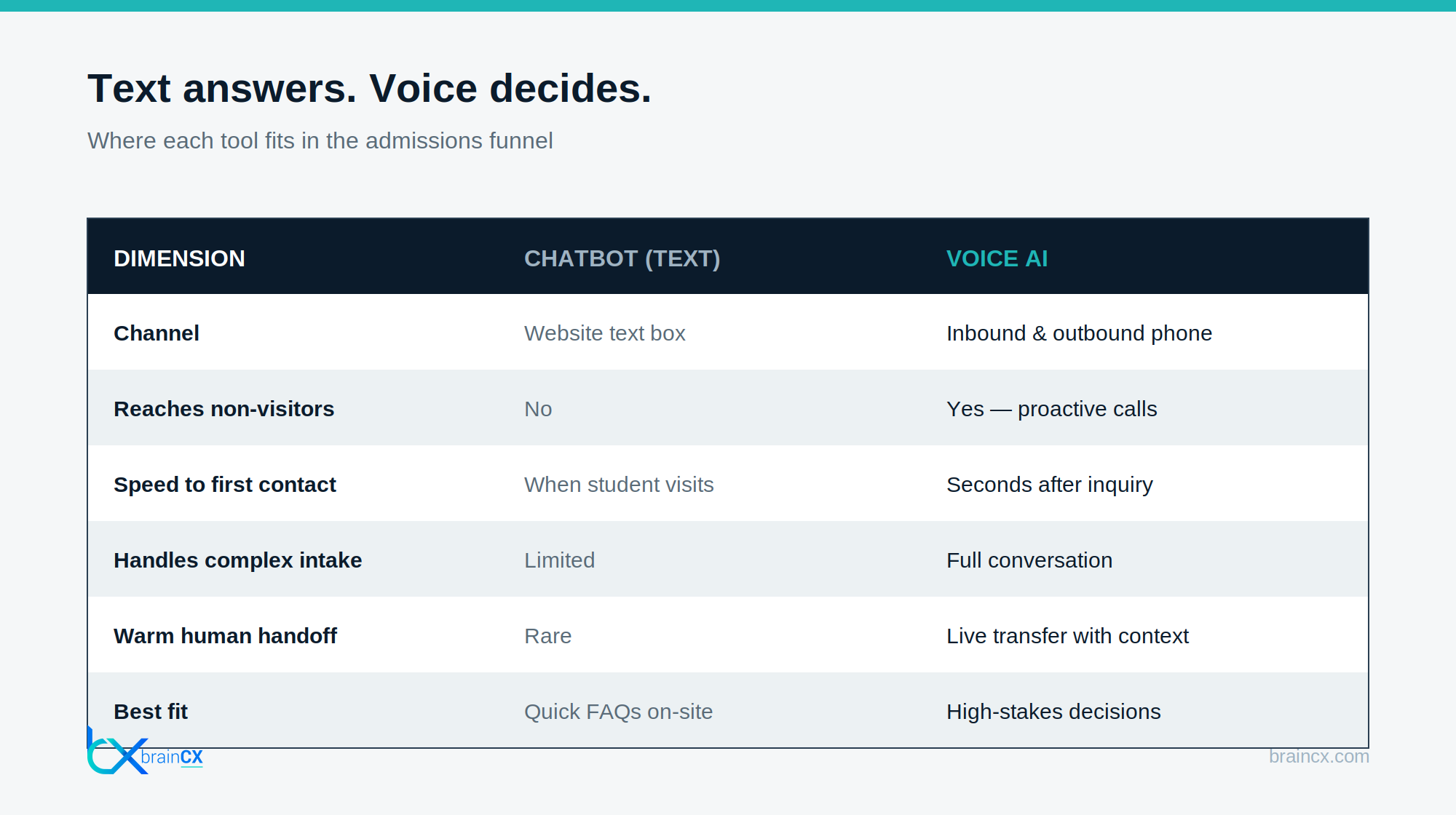
- It only reaches people who visit. A chatbot cannot call the applicant who went quiet three weeks ago. It waits for the student to come back, and the students most at risk are exactly the ones who do not.
- It stalls on anything open-ended. “Which program is right for me?” and “Can I actually afford this?” are the questions that decide enrollment, and they are exactly where a text box gives up.
- Escalation is often a dead end. Poor handoff is one of the most common failure points in chatbot deployments, and a frustrated family that hits a wall does not come back.
- It cannot read tone. A worried parent and a confident applicant type the same words. Voice hears the difference. Text does not, so the chatbot treats a crisis and a casual question identically.
Even chatbot vendors concede the ceiling. Industry coverage acknowledges that a bot is no match for an authentic human conversation when the stakes are personal, which is precisely the admissions moment that matters most. A chatbot is a good receptionist for your website. It is not a recruiter.
Where voice AI loses students
Voice is not a universal upgrade. It has its own failure modes, and pretending otherwise is how vendors lose trust. An honest comparison names them.
- It is the wrong tool for a quick on-site FAQ. Someone reading a program page at midnight wants a text answer, not a phone call. Forcing a call where a text would do is friction, not service.
- Bad voice AI is worse than no voice AI. A robotic, high-latency agent that mishears a name damages the brand on the first call. Quality is not optional, and a cheap voice bot can do real reputational harm.
- It needs governance. Without approved knowledge and clear escalation rules, a voice agent can confidently say the wrong thing at scale. Grounding and guardrails are the difference between an asset and a liability.
- It is easy to deploy badly. A voice program with no calling-hour discipline, no consent handling, and no human handoff will annoy families and expose the institution. The channel is powerful, which means the implementation has to be disciplined.
None of these are arguments against voice. They are arguments against unmanaged, low-quality voice. The same way a badly built chatbot frustrates site visitors, a badly built voice agent frustrates callers. The channel is only as good as the system behind it, which is why how you buy matters as much as what you buy.
The moment that decides enrollment is a conversation
Speed-to-lead is the clearest place the two diverge. Research on lead response is unambiguous: the odds of qualifying a lead drop sharply when first contact slips from five minutes to thirty. A chatbot can only respond when the student happens to be on the page. A voice agent calls within seconds of an inquiry, which is why so much of the BrainCX work on voice AI for higher education admissions centers on being first, not fast. In a cycle where a prospective student inquires at eight schools in one session, the school that calls first frames the entire decision.
Think about how a real inquiry unfolds. A student fills out a form on your program page at 9 p.m. A chatbot might have answered a question while they were on the site, but the moment they close the tab, the chatbot’s reach ends. A voice agent calls back within seconds, has a two-minute conversation, answers the affordability question that was actually holding them back, and books a counselor call for the next morning. By the time your competitors’ emails land, the student has already had a conversation with you. That sequence is not available to a text-only tool.
This is also where the tired framing of AI replacing counselors falls apart. The point is not to remove the human. It is to make sure a human conversation happens at all, at the moment it changes the outcome, instead of a form that never gets a callback. The voice agent handles first contact and the routine follow-up so the counselor spends their time in the conversations that need a person, not chasing voicemails.
Where each tool actually fits the funnel
Map the two tools onto the admissions funnel and the division of labor becomes obvious. They are complementary, not competing, when deployed with intent.
- Top of funnel, on-site: chatbot. Instant answers to program, deadline, and requirement questions for students already browsing.
- Inquiry response: voice. Call within seconds of a form submission, before the lead cools and before competitors reach out.
- Nurture and follow-up: voice. Proactive outreach to applicants who have gone quiet, which a chatbot structurally cannot do.
- Complex intake and objections: voice. The affordability conversation, the program-fit conversation, the wavering-applicant conversation.
- Simple status lookups: either, depending on where the student is when they ask.
So which one should a university deploy
The correct answer is rarely one or the other. Use each where it is strongest, and stop treating the decision as a versus.
- Chatbot: instant, low-stakes FAQs for students already on your website.
- Voice AI: proactive outreach, inquiry follow-up, complex intake, and any high-stakes conversation that decides whether a student enrolls.
The deployment decision that trips teams up is not text versus voice. It is build versus buy. A managed voice AI service compared to a self-serve platform determines whether your team maintains the system or your vendor does, and for most enrollment offices that choice matters more than the channel. A voice program that no one has time to tune will underperform a chatbot that someone actually maintains, so the operating model is the real decision.
Before you sign with any vendor
Whichever way you go, the questions that separate a running system from a good demo are the same: SIS write-back, data handling, escalation SLA, and who tunes the agent after launch. A polished demo tells you the tool can talk. It does not tell you whether it will still be accurate in November when your programs, deadlines, and staff have all changed. Work through the questions enrollment leaders should ask a voice AI vendor before you commit, and hold any vendor, chat or voice, to the same standard.
Frequently asked questions
1. What is the difference between a chatbot and voice AI for universities?
A chatbot is a text program on your website that answers questions from visitors. A voice AI phone agent handles inbound and outbound phone calls conversationally, including proactive outreach the chatbot cannot do. They meet students at different points in the funnel.
2. Is voice AI better than a chatbot for admissions?
Neither is universally better. Chatbots win for instant, low-stakes FAQs from on-site visitors. Voice AI wins for proactive follow-up, complex intake, and the high-stakes conversations that decide enrollment. Most universities benefit from using each where it is strongest.
3. Does voice AI replace admissions counselors?
No. It ensures a real conversation happens at the moment it changes the outcome and escalates to a counselor with full context when judgment is needed, rather than leaving an inquiry to a form that never gets a callback.
4. Why do chatbots lose students in admissions?
Chatbots only reach students who visit the site, stall on open-ended questions like program fit and affordability, and frequently hand off poorly. Those gaps are where students disengage and go quiet.
5. Should a university use both a chatbot and voice AI?
Usually yes. Use the chatbot for instant on-site FAQs and voice AI for inquiry response, proactive follow-up, and complex conversations. The two cover different parts of the funnel.
See the difference a real conversation makes
Text answers questions. Voice closes decisions. Talk to the BrainCX solutions team about where voice fits alongside your existing chat, or explore how BrainCX serves trust-dependent industries.