
Is there such a thing as a FERPA compliant AI vendor?
Not in the way procurement usually means it. FERPA binds the educational institution, not the vendor, so there is no certification body and no certificate to produce. A FERPA compliant AI deployment is one where the vendor has been brought inside the institution’s framework through the school official exception, which is a contractual and architectural arrangement.
Any vendor claiming FERPA certification is describing something that does not exist. That is worth knowing before the security review, not during it.
What the regulation actually says
The Family Educational Rights and Privacy Act sits at 20 U.S.C. § 1232g, and its implementing regulations are at 34 CFR Part 99. The statute restricts disclosure of personally identifiable information from education records without consent, with a list of exceptions.
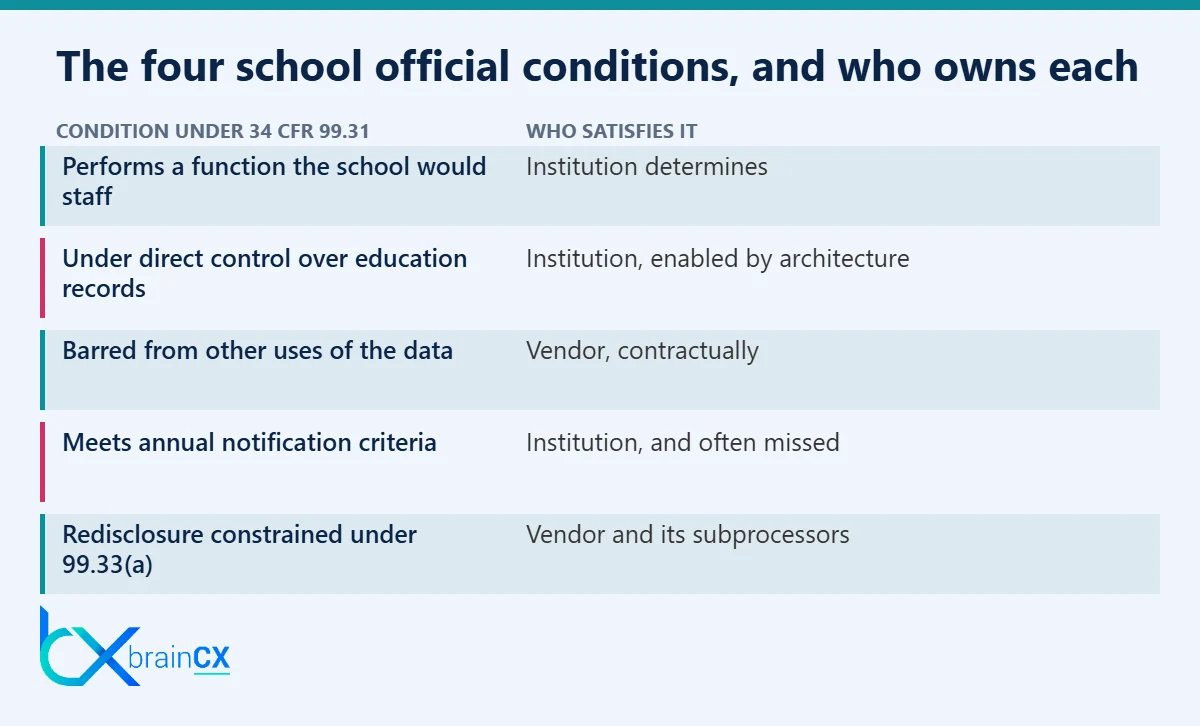
The exception that matters for vendors is the school official exception at 34 CFR § 99.31(a)(1)(i)(B). It permits an institution to treat a contractor, consultant, volunteer, or other outside party as a school official, provided that party:
- performs an institutional service or function for which the institution would otherwise use employees;
- is under the direct control of the institution with respect to the use and maintenance of education records;
- is prohibited from using personally identifiable information from education records for any purpose other than providing the service; and
- meets the criteria set out in the institution’s own annual notification of FERPA rights for a school official with a legitimate educational interest.
The Department of Education’s student privacy office sets out the same four conditions in its guidance on who counts as a school official.
Read that list again and notice who the obligations fall on. Three of the four are things the institution has to do: determine the function, retain direct control, and write the vendor into its annual notification. Only the use restriction is primarily the vendor’s.
Why this changes the procurement conversation
A question like “are you FERPA compliant?” has no true answer, which is why vendors answer it with marketing. The questions that do have answers are narrower.
Does the vendor perform a function the institution would otherwise staff? For inquiry follow-up and student service calls, plainly yes, which is the easy part.
Is the vendor under the institution’s direct control over the use and maintenance of education records? This is an architecture question. Where does call data live, who can access it, who decides retention, and can the institution direct deletion. A vendor that holds student data in its own environment on its own terms is harder to characterise as under direct control than one whose data sits in the institution’s infrastructure.
Is the use restriction contractual and enforceable? Specifically, is the vendor barred from using student data to train general models, improve its product for other customers, or for any purpose beyond the service.
Has the institution actually updated its annual notification? This is the condition most often missed, and it is entirely on the institution. A vendor cannot fix it.
Is redisclosure handled? Onward disclosure by a school official is constrained under 34 CFR § 99.33(a), which means the vendor’s own subprocessors are in scope.
Where BrainCX stands, stated plainly
FERPA is planned, not certified, and no vendor is certified because there is nothing to be certified against. What BrainCX can do is satisfy the conditions the exception requires: perform a function the institution would otherwise staff, operate under contractual use restrictions, and, where the deployment allows, keep call data inside the client’s own infrastructure rather than the vendor’s.
SOC 2 Type II is in process. HIPAA with a signed BAA and TCPA process are in place. Those are separate frameworks with separate answers and conflating them is how procurement reviews go wrong.
BrainCX was built by CX operators, not AI tourists. Operators who have sat on the institution’s side of a vendor security review tend to be blunter about what a framework does and does not cover, because they have been the ones answering to a general counsel.
The practical shape of a compliant deployment
Scope the data. A voice agent handling inquiry follow-up and speed-to-lead needs far less student data than one handling registration or financial aid records. The narrowest scope that does the job is the easiest to defend.
Separate the directory-information cases from the education-record cases. Some outbound contact can run on directory information, which the institution may disclose under 34 CFR § 99.37 if it has given public notice and honoured opt-outs. Prospective-student inquiry follow-up often falls outside education records entirely, because an inquiry from someone who is not yet a student is not a record of a student.
That last point is underappreciated and it changes the risk profile of most admissions use cases. Much of what an enrollment team wants a voice agent to do sits before FERPA attaches at all.
Write the annual notification language early. It is a short amendment and it is a hard blocker if nobody owns it.
Then handle TCPA separately, because consent to be called is a different question from permission to disclose a record, and the FCC’s consent revocation rules changed on November 25, 2026.
What to ask a vendor
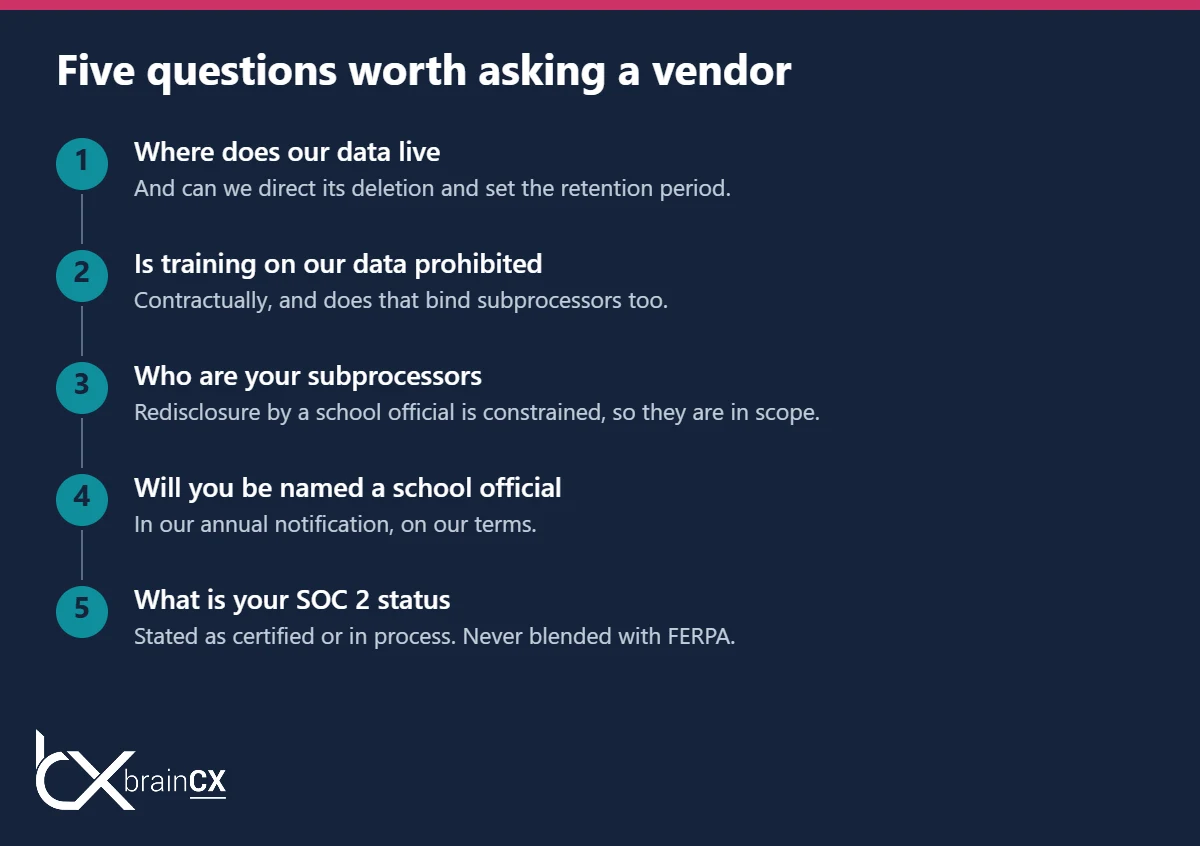
The list is short once the framework is clear. Where does our data live and can we direct its deletion. Is training on our data contractually prohibited. Who are your subprocessors and how is redisclosure constrained. Will you sign terms that name you as a school official under our annual notification. What is your SOC 2 status, stated as certified or in process.
A vendor that answers those five without reaching for the word “certified” is the one to shortlist. More questions worth asking a voice AI vendor during enrollment procurement covers the operational side of the same review, and the chatbot versus voice AI comparison covers scope.
Why “we don’t train on your data” is the load-bearing answer
Of the four conditions, the use restriction is the one a vendor controls outright, and it is where AI vendors differ most from the software vendors FERPA offices are used to reviewing.
A traditional student information system holds data and does nothing else with it. A model-based system may improve from the data it sees, and if student records are part of that improvement loop then the data is being used for a purpose beyond providing the service to that institution. That is the condition failing, stated plainly.
So the question is not whether the vendor has good intentions about training. It is whether the contract prohibits it, whether the architecture makes it unnecessary, and whether subprocessors are bound by the same term. A vendor that answers the first but not the third has not answered.
Retention is the adjacent question. Call recordings and transcripts of conversations with students are education records when they concern enrolled students, and a vendor holding them indefinitely is holding education records indefinitely. The institution should be able to set that period and direct deletion.
Where multi-campus systems get stuck
A system with several institutions under one board has several annual notifications, which means the school official designation has to be made at each institution rather than once centrally.
That is an administrative detail that stalls deployments for months, because nobody owns it and it is discovered late. It is worth resolving before procurement rather than after, particularly for multi-campus community college systems where the registrar functions are distributed and the notifications are not identical.
The narrow scoping point helps here too. A deployment confined to prospective-student inquiry touches fewer education records at fewer institutions, which shortens the review at every one of them.
This article describes published federal regulations as of November 2026 and is not legal advice. FERPA application depends on institutional facts, and your general counsel should review any vendor arrangement before student data is disclosed.
Frequently asked questions
Can a vendor be FERPA certified?
No. FERPA creates obligations for educational institutions, and there is no certification scheme or certifying body for vendors. A vendor can only be brought inside an institution’s compliance posture through the school official exception.
What is the school official exception?
34 CFR § 99.31(a)(1)(i)(B) lets an institution treat a contractor as a school official where the contractor performs a function the institution would otherwise staff, is under the institution’s direct control over education records, is barred from using the data for other purposes, and meets the criteria in the institution’s annual FERPA notification.
Does FERPA apply to prospective student inquiries?
Often not. FERPA protects education records of students, and an inquiry from someone who has not enrolled is generally not a record of a student. Much admissions outreach therefore sits before FERPA attaches.
Is BrainCX FERPA compliant?
FERPA is planned. BrainCX is designed to meet the school official exception conditions, including contractual use restrictions and, where the deployment allows, keeping call data in the institution’s own infrastructure.
What about SOC 2?
SOC 2 Type II is in process. It is a separate framework from FERPA and should be evaluated separately.
Who updates the annual notification?
The institution. It is one of the four conditions and no vendor can satisfy it on the institution’s behalf.