

Prior authorization is the call your revenue cycle team dreads, and the one your budget never accounts for. It does not produce revenue. It protects it. And it eats hours that nobody planned to spend.
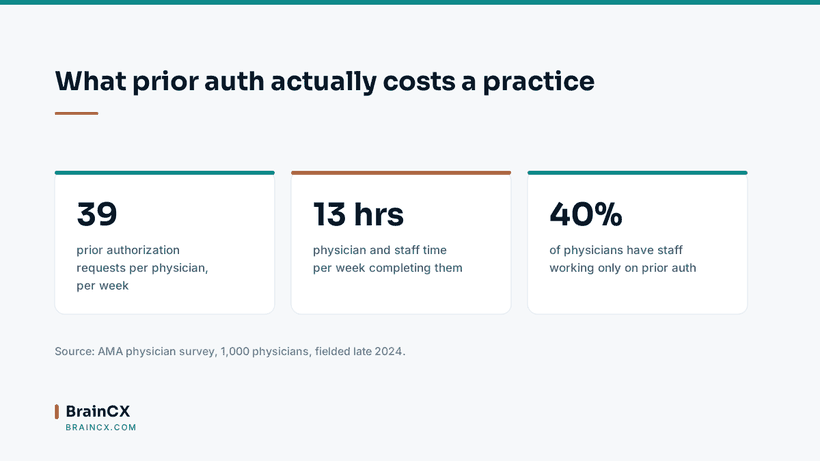
The numbers are not subtle. An AMA survey of 1,000 physicians found practices handle an average of 39 prior authorization requests per physician, per week. Completing them takes 13 hours of physician and staff time each week. And 40% of physicians now have staff who work exclusively on prior authorizations.
That is a full staffing line built around hold music.
Where the time actually goes
The clinical decision is not the slow part. A physician decides what a patient needs in minutes. The slow part is everything after.
Somebody has to call the payer line. Sit in the queue. Read back the member ID. Confirm what was submitted. Find out a form is missing. Resubmit. Call again two days later to check status. None of that requires a clinical license. All of it requires a person tied to a phone.
So the work lands on patient access and revenue cycle staff, and it crowds out everything else they are supposed to do. The person who should be rebooking a cancelled slot is on hold with a payer instead.
What voice AI carries, and what it does not
The useful question is not whether AI can do prior auth. It is which parts of the call belong to a machine and which stay with a person.
The queue and the hold time. Voice AI calls the payer line, works through the phone tree, and holds. It does not get tired, it does not skip the call because the lobby is full, and it does not need a person sitting there while the hold timer runs.
Status checks. The follow-up call two days later. Is it approved, denied, or still pending. Voice AI makes that call on schedule and records the answer.
Documentation follow-up. Confirming what was submitted and flagging what is missing, so the resubmission happens the same day instead of next week.
Capturing the outcome. TrustVoice handles the call and Knowledge Fusion writes the result, approved, denied, or pending, straight back into your system. Nobody transcribes a sticky note at the end of the shift.
Here is the line that does not move. The AI handles the process. It does not make clinical or coverage determinations. It never decides what a patient needs or whether a plan covers it. Those calls go to a person, every time. We give your staff superpowers on the parts that are pure logistics, and we keep them firmly in charge of anything that requires judgment.
Why this is an operator problem, not a software problem
Most of what gets sold into revenue cycle automation was built by people who have never sat in a payer phone queue. It shows. The systems handle the clean path and fall apart the moment a payer rep asks an unscripted question.
The reality is that prior auth calls are messy. Reps put you on hold mid-sentence. Phone trees change. A rep asks for a detail that was not in the original request. A system that only handles the happy path is a system that hands every real call back to a human anyway.
Across BrainCX production calls, fewer than 1% of callers ever asked if they were speaking with AI. That number comes from building to handle the mess, not the demo. Operator perspective, not developer perspective.
What to measure before you start
Pull two numbers for the last quarter.
First, staff hours spent on prior authorization follow-up calls specifically. Not the submission, the calling. Most teams have never separated this out, and the number is usually higher than anyone guessed.
Second, your average time-to-resolution on a prior auth. From submission to a yes or no. That is the number voice AI moves, because the delay is almost always a call that nobody had time to make.
If follow-up calls are consuming a meaningful slice of a full-time role, and resolution is dragging because status checks slip, the phone is where the fix is. We cover the broader intake and coverage picture in AI for eligibility verification calls.
BrainCX runs this as a managed deployment. We design it, tune it against your real payer calls, and operate it. Most clients go live in 4-6 weeks, and simpler environments have gone live in as few as 3. You can see the platform modules that carry it, or how the same system handles patient scheduling and no-shows on the front end.
I ran contact center floors for three decades before I built any of this. The pattern I watched repeat was always the same. The most expensive work in a practice is the work nobody counts, and prior auth follow-up is the clearest example there is. Count it. Then take it off your people.
Book a demo and hear it work a real payer call.
Frequently asked questions
Can voice AI handle prior authorization calls to payers?
Yes, for the logistical parts. Voice AI calls the payer line, works the phone queue, holds, performs status checks, and follows up on documentation. It captures the approved, denied or pending outcome and writes it back to your system. It does not make clinical or coverage determinations.
How much staff time does prior authorization take?
An AMA survey of 1,000 physicians found practices handle an average of 39 prior authorization requests per physician per week, taking 13 hours of physician and staff time. Forty percent of physicians reported having staff who work exclusively on prior authorizations.
Does the AI decide whether a service is covered?
No. The AI handles the process, the calls, the queue, the status checks, and the documentation follow-up. Any clinical or coverage determination routes to a person. The system never decides what a patient needs or whether a plan covers it.
Which parts of prior auth does BrainCX automate first?
Most deployments start with the follow-up and status-check calls, because that is where staff lose the most time to hold queues. Submission capture and documentation follow-up are added from there.
How does the outcome get into our system?
Knowledge Fusion writes the result of each call, approved, denied or pending, back into your system in real time, so staff are not transcribing notes after the fact.
How quickly can this go live?
Most BrainCX deployments go live in 4-6 weeks, and simpler environments have gone live in as few as 3 weeks.