

A denied claim almost always started as a phone call nobody had time to finish. Coverage goes unverified, the visit happens anyway, and three weeks later the claim comes back rejected. Now someone has to rework it, or the patient gets a surprise bill, or both.
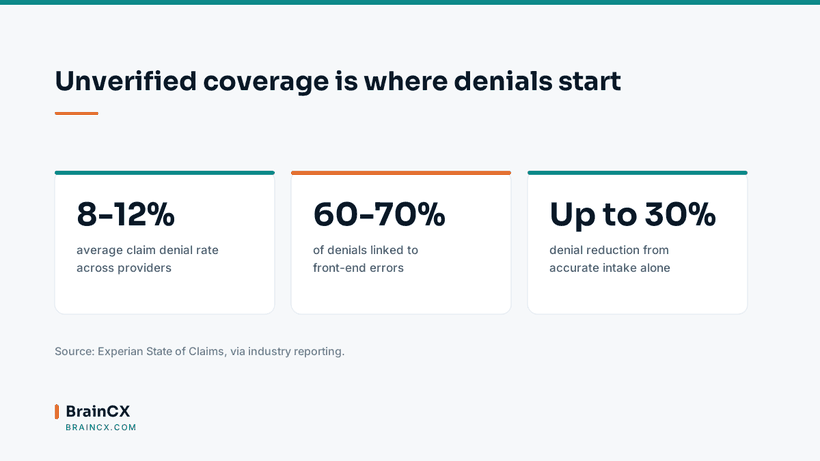
The pattern is measurable. Industry data puts the average claim denial rate at 8% to 12%, and 60% to 70% of denials trace back to front-end errors like eligibility and patient data. The good news in the same data: accurate intake alone can cut denials by up to 30%.
That is the whole argument for fixing coverage at the front door instead of the back office. The cheapest denial is the one that never happens.
Why eligibility slips through
It is not that front-desk staff do not know to verify coverage. It is that the moment to do it and the capacity to do it rarely line up.
A patient calls to book. The person answering is also checking someone in, finding a chart, and taking a second line. They book the appointment and mean to verify the insurance later. Later gets busy. The visit happens on unconfirmed coverage.
Then there is the callback queue. A patient leaves a message about a plan change. The message sits. By the time anyone calls back, the appointment is tomorrow and the coverage is still unverified.
None of this is a training problem. It is a sequencing problem, and it only gets worse at a multi-site group where the front desk is stretched the same way at every location.
Where voice AI captures the detail
The fix is to collect coverage information at the moment the patient is already on the phone, and to write it down somewhere real instead of a sticky note.
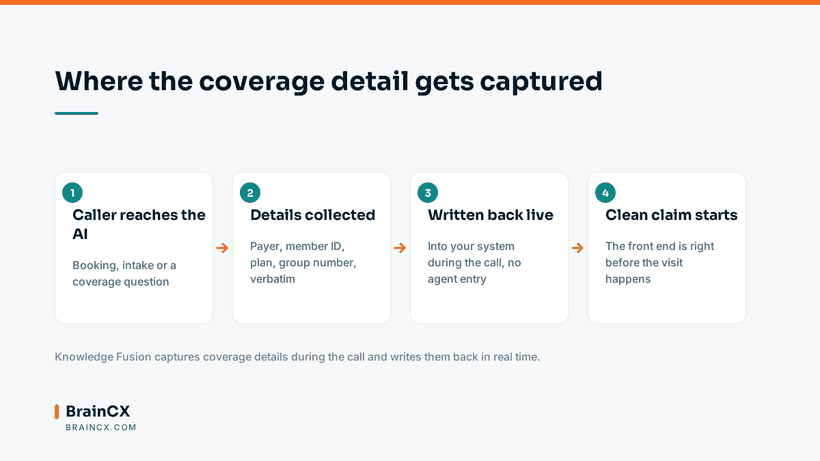
On the booking call. When a patient calls to schedule, the AI collects the payer, member ID, plan and group number as part of the same conversation. No separate verification step, no callback.
Verbatim capture. The detail gets taken exactly as the patient reads it, not paraphrased from memory after the call. Knowledge Fusion is tuned for this, including the plan names and ID formats that trip up a generic system.
Written back live. The coverage information lands in your system during the call, not at the end of the shift. There is no transcription step where a digit gets transposed.
A clean front end. By the time the visit happens, the coverage detail is already in the record and ready to verify against the payer. The claim starts clean because the intake was clean.
This is the Knowledge Fusion difference, and it is the part of the platform that does the most quiet work. Real-time form auto-fill during the call means your staff are not re-keying insurance details from a message queue. The data goes in once, correctly, while the patient is still on the line.
Keep the scope honest
This is an operations capability, not a compliance one. The AI captures coverage details and writes them back. It does not adjudicate claims, decide what a plan covers, or make a determination about a patient’s benefits. Those are different jobs, and they stay with your team and your payer.
What the AI removes is the data-entry gap, the place where a member ID gets written down wrong or never written down at all. That gap is where a large share of preventable denials are born.
Why operators build this differently
Most intake automation was built by people who have never worked a denial. They optimize for the clean call and ignore the one where the patient is reading a member ID off a photo of a card their spouse texted them.
The reality is that real intake calls are messy, and the messy ones are exactly where the errors come from. A system that only handles the tidy path hands every hard call back to a person, which is where the mistakes were happening in the first place.
Across BrainCX production calls, fewer than 1% of callers ever asked if they were speaking with AI. That comes from building for the hard calls, not the demo. Operator perspective, not developer perspective.
What to measure first
Pull your denial data for the last quarter and sort by reason code. Look at the share tied to eligibility, registration and patient data. If that slice is large, and for most groups it is, the front end is where your money is leaking.
Then look at how many of those denied claims were reworked versus written off. Reworking a denial costs staff time you could have spent not creating it. We cover the downstream side of this in voice AI and EHR write-back, and the payer-call side in AI for prior authorization calls.
BrainCX runs this as a managed deployment. We design it against your real intake calls, tune Knowledge Fusion to your payers and plan names, and operate it. Most clients go live in 4-6 weeks. You can see the platform modules that carry it, or how the same system handles patient scheduling.
I spent three decades on contact center floors before building this. The lesson that stuck was that the cheapest problem to fix is the one you catch at the front door. Eligibility is the front door. Catch it there.
Book a demo and hear it capture a real intake call.
Frequently asked questions
Can voice AI verify insurance eligibility during a patient call?
Voice AI captures the coverage details, payer, member ID, plan and group number, during the booking or intake call and writes them back to your system in real time. That gives your team accurate information to verify against the payer. The AI does not adjudicate claims or decide what a plan covers.
How do eligibility errors cause claim denials?
Industry data attributes 60% to 70% of denials to front-end errors including eligibility and patient data. When coverage is unverified or a member ID is captured incorrectly, the claim is more likely to be rejected and sent back for rework.
How much can accurate intake reduce denials?
Industry data indicates accurate intake alone can reduce denials by up to 30%, because a large share of denials trace back to front-end data problems that are preventable at the point of capture.
Does the AI decide what a patient’s plan covers?
No. The AI captures and records coverage details. It does not adjudicate claims, determine benefits, or decide what is covered. Those decisions stay with your team and the payer.
How does the coverage information get into our system?
Knowledge Fusion writes the captured details into your system during the call, so there is no separate data-entry step where a digit gets transposed or a message sits in a queue.
How quickly can this go live?
Most BrainCX deployments go live in 4-6 weeks, and simpler environments have gone live in as few as 3 weeks.