
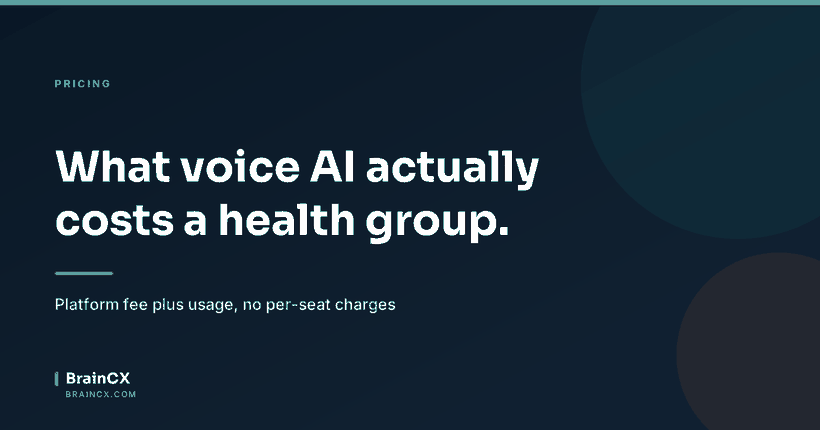
Here is the number most vendors will not put in writing. BrainCX runs on a platform fee plus usage, with no per-seat charges, and annual ACV lands between $15K and $175K depending on call volume and the modules you turn on.
That is the whole structure. Two line items. No seat licenses, no surprise metering, no quote that balloons the first busy month.
Most pricing pages in this category hide the number because the model is designed to grow on you. Per-minute billing looks cheap in the demo and gets expensive the moment real call volume shows up. So let me walk through what you are actually paying for, what moves the number, and why a managed model is priced the way it is.
Two ways voice AI gets priced
There are really two pricing models in this market, and they reflect two different products.
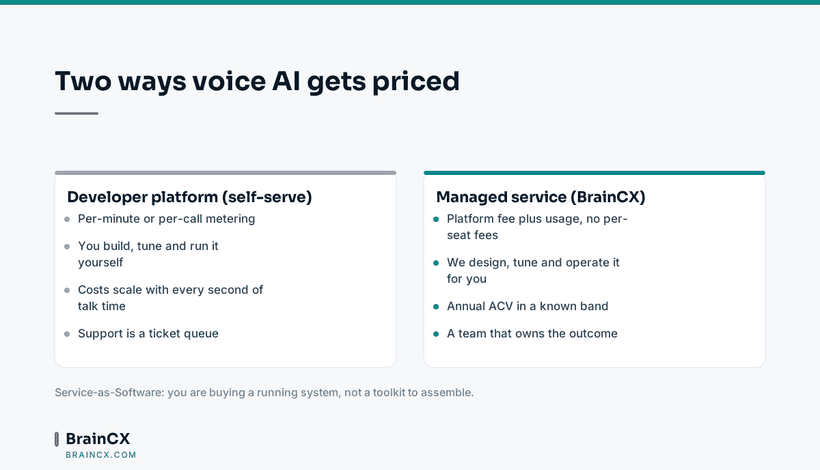
The developer platform. You buy access to a toolkit, billed per minute or per call, and you build, tune and run the thing yourself. The sticker looks low because the cost of making it work, your engineering time, your tuning, your maintenance, is not on the invoice. It is on your payroll. And the meter runs on every second of talk time, so your bill scales with your success.
The managed service. You buy a running system. We design it, tune it against your real calls, and operate it. You pay a platform fee plus usage, in a known annual band, and the team that owns the outcome is us, not a ticket queue. This is the Service-as-Software model, and it is a different purchase from a self-serve subscription.
The difference matters most at a multi-site group, because the self-serve model means building and maintaining the same thing at every location, or building it once and fighting to keep it consistent across all of them. The managed model deploys once and extends across the portfolio, which we cover in rolling out voice AI across a clinic platform.
What moves the number
Two things drive where you land in the range.
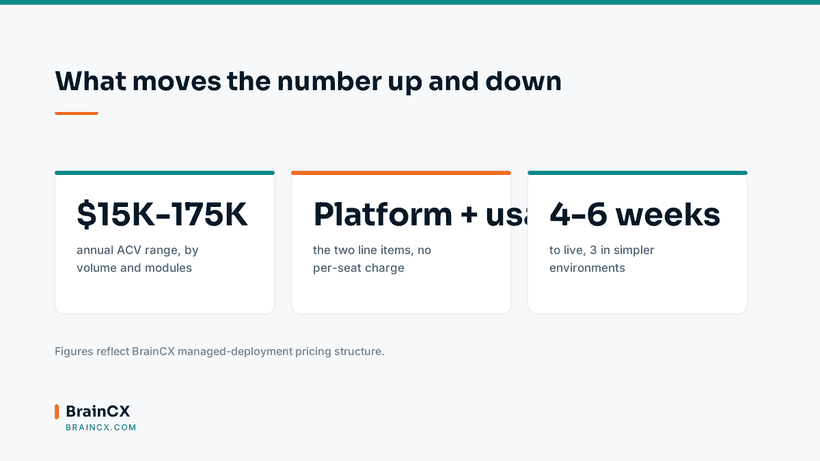
Call volume. More calls, more usage. This is the honest part of usage-based pricing, and it is the part that should scale with the value you are getting. A group handling tens of thousands of patient calls a month is a different deployment from a single clinic.
Modules. TrustVoice is the core. Add Knowledge Fusion for real-time write-back, AgentClone to replicate your best agent, Interpreterly for 40+ languages, SightLine for call analytics, and the number moves with the capability. You turn on what you need, not a bundle you do not.
What does not move the number is headcount. There are no per-seat fees, because you are not licensing software for people to operate. The system is the service.
Why managed costs what it costs
The fair question from a CFO is why not just buy the cheap per-minute platform and have the team run it.
The reality is that the per-minute platform is not cheaper once you count what it takes to run. Someone has to build the call flows, tune them against real calls, maintain them when a payer changes a phone tree, and fix them when a new call type shows up. At a multi-site group, that someone is a role, or several. The self-serve sticker price does not include that role. The managed price does.
And the thing you are actually buying is reliability on calls that matter. Across BrainCX production calls, fewer than 1% of callers ever asked if they were speaking with AI. That number does not come from a cheaper model. It comes from operators tuning the system against the messy, real calls that a self-serve buyer has to tune themselves. Operator perspective, not developer perspective.
What the number includes
A BrainCX deployment is not a license handoff. The platform fee covers the design, the tuning, the deployment and the ongoing operation. We go live in 4-6 weeks, and in as few as 3 in simpler environments. After launch, we keep tuning it, because a system that was right at launch drifts as your call patterns change.
So the comparison is not platform fee versus per-minute rate. It is the total cost of a running system versus the total cost of building and maintaining one yourself. For a multi-site group, the managed model is usually the lower number once the hidden line items are on the table. We lay out the full build-versus-buy case in managed voice AI vs self-serve platforms, and the broader cost comparison in voice AI vs outsourced call centers.
How to think about the budget
Start with your call volume and the two or three call types that cost you the most in staff time or lost revenue. That tells you which modules you need and roughly where in the range you land. Then compare that against what those calls cost you today, in staff hours, in abandoned calls, in denials, in no-shows.
The deployments that pay back fastest are the ones aimed at a specific, expensive problem, not a vague efficiency goal. A group losing revenue to unverified coverage or dropped rebookings knows exactly what the current cost is, which makes the pricing conversation simple.
BrainCX runs this as a managed deployment. We will scope it against your actual call volume and tell you where in the range you land before you commit. You can see the platform modules that make up a deployment.
I spent three decades running contact centers before building this, including the ones where the cheap tool turned out to be the expensive one. The number that matters is never the sticker. It is the total cost of the work getting done. Put every line item on the table, then decide.
Book a demo and we will scope the number for your group.
Frequently asked questions
How much does voice AI cost for a multi-site health group?
BrainCX pricing is a platform fee plus usage, with no per-seat charges. Annual ACV lands between $15K and $175K depending on call volume and the modules you turn on.
Does BrainCX charge per seat or per agent?
No. There are no per-seat or per-agent fees. You are buying a managed running system, not licensing software for people to operate. Pricing is the platform fee plus usage.
What drives the price up or down?
Call volume and modules. Higher call volume means more usage. Turning on modules such as Knowledge Fusion, AgentClone, Interpreterly or SightLine adds capability and moves the number. Headcount does not affect the price.
How is managed pricing different from a per-minute platform?
A per-minute platform bills for talk time and leaves you to build, tune and run the system. A managed service includes the design, tuning, deployment and ongoing operation in the platform fee, so the comparison is the total cost of a running system versus building and maintaining one yourself.
What does the platform fee include?
Design, tuning, deployment and ongoing operation. BrainCX goes live in 4-6 weeks, and in as few as 3 in simpler environments, and keeps tuning the system after launch as call patterns change.
How quickly can a deployment go live?
Most BrainCX deployments go live in 4-6 weeks, and simpler environments have gone live in as few as 3 weeks.