
A Spanish-speaking patient calls to book an appointment, and the front desk has to put them on hold to find an interpreter who may not be available. That pause is where the patient gives up, and where a health group loses them.
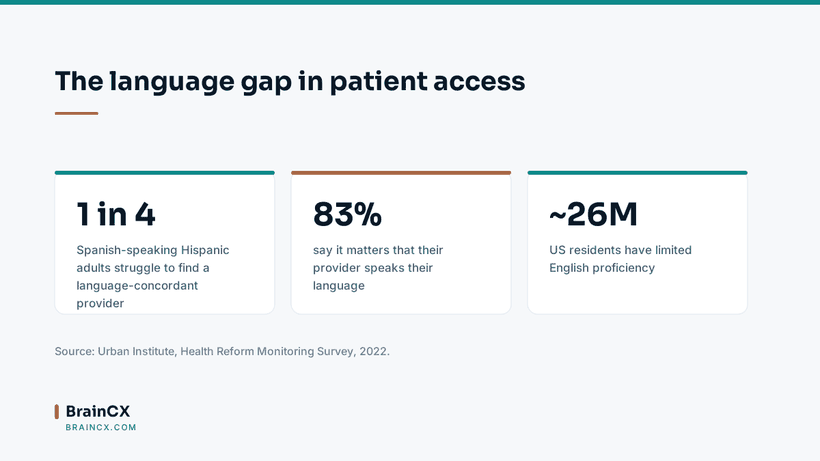
The gap is wide and well documented. Urban Institute research found that 1 in 4 Spanish-speaking Hispanic adults had difficulty finding a provider who speaks their language or offers translation. Eighty-three percent said it matters that their provider can. And roughly 26 million people in the US have limited English proficiency.
That is not an edge case. That is a standing share of the patient population that most phone systems are not built to serve.
Why the usual fix does not hold
Most groups handle language access with a three-way interpreter line. It works, when it works. But it adds a step to every call, and the step is the problem.
The patient waits while the front desk dials in an interpreter. The interpreter is shared across the whole organization, so sometimes there is a queue. Evening and weekend calls, when a lot of working patients actually call, are the hardest to cover. And ad hoc interpreters, a bilingual staff member pulled from another task, are linked to lower patient satisfaction, not higher.
So the patient who called to book a visit experiences the health system as hold music and a scramble. First impression, made.
One workflow, not a separate line
The better model is to handle the call in the patient’s language inside the same workflow, with no separate interpreter step.
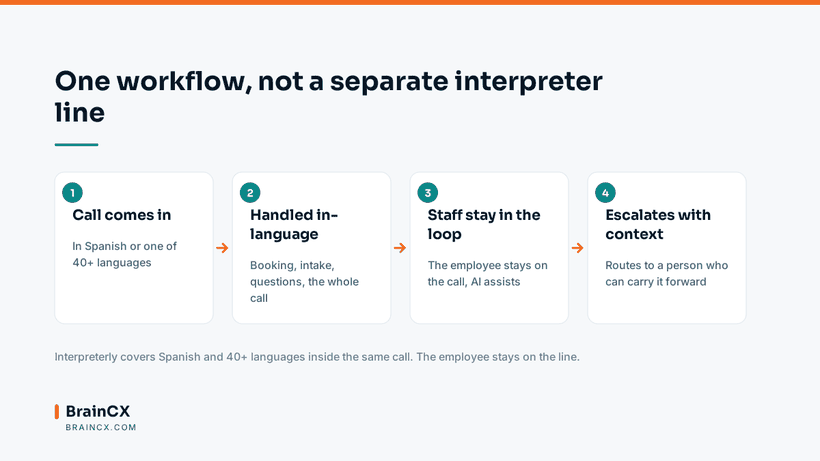
The call is handled in-language from the start. Interpreterly covers Spanish and 40+ other languages. A patient calling in Spanish books, reschedules, asks a question and completes the call in Spanish. No hold, no three-way dial-in.
It is the same system, not a bolt-on. The multilingual capability is part of the platform, so a Spanish-speaking patient gets the same booking, intake and scheduling the English-speaking patient gets. One workflow, every language.
The employee stays on the call. This is the line that matters, and it is not negotiable. The AI does not replace the human interpreter or the staff member. It gives your people the ability to serve a patient in a language they do not speak, with the employee staying on the line and in control. The technology is a force multiplier for your staff, not a substitute for them.
Escalation carries context. When a call needs a person, it routes to one with everything the patient has already said, so the patient does not start over in a language the next person may not speak either.
That last point about the employee staying on the call is the heart of how we think about this. Framing AI as a replacement for human language access is the wrong model, operationally and ethically. The right model is that your staff can now cover a call they could not cover before, without putting the patient on hold to go find someone.
Why operators build this differently
Language access is exactly the kind of thing that looks fine in a demo and breaks on a real call. A patient reads a member ID with a regional accent. Somebody switches between Spanish and English mid-sentence. A family member takes the phone. A generic system stumbles on all of it.
The reality is that real multilingual calls are messy in ways a scripted demo never shows, and the mess is where trust is won or lost. A system built by people who have actually run patient-facing phone lines handles the switch, the accent, the handoff, because those are the calls it was tuned on.
Across BrainCX production calls, fewer than 1% of callers ever asked if they were speaking with AI. That holds across languages, because the system was built from the science of human communication, not bolted together from a translation API. Operator perspective, not developer perspective.
What to look at first
Pull your call data and estimate the share of calls that arrive in a language other than English, and how many of those currently get completed on the first call versus held, transferred or abandoned. Most groups have never measured this, and the abandoned-call number is usually higher than anyone wants it to be.
Then look at when those calls come in. If a meaningful share land in the evening or on weekends, when interpreter coverage is thinnest, that is where the losses concentrate, and that is where in-language handling pays back fastest. We cover the after-hours side of this in after-hours patient calls, and the intake side in AI for eligibility verification calls.
BrainCX runs this as a managed deployment. We design it against your real calls, tune it to your patient population, and operate it. Most clients go live in 4-6 weeks. You can see the platform modules that carry it.
I spent three decades on contact center floors, a lot of them serving callers in more than one language. The thing I learned is that a patient decides whether they trust you in the first ten seconds of the call, and a scramble for an interpreter spends that trust before the conversation starts. Give the patient a conversation in their language from the first word. That is the whole game.
Book a demo and hear it handle a call in Spanish.
Frequently asked questions
Can voice AI handle patient calls in Spanish and other languages?
Yes. Interpreterly covers Spanish and 40+ other languages inside the same workflow. A patient calling in Spanish can book, reschedule, complete intake and ask questions in Spanish, with no separate interpreter line.
Does the AI replace human interpreters?
No. The AI gives your staff the ability to serve a patient in a language they do not speak, with the employee staying on the call and in control. It is a force multiplier for your people, not a replacement for human language access.
Why is this better than a three-way interpreter line?
A three-way line adds a step to every call, the patient waits while an interpreter is dialed in, and coverage is thinnest in the evenings and on weekends. In-language handling completes the call in one workflow with no hold and no scramble.
How many patients does this affect?
Urban Institute research found 1 in 4 Spanish-speaking Hispanic adults had difficulty finding a language-concordant provider, and 83% said it matters that their provider speaks their language. Roughly 26 million people in the US have limited English proficiency.
What happens when a multilingual call needs a person?
The call routes to a staff member with the full context of what the patient has already said, so the patient does not have to start over.
How quickly can this go live?
Most BrainCX deployments go live in 4-6 weeks, and simpler environments have gone live in as few as 3 weeks.