
A call that ends with a note someone has to retype is not automation. It is a voicemail with extra steps. If your voice AI books an appointment and then hands a staff member a message to key into the chart, you have moved the work, not removed it.
The whole point of voice AI in a contact center is that the record is updated by the time the call ends. The patient says what they need, the system structures it, and it lands in your EHR, your CRM and your telephony stack in real time. No transcription, no end-of-day reconciliation, no transposed digit.
This is the question every evaluation-stage buyer asks first, and rightly so. Before anyone cares what the AI can say, they need to know what it can write to.
What live write-back actually means
Write-back is the difference between a system that talks and a system that works. Here is what happens to the chart during a call.
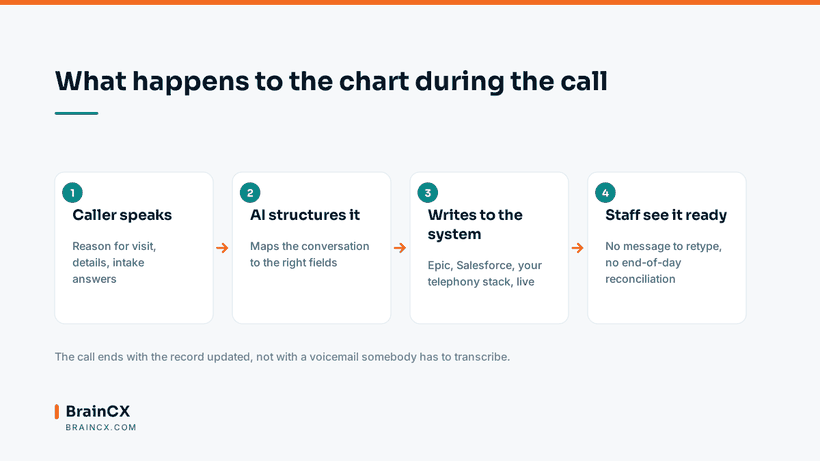
The patient speaks. Reason for visit, insurance details, intake answers, the appointment they want. A normal conversation.
The AI structures it. Knowledge Fusion maps the conversation to the right fields, not a block of transcript somebody has to parse. The member ID goes in the member ID field. The appointment reason goes where your schedulers expect it.
It writes to your systems. The structured data lands in Epic, Salesforce or your telephony stack while the call is still live, through Telephony and CRM Connect.
Staff see it ready. When your team looks at the record, the work is done. There is no message to retype, no queue of voicemails to clear before the day starts.
That last part is the whole return. The expensive, error-prone step in most call operations is a human re-keying what a patient said into a system after the call. Live write-back removes that step, which is where a lot of the data errors were coming from in the first place.
What is live, and what is on the roadmap
Buyers in evaluation want the real list, not the aspirational one. Here is where BrainCX stands
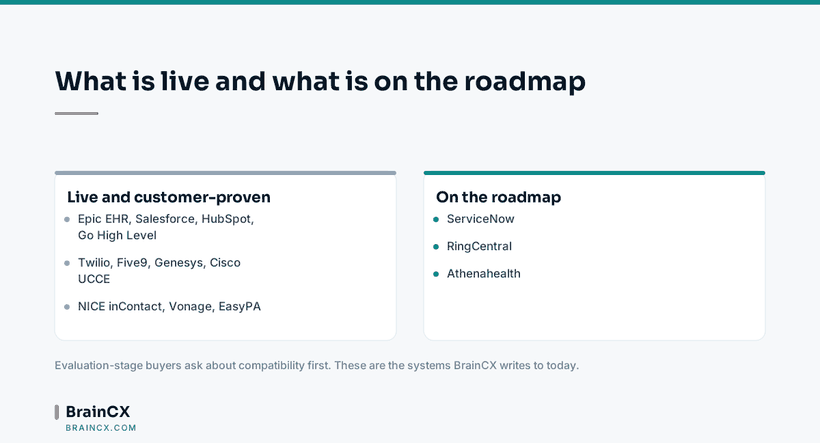
Live and customer-proven today: Epic EHR, Salesforce CRM, HubSpot, Go High Level, Twilio, Five9, Genesys, Cisco UCCE, NICE inContact, Vonage and EasyPA.
On the roadmap, not yet live: ServiceNow, RingCentral and Athenahealth.
I am drawing that line on purpose. A vendor that lists every system as if it were live is a vendor you will discover the truth about during implementation, which is the worst possible time. The systems above are the ones BrainCX writes to today, in production, for real clients.
Why this is harder than it looks
Any system can read from an API. Writing to a clinical or CRM system correctly, during a live call, while the conversation is still going, is a different problem. The field mapping has to be right. The timing has to be right. And it has to handle the call where the patient changes their mind halfway through and the record has to change with them.
The reality is that write-back is where most voice AI quietly fails. It demos a clean booking and then, in production, drops a malformed note into the wrong field, or writes nothing and leaves a message for staff. That is the failure that turns a time-saver into extra work.
Across BrainCX production calls, fewer than 1% of callers ever asked if they were speaking with AI, and the reason the write-back holds up is the same reason the conversation does. It was built by people who have run these systems, not people who read the API docs. Operator perspective, not developer perspective.
Keep the scope clear
The AI captures and writes operational data: appointments, reason for visit, coverage details, intake answers. It does not make clinical entries, diagnoses or care decisions, and it does not alter clinical records beyond the structured fields it is scoped to write. Your clinicians own the chart. The AI handles the front-desk data that was being keyed in by hand.
Your technical team will want to review exactly which fields the system writes to and how the mapping is configured before it goes live. That review is part of a BrainCX deployment, not an afterthought.
What to check first
Ask your current process one question. When a patient call ends, how does what the patient said get into your systems. If the honest answer is that a staff member types it in later from a message, you have found both your error source and your time sink.
Then look at how often those re-keyed entries are wrong, the transposed member ID, the appointment booked in the wrong provider’s schedule, the intake field left blank. Those errors have downstream costs, in denials and in rework, that we cover in AI for eligibility verification calls. The pricing of a full deployment is laid out in what voice AI costs a multi-site health group.
BrainCX runs this as a managed deployment. We design the field mapping with your technical team, tune it against your real calls, and operate it. Most clients go live in 4-6 weeks. You can see the platform modules that carry it.
Three decades on contact center floors taught me that the most expensive minute in any call operation is the one after the call ends, when a person retypes what was already said. Close that gap, and the whole operation gets faster and more accurate at the same time. That is what write-back is for.
Book a demo and see it write to a real system.
Frequently asked questions
Does voice AI write back to our EHR during the call?
Yes. BrainCX structures the conversation through Knowledge Fusion and writes the data to your systems in real time through Telephony and CRM Connect, so the record is updated by the time the call ends rather than left as a message for staff to retype.
Which EHR and CRM systems does BrainCX integrate with?
Live and customer-proven today: Epic EHR, Salesforce, HubSpot, Go High Level, Twilio, Five9, Genesys, Cisco UCCE, NICE inContact, Vonage and EasyPA. ServiceNow, RingCentral and Athenahealth are on the roadmap and not yet live.
Does the AI make clinical entries in the chart?
No. The AI captures and writes operational data such as appointments, reason for visit, coverage details and intake answers. It does not make clinical entries, diagnoses or care decisions. Clinicians own the chart.
Why does write-back matter more than the conversation?
A call that ends with a note someone has to retype moves the work instead of removing it. Live write-back removes the manual re-keying step, which is where many front-desk data errors originate.
Can we control which fields the AI writes to?
Yes. The field mapping is configured with your technical team as part of the deployment, and your team reviews exactly which fields the system writes to before it goes live.
How quickly can this go live?
Most BrainCX deployments go live in 4-6 weeks, and simpler environments have gone live in as few as 3 weeks.