

What does voice AI for telehealth actually handle?
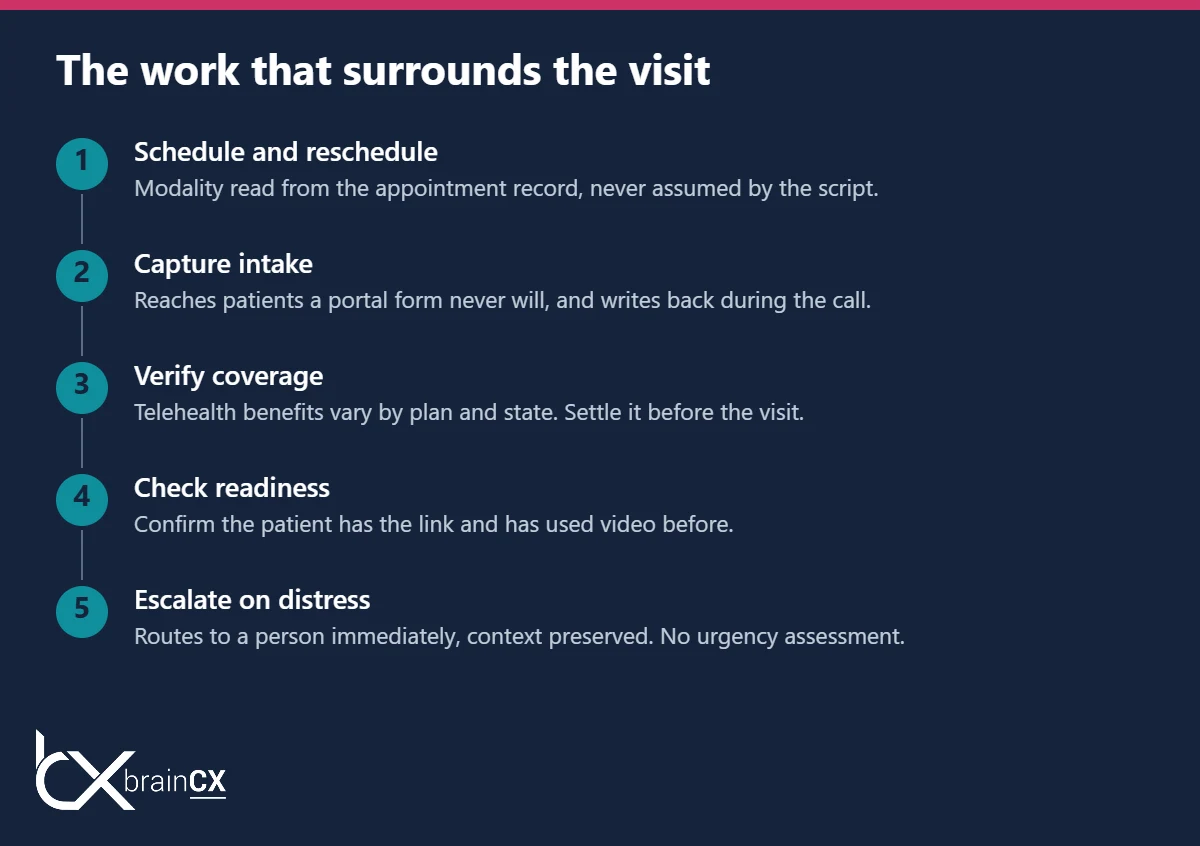
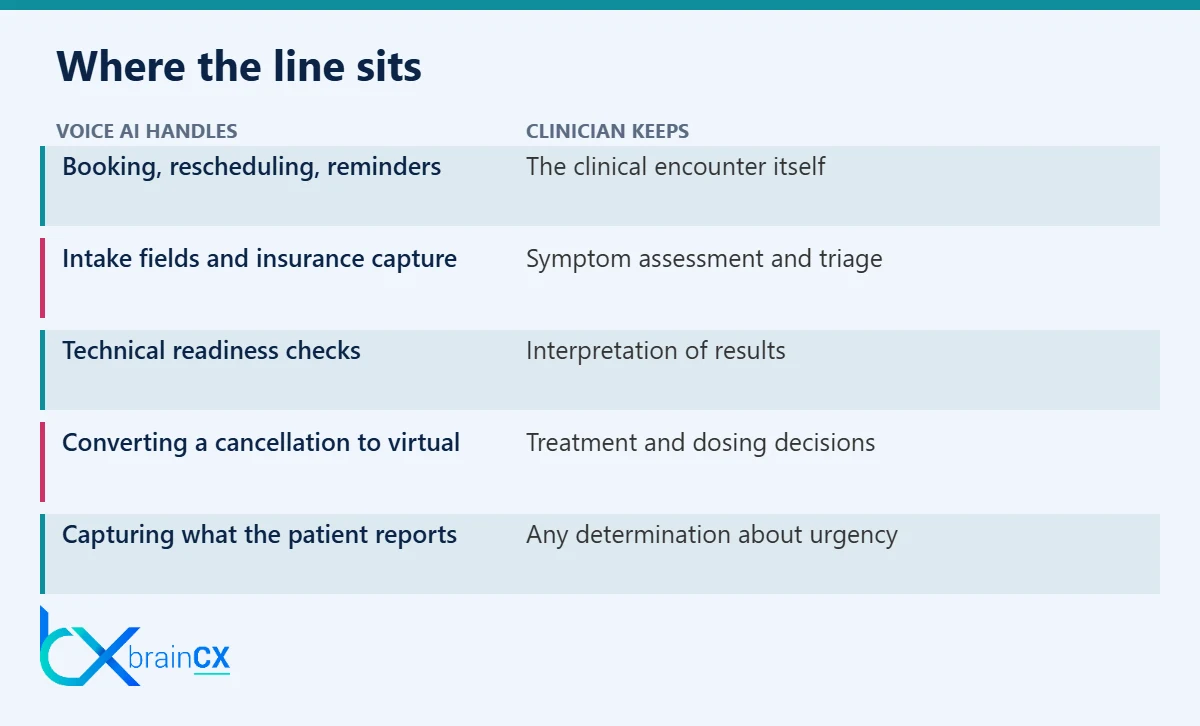
Voice AI for telehealth handles the work that surrounds the visit rather than the visit itself: scheduling, rescheduling, intake data, insurance capture, technical readiness checks, and the reminder sequence that decides whether the patient shows up. The clinical encounter stays with the clinician.
Telehealth programs tend to invest heavily in the video platform and lightly in the phone line that fills it. That imbalance is where the no-show rate comes from.
The visit nobody attended
A telehealth no-show looks different from a clinic no-show. The patient did not forget to drive somewhere. They clicked a link that did not work, or they never received it, or they were not sure whether the appointment was still on, or they could not find the portal password and gave up rather than calling.
Each of those failures is a phone call that did not happen. A reminder call that confirms the appointment, checks the patient has the link, and asks whether they have used video with your organization before will surface a technical problem while there is still time to fix it.
That is a scripted, repetitive, high-volume call, which is to say it is the kind of call that never gets staffed. Reminder programs get built, run for a quarter, and quietly stop when the team that was making the calls gets pulled onto intake.
Intake is the real prize
A telehealth visit with incomplete intake becomes a clinician spending the first third of the appointment collecting information a form should have gathered. On a fifteen-minute behavioral health follow-up, that is a material share of the encounter.
Voice intake solves this differently from a portal form, because it works for the patients a portal form does not reach. Patients without reliable broadband, patients who do not use the portal, patients who are more fluent speaking than typing, and patients in a language the portal does not offer all complete a phone conversation when they will not complete a web form.
The capture has to land in the record during the call to be worth anything. A voice agent that fills the intake fields and the insurance details while the patient is still on the line removes a step rather than relocating it, which is the same mechanic described in EHR write-back and in eligibility verification during intake.
Coverage verification belongs in the same call. Telehealth benefits vary by plan and by state, and a patient who finds out at the visit that the modality is not covered is a cancelled appointment and an angry call afterwards.
Behavioral health is the sharpest case
Behavioral health moved to telehealth faster and further than most specialties, and its scheduling pattern is unusually sensitive. Appointments are frequent, often weekly, and a single missed session can break a treatment sequence rather than cost one slot.
The intake conversation is also where risk shows up. Any voice agent operating in this setting needs an escalation path that triggers on distress signals and routes to a human immediately, with context preserved. That boundary is not negotiable and it is not a model setting; it is call-flow design, and it is the same discipline that governs behavioral health intake generally.
BrainCX’s escalation logic routes uncertain or sensitive calls to a person with full context rather than leaving the caller to repeat themselves. BrainCX was built by CX operators, not AI tourists, and that handoff behaviour is the part operators insist on first.
Where the clinical line sits
The agent does not assess symptoms, triage urgency, interpret results, or advise on treatment. It captures what the patient says and routes.
That distinction matters more in telehealth than in a clinic, because the patient is often calling instead of walking into a waiting room where a nurse would see them. The call flow has to assume the phone is the only channel and route conservatively because of it.
BrainCX is never positioned as a medical or clinical decision-maker, and no content or deployment should imply otherwise.
Multi-state programs and language
A telehealth group operating across several states is running several regulatory environments at once, and the phone workflow has to reflect that. Which modality is covered, what consent language is required, and which clinician is licensed where are all call-flow variables rather than footnotes.
Language access is the other multiplier. A telehealth program serving a Spanish-speaking population cannot staff bilingual intake across every hour the platform is open. BrainCX supports 40+ languages with real-time Spanish inside the same workflow, and the positioning holds throughout: the employee stays on the call and the AI gives them reach they did not have, as set out in multilingual patient access.
Compliance, stated plainly
Telehealth calls carry protected health information, so a voice vendor is a business associate and requires a business associate agreement under 45 CFR 164.502(e).
BrainCX is HIPAA compliant and operates under a signed BAA. SOC 2 Type II is in process. Those are distinct claims and procurement should treat them as distinct; the full procurement question list covers what else to ask.
Outbound reminder calls also sit under the TCPA, and the consent revocation rules changed on November 25, 2026 under FCC 26-67. Any reminder program running on a consent record needs to handle revocation in the new scope.
The hybrid problem
Most telehealth is not a telehealth program. It is a hybrid schedule where the same patient has in-person visits and virtual ones, sometimes with the same clinician in the same week.
That makes the phone workflow harder rather than easier, because the reminder, the preparation instructions, and the arrival logic differ by modality while the patient experiences one relationship. A reminder that tells a patient to arrive fifteen minutes early for a video visit has undermined the whole program’s credibility.
Modality therefore has to be a variable the agent reads from the appointment record, not an assumption baked into a script. The same call flow then handles both, and the patient hears one organisation rather than two.
Conversion between modalities is the other piece. A patient who cannot attend in person often can attend virtually, and the reschedule conversation is the moment to offer it. A front desk under pressure cancels; an agent with the rules can convert, which turns a lost slot into a kept one.
What to measure
Telehealth no-show rate separated from in-person no-show rate. Reporting them together conceals which problem you have.
Share of virtual visits where intake was incomplete at the start of the encounter, which is the clinician-time measure and the one clinicians will confirm immediately.
Technical failure rate at the start of the visit, and how many of those were preventable by a readiness call.
Reschedule-to-virtual conversion rate on in-person cancellations.
Portal completion rate against phone completion rate for the same intake, which usually makes the case for voice capture on its own.
Then compare all of it against the broader no-show pattern, because telehealth tends to be assumed more convenient and therefore better attended, and in many programs it is not.
This article describes operational practice and published federal requirements as of November 2026 and is not legal advice. Telehealth coverage, consent, and licensure rules vary by state and should be confirmed with counsel.
Frequently asked questions
Does voice AI for telehealth conduct the visit?
No. It handles scheduling, rescheduling, intake, insurance capture, readiness checks, and reminders. The clinical encounter stays with the clinician.
How does it reduce telehealth no-shows?
By making the reminder call a real conversation rather than a text, confirming the patient has the link, and surfacing a technical or coverage problem while there is still time to resolve it.
Can it complete intake for patients who do not use the portal?
Yes, and that is the main advantage over a web form. Patients without reliable broadband, without portal access, or more comfortable speaking than typing will finish a phone conversation they would abandon online.
What happens if a patient is in distress?
Escalation triggers on distress signals and routes to a human immediately with the context already captured. The agent does not assess urgency.
Does it verify telehealth coverage?
Insurance and eligibility capture happen during the same call and write back to the record, which is what prevents a patient discovering at the visit that the modality is not covered.
What about multi-state programs?
Licensure, consent language, and covered modality differ by state and are handled as call-flow variables rather than a single national script.
How does it handle hybrid schedules?
Modality is read from the appointment record rather than assumed, so the same call flow produces the right reminder, preparation instructions, and arrival logic for in-person and virtual visits without the patient hearing two different organisations.
Can it convert a cancelled in-person visit to a virtual one?
Yes, and that is one of the clearer wins. A front desk under pressure tends to cancel, while an agent holding the modality rules can offer the virtual alternative during the same conversation and keep the slot.
What languages are supported?
40+ languages with real-time Spanish inside the same workflow, which matters more in telehealth because there is no waiting room where a bilingual staff member might intervene.