

Is AI for collections calls allowed under the FDCPA and Regulation F?
Yes. The Fair Debt Collection Practices Act and Regulation F apply to an automated call exactly as they apply to a human one. There is no AI exemption and no AI prohibition. AI for collections calls is governed by the same frequency presumptions, disclosure requirements, and time-of-day restrictions that already govern the floor.
What changes is not the rulebook. It is how reliably the rulebook gets followed at volume.
The metric that runs the floor
Right-party contact is the share of calls that reach the person who actually owes the debt. Everything downstream depends on it. Promise-to-pay rates, liquidation, and agent productivity are all functions of how often the right person picks up.
Collections operations attack this with volume, which is where the compliance exposure comes from. More dials against a bad list raise frequency exposure without raising contact, because the problem was never the number of attempts. It was the timing, the number, and whether anyone is home.
A voice agent changes the economics of the attempt rather than the strategy. An attempt that costs almost nothing can be made at the hour the person is most likely to answer rather than the hour the dialler happens to reach them, and an attempt that reaches a wrong number or a voicemail consumes no agent time at all.
That last point is worth sitting with, because it is the same reason voicemail stopped being a useful contact channel in any contact center: a message left is not a contact made, and the operations that depend on it are measuring activity rather than outcome.
What Regulation F actually requires
This is the part most summaries get wrong, and getting it wrong in either direction is costly.
Regulation F is the Consumer Financial Protection Bureau’s rule implementing the FDCPA. It took effect November 30, 2021. The frequency provision sits at 12 CFR § 1006.14.
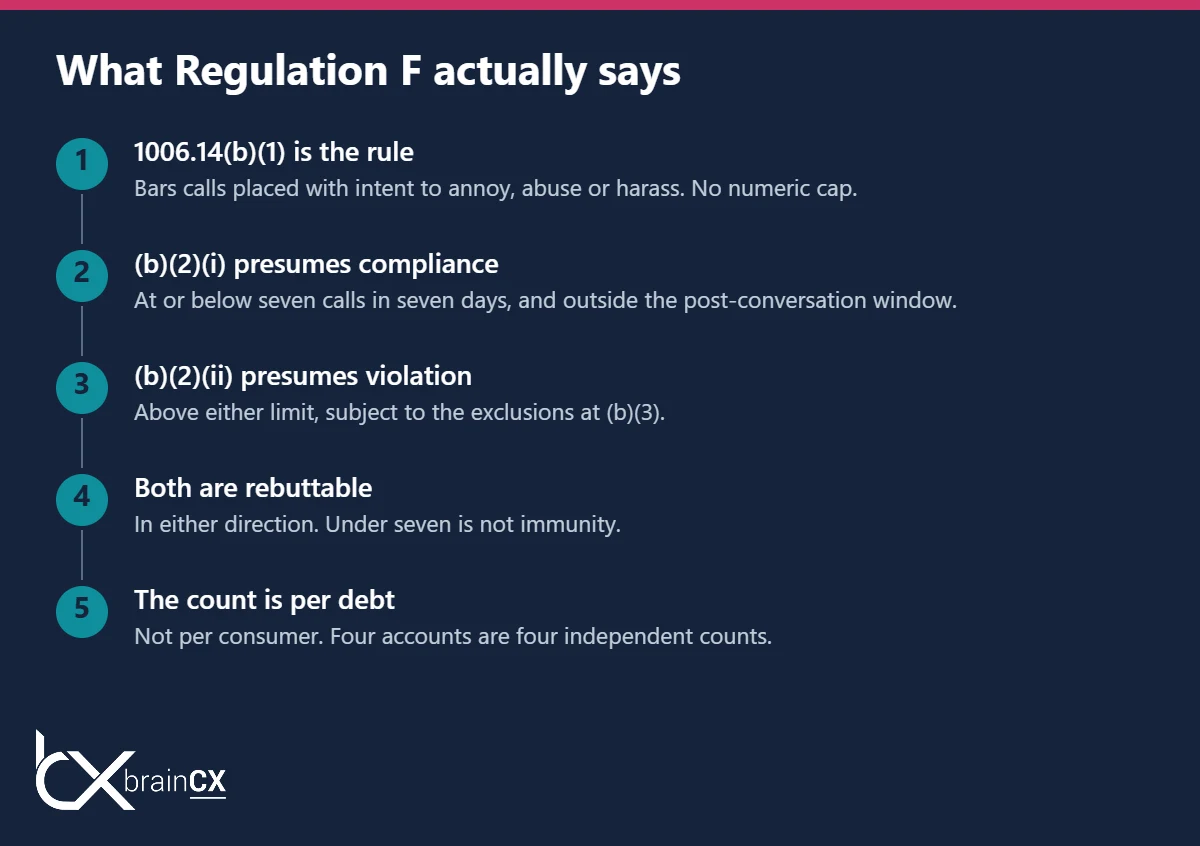
Paragraph (b)(1) is the operative prohibition and it sets no numeric cap. It bars placing calls repeatedly or continuously with intent to annoy, abuse, or harass.
Paragraph (b)(2)(i) creates a presumption of compliance, not a hard limit. A collector is presumed to comply where calls to a person about a particular debt are neither more than seven times within seven consecutive days, nor placed within seven consecutive days after a telephone conversation with that person about that debt.
Paragraph (b)(2)(ii) creates the mirror presumption of violation when either limit is exceeded, subject to the exclusions at (b)(3).
Both presumptions are rebuttable in either direction. Staying under seven does not immunise a campaign whose pattern is harassing for other reasons, and exceeding seven is not automatically a violation.
And the count is per debt, not per consumer. Under (b)(4), “particular debt” means each of a consumer’s debts in collection, with the stated exception that student loans serviced under a single account number count as one debt. A consumer with four accounts in collection is four separate frequency counts.
That per-debt distinction is the one most campaign tools have no concept of, and it is the one a voice platform has to model explicitly.
The other obligations in the same call
Time of day is statutory. The FDCPA at 15 U.S.C. § 1692c(a)(1) presumes it inconvenient to call before 8:00 a.m. or after 9:00 p.m. in the consumer’s local time, which makes the consumer’s time zone a call-flow variable rather than an assumption.
Disclosure is required. The mini-Miranda under § 1692e(11) has to appear, and a voice agent has to deliver it reliably on every call rather than when a script is followed correctly.
Limited-content messages are a safe harbour with precise contents, defined at 12 CFR § 1006.2(j). A voicemail that goes beyond that definition risks a third-party disclosure problem under § 1692c(b).
Then the TCPA sits on top of all of it. An AI-generated voice is an artificial or prerecorded voice under FCC Declaratory Ruling 24-17, so prior express consent is required for covered calls, and the consent revocation rules at 47 CFR § 64.1200(a)(10) changed on November 25, 2026 under FCC 26-67, published at 91 FR 67214.
Why automation helps compliance rather than threatening it
A human agent follows the disclosure script correctly most of the time. A platform that cannot physically place a call outside the window, cannot exceed a per-debt frequency count, and cannot omit the mini-Miranda follows it every time.
That is the argument that lands with a chief compliance officer, and it is the opposite of the argument most vendors make. The value is not that the calls get cheaper. It is that the rules become structural instead of behavioural.
It is also why BrainCX is delivered as a managed service rather than a platform handed over at signing. A frequency rule encoded once and never revisited drifts as campaigns change, and someone has to own that drift; the BrainCX platform’s compliance and governance layer exists for exactly that reason, and the documented TCPA practices sit alongside it.
Frequency counting per debt, time-zone gating, disclosure delivery, and revocation capture are all things a system does better than a person under pressure at the end of a shift. BrainCX was built by CX operators, not AI tourists, and anyone who has managed a collections floor knows exactly which of those four fails first when the month-end target is behind.
Where the human stays
Hardship conversations, disputes, settlement authority, and anything where the consumer becomes distressed route to a person. The agent captures context and hands it over rather than making the caller start again.
The positioning holds here as everywhere: the AI gives agents reach and consistency they did not have, and the agent stays in the conversation that requires judgement. BrainCX is not positioned to make determinations about a consumer’s account.
The same real-time write-back that matters in patient intake matters here, because a promise to pay, a dispute, or a revocation that lands in a call summary someone reads tomorrow is a compliance gap rather than a record.
What to check before deploying
Confirm the platform counts frequency per debt rather than per consumer, and ask to see it demonstrated against a multi-account test record.
Confirm the consumer’s local time zone drives the calling window, derived from something more reliable than area code.
Confirm the mini-Miranda is delivered on every call by the platform and not by a prompt that a model may paraphrase.
Confirm voicemail content is constrained to the limited-content definition.
Confirm revocation is captured during the call, scoped correctly under the November 2026 rules, and written back immediately.
Right-party contact is a data problem before it is a dialling problem
The reason contact rates are low is usually that the phone numbers are wrong, stale, or belong to someone else. No calling strategy fixes a bad number, and calling a reassigned number repeatedly creates exposure rather than recovery.
A voice agent helps here in a way a dialler does not, because every call produces structured information about the number itself. Whether a person answered, whether they confirmed being the right party, whether they said the number was wrong, and whether they identified themselves as someone else are all capturable outcomes rather than disposition codes an agent selects under time pressure.
That is the cleanest operational gain available. A list that improves with every pass raises right-party contact without raising attempt volume, which is the only way to raise it without raising compliance exposure at the same time.
Wrong-number handling deserves its own flow. A person who says they are not the debtor should be removed promptly and recorded as such, and that outcome should propagate to every campaign rather than to the one that reached them.
What the compliance officer should ask to see
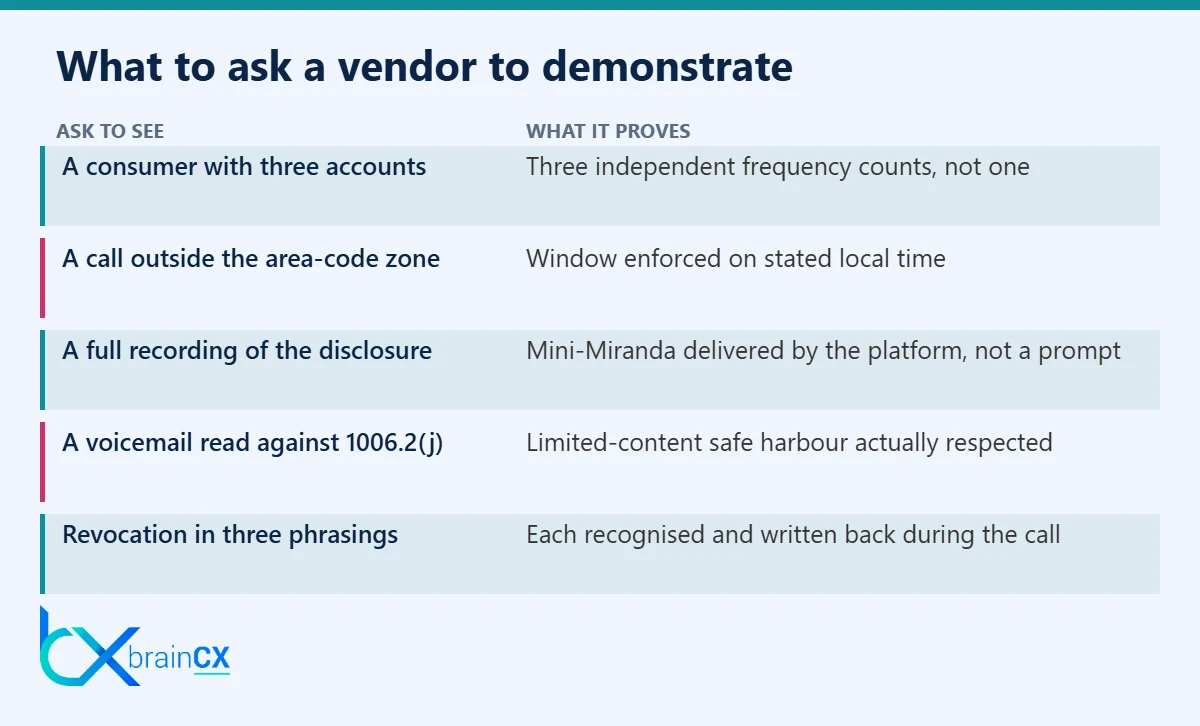
A demonstration, not a policy document. Specifically: a test consumer with three accounts, showing three independent frequency counts rather than one.
A call placed against a consumer whose stated local time zone differs from their area code, showing the window enforced on the former.
A full call recording of the mini-Miranda being delivered, with the platform rather than a prompt responsible for it.
A voicemail left under the limited-content definition, read against 12 CFR § 1006.2(j) line by line.
A revocation spoken in three different phrasings, each recognised and each written back during the call.
If a vendor can show those five, the compliance conversation is substantially over. If the answer to any of them is that it depends on configuration, that is the answer: the obligation lives in configuration rather than in the platform, and configuration drifts.
This article describes published federal regulations as of November 2026 and is not legal advice. The FDCPA, Regulation F, and the TCPA interact with state collections statutes, and your counsel should review any automated calling program before deployment.
Frequently asked questions
Does the FDCPA apply to AI voice agents?
Yes, in full, wherever it would apply to a human collector making the same call. There is no AI carve-out in the statute or in Regulation F.
Is seven calls in seven days a hard limit?
No. 12 CFR § 1006.14(b)(2)(i) creates a rebuttable presumption of compliance below that frequency and (b)(2)(ii) a rebuttable presumption of violation above it. The operative prohibition at (b)(1) is intent-based and sets no numeric cap.
Does the frequency limit count per consumer or per debt?
Per debt. Under (b)(4), each of a consumer’s debts in collection is counted separately, except that student loans serviced under one account number count as a single debt.
What about calling hours?
The FDCPA presumes calls before 8:00 a.m. or after 9:00 p.m. in the consumer’s local time to be inconvenient, so the platform must gate on the consumer’s time zone.
Does TCPA consent apply as well?
Yes. An AI voice is an artificial or prerecorded voice under FCC 24-17, so covered calls need prior express consent, and the revocation rules changed on November 25, 2026.
Who handles disputes and hardship calls?
A person. The agent captures the context and routes, and does not exercise settlement authority or decide a dispute.