

How does AI for referral scheduling close the gap between referral and appointment?
AI for referral scheduling calls the patient as soon as the referral is created, books the specialty or imaging appointment while the patient is on the phone, captures the insurance and clinical details the receiving department needs, and writes it all back to the record. The failure it prevents is the referral that sits in a work queue until the patient has forgotten about it.
Referral leakage is usually described as a network problem. It is mostly a phone problem.
Where referrals die
A primary care clinician enters a referral. It lands in a work queue at the receiving department, or in a central scheduling team’s queue, or in a basket nobody owns. Someone is supposed to call the patient.
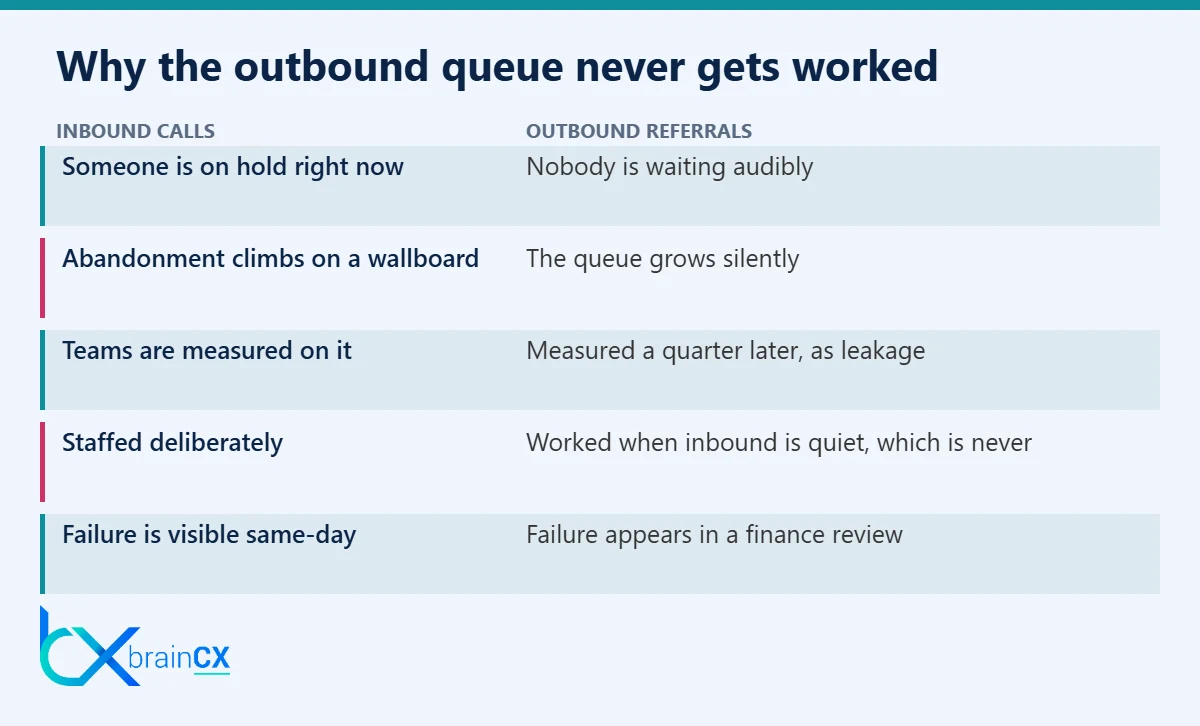
That call competes with every inbound line. Scheduling teams are measured on the calls they answer, so outbound referral work is what happens when inbound is quiet, which in a busy department is never. The referral ages.
Meanwhile the patient is waiting to be called. They were told the specialist’s office would be in touch. After a week or two they either call to chase it, which adds inbound volume, or they conclude it was not urgent, or they go somewhere that answered faster.
Imaging has the same pattern with tighter timing. An order for a scan has a clinical window, and a scan that slips outside it means the ordering physician is managing a patient without the information they asked for.
Why outbound is the hard part
Inbound call handling is a solved operational problem. Staff it, measure abandonment, improve it, as covered in reducing call abandonment across multi-site groups.
Outbound referral work is harder because it has no natural pressure. Nobody is on hold. There is no abandonment rate climbing on a wallboard. The queue grows silently, and the only signal is a leakage number that arrives a quarter later in a finance review.
A voice agent removes the competition entirely. The outbound call happens the moment the referral is created, because there is no queue to wait behind and no staffing decision to make. That immediacy is the entire mechanism, and it is the same one that makes speed-to-lead work in a completely different industry.
What the call has to collect
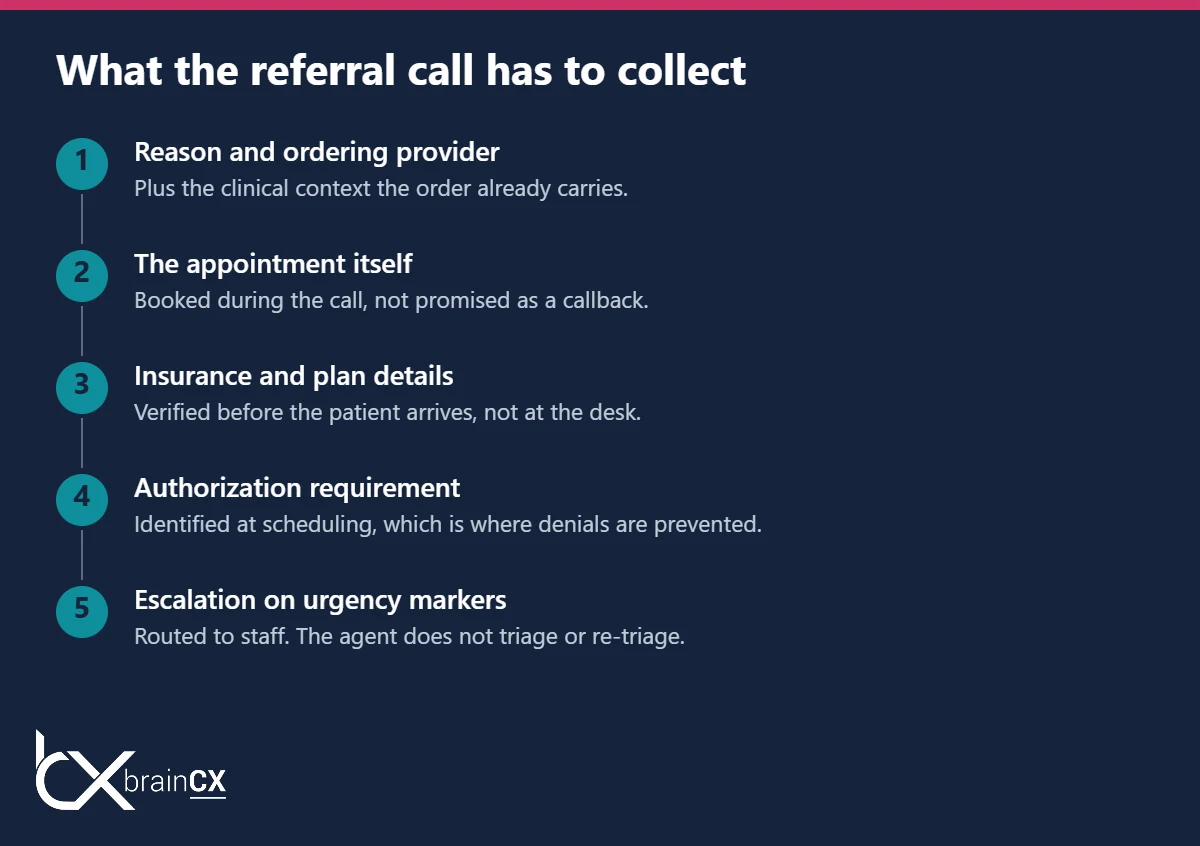
A referral appointment needs more than a time slot. The receiving department needs the reason for referral, the ordering provider, the relevant clinical context the order carries, insurance and plan details, and whether a prior authorization is required.
That last one is where referral scheduling and prior authorization work meet. A specialty appointment booked without a required authorization becomes a cancelled appointment or a denied claim. Identifying the requirement during the scheduling call is the difference between a clean visit and a rework cycle.
Coverage verification belongs in the same conversation, for the same reason it belongs in intake generally. A patient who learns at the imaging centre that the scan is not covered is a cancellation, a bad experience, and a complaint call.
All of it has to write back during the call. A referral conversation that produces a summary someone retypes into the scheduling system has moved the work rather than removed it, which is the point of real-time write-back to Epic and the rest of the stack.
What stays with clinical staff
The agent does not assess urgency, re-triage a referral, or decide whether a scan is appropriate. Those are clinical determinations and they stay with clinicians.
Where a referral carries urgency markers, the call flow escalates to staff rather than scheduling against a standard template. A voice agent that books an urgent referral into a routine slot because the script did not distinguish them has caused the harm the automation was meant to prevent.
BrainCX is never positioned as a clinical or coverage decision-maker. The agent captures, books, verifies, and routes.
Multi-site and multi-specialty
A single specialty practice can work its referral queue by hand. A health system with twenty specialty departments and three imaging sites cannot, because the queue is distributed across teams with different templates, different authorization requirements, and different capacity.
Centralising the outbound call without centralising the scheduling rules is what makes this tractable. One voice workflow reaches every referred patient; the booking rules stay with the department. That is the same structural pattern that makes voice AI worth deploying across multi-site dental groups and clinic platforms rather than one location at a time.
BrainCX was built by CX operators, not AI tourists. Referral leakage is a problem operators recognise immediately and that software vendors usually describe as a network integrity initiative, which is how it stays unsolved for years.
What to measure
Time from referral creation to first outbound attempt. This is the number that predicts everything else and most systems do not report it.
Share of referrals with zero outbound attempts after seven days.
Conversion from referral to scheduled appointment, and separately from scheduled to attended.
Share of specialty appointments cancelled for missing authorization, which is the rework measure.
Language distribution of referred patients against the hours bilingual staff are available, because the gap there is usually larger than anyone expects and BrainCX covers 40+ languages inside the same workflow, as described in multilingual patient access.
The leakage argument finance will accept
Referral leakage is normally presented to a finance committee as a network integrity initiative, which is a phrase that has never moved a budget. The phone framing is more persuasive because it is measurable.
Start with the referrals created in a period. Count how many were contacted, how many were scheduled, and how many attended. The drop between created and contacted is the phone problem, and it is almost always the largest single step in the sequence.
Then attach the downstream value of the specialty or imaging encounter the organisation did not perform. That figure belongs to your finance team rather than to a vendor, and it should come from your own case rate rather than an industry benchmark.
The comparison that follows is straightforward. The cost of contacting every referred patient immediately, against the margin on the encounters currently lost between creation and contact. In most multi-site organisations that comparison is not close, which is why the framing matters more than the technology.
Why this is outbound-first, not a portal feature
The common alternative is to push scheduling into a patient portal and let the patient book themselves. That works for the patients who use the portal, and it fails for the ones who generate the leakage.
Self-scheduling also struggles with the parts of a referral that need judgement about the booking rather than the medicine: which sub-specialty, which location, whether an authorization is needed, whether a prior scan has to be retrieved first. A patient cannot reasonably be asked to resolve those, and a portal that asks them to produces incorrect bookings that a scheduler has to unwind.
An outbound conversation resolves all of it in one pass, and it reaches the patients a portal never will. The two are complements rather than alternatives, and the organisations that get this right run both.
This article describes operational practice and is not clinical or legal advice. Referral triage and scheduling protocols should be set by your clinical leadership, and payer authorization requirements confirmed with your revenue cycle team.
Frequently asked questions
What does AI for referral scheduling do that a work queue does not?
It makes the outbound call immediately rather than when a scheduling team has capacity, which is the variable that decides whether the patient is still engaged when someone finally calls.
Does it book the appointment during the call?
Yes. The appointment, the clinical context, the insurance details, and any authorization requirement are captured and written back while the patient is on the line.
Can it handle imaging orders as well as specialty referrals?
Yes, and imaging is often the sharper case because scans carry a clinical window that a delayed call can push the patient outside of.
Does it decide whether a referral is urgent?
No. Urgency markers escalate to clinical staff. The agent does not triage or re-triage.
How does it reduce cancellations for missing prior authorization?
By identifying the authorization requirement during the scheduling call rather than after the appointment has been booked, which is where most of that rework originates.
Does it work across multiple departments with different rules?
The outbound conversation is centralised while booking rules stay with each department, which is what makes this deployable across a system rather than a single practice.
Is this a replacement for patient self-scheduling?
No, a complement. A portal serves the patients who use it and misses the ones who generate the leakage, and it also struggles with referral decisions that need judgement about the booking, such as which sub-specialty or whether a prior scan must be retrieved first.
What should we measure first?
Time from referral creation to first outbound attempt, and the share of referrals with no attempt after seven days. Those two numbers usually carry the business case without further argument.
How long does deployment take?
4 to 6 weeks for a managed deployment, and as little as 3 weeks in simpler environments.