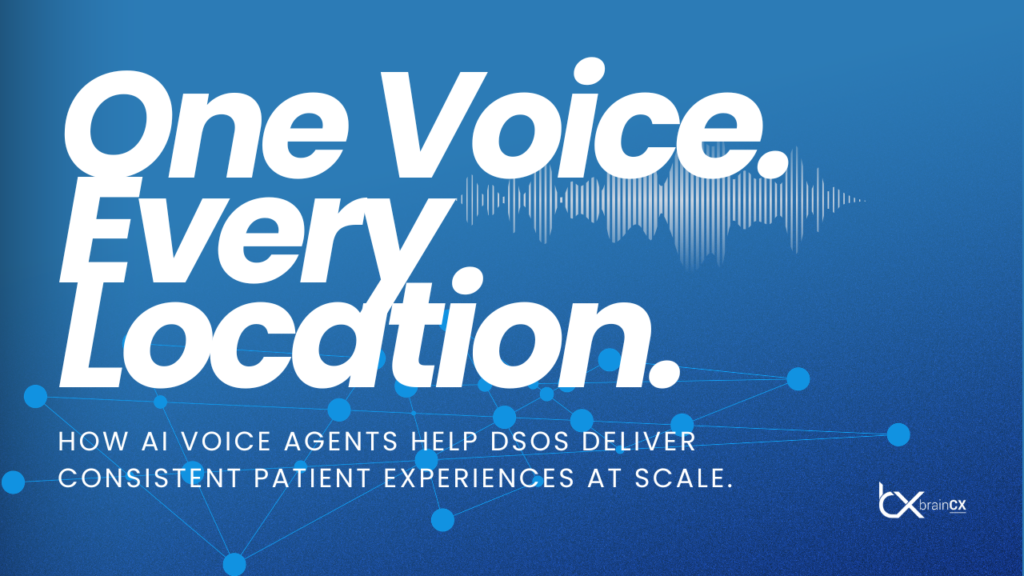
Running one dental office is a phone problem you can solve with staffing. Running fifteen across three states is a systems problem. Each location has its own front desk and its own schedule. Each has a different after-hours protocol. The patient experience changes depending on which office someone calls. A receptionist calls in sick at location seven. There is no backup. Location twelve gets buried at lunch, and the phones ring out. Corporate asks how many new-patient calls the group missed last month. Nobody has the exact number.
The shift toward group ownership continues to grow. The ADA Health Policy Institute reports DSO affiliation among US dentists reached roughly 16 percent in 2024. This is double the level in 2015. More than one in four dentists within ten years of graduation now work with a DSO. As groups consolidate, the phone becomes an operations metric. This guide is for the DSO operations lead. You need every location answered consistently without adding headcount.
What is an AI phone agent for a DSO?
An AI phone agent is a voice-first system. It answers patient calls in natural speech. It qualifies the caller and books or reschedules the appointment. It handles routine questions and routes to a person when a call requires human intervention. For a single practice, this acts as a receptionist substitute. For a DSO, it provides one standardized voice layer across every location. It routes patients to the correct office and connects to each site’s practice management system. It gives leadership a single view of the phones group-wide.
This distinction matters. A single-office tool stretched across a group creates automated fragmentation. A DSO-grade agent is built for multi-location complexity from day one. It handles cross-location routing and per-location configuration under corporate standards. It provides multi-PMS integration and centralized analytics. Operations leads must hold vendors to this standard.
Why the DSO phone problem compounds
What is manageable at one office becomes a crisis at ten. The drivers stack differently for a group.
- Missed calls multiply. Industry analyses put dental missed-call rates around a third of inbound calls during peak hours. Across twenty locations, that is thousands of lost patient contacts a year. The patient rarely tries again. Most call the next practice on the list.
- No cross-location backup. A busy office cannot lean on a quiet sister site ten miles away. Calls pile up and abandon locally even when the group has spare capacity.
- Inconsistent experience. One office answers warmly on the first ring. Another lets it ring eight times. Brand standards exist on paper and nowhere else.
- No visibility. Without a centralized view, leadership cannot see which locations miss the most calls. They cannot measure the cost in booked production.
The revenue math is real. Each new patient a group fails to reach represents years of care. CareCredit quantifies this in its Dental Lifetime of Care study. A missed new-patient call is far more expensive than the empty slot it looks like on the schedule.
Centralized vs per-location deployment
The first architectural choice is whether one AI system handles all locations or each site runs its own instance. Most groups land on a hybrid approach. Here is the tradeoff an operations lead must weigh.
The first architectural choice is whether one AI system handles all locations or each site runs its own instance under a central management layer. Most groups land on a hybrid. Here is the tradeoff an operations lead is actually weighing.
| Model | Best when | Watch out for |
|---|---|---|
| Centralized | One AI handles every location; unified voice, one dashboard, one place to update scripts and protocols | More complex routing logic; risk of misidentifying the target office; harder to reflect location-specific nuances |
| Per-location | Each office gets its own instance, number, and PMS connection; easy local customization | More instances to manage; configuration drift between sites; harder cross-location scheduling |
| Hybrid (common) | Per-location handling and PMS connections, under a central layer for analytics, templates, and group-wide updates | Requires a vendor that genuinely supports both layers, not a single-office tool with a reporting bolt-on |
The practical answer for most groups with ten to fifty locations is the hybrid model. The question to ask a vendor is how they keep configuration consistent as you add locations.
Intelligent cross-location routing keeps patients in the network
The most valuable DSO capability is routing a patient to the right office. When a caller reaches the group line or their preferred location is booked, the voice AI platform weighs several factors at once. It offers a real alternative rather than a dead end.
- Geographic proximity. A patient in one neighborhood is not booked across town.
- Provider availability. A patient who wants a specific dentist is routed to wherever that provider is working that week.
- Appointment type. Not every office offers every service.
- Insurance network. The alternative location accepts the patient’s plan.
A human receptionist at a single office cannot see schedules at other locations. The voice bot can. It uses that visibility to capture patients who would otherwise be lost to the group.
Consistency and PMS integration across every site
Standardization is where groups struggle most. An AI layer answers every location on the first ring. It delivers the same greeting and runs the same intake questions. It follows the same emergency triage protocol regardless of which office the patient dials. The brand experience becomes predictable.
Integration is the harder half. A group that grew by acquisition often runs different practice management systems at different sites. The agent must read and write to each location’s system in real time. An appointment it books must appear on the schedule exactly as a staff-booked one would. Patient details captured on the call must flow into the record without manual re-entry. Confirm the integration is direct and covers the specific systems your group runs.
Compliance: HIPAA, BAA, and TCPA for outbound
For a group, compliance is managed at the system level. A patient-facing voice agent must operate under a signed Business Associate Agreement. It must encrypt data in transit and at rest. It must restrict each location to its own patient data with audit logging across the system.
One area the category glosses over is outbound calling. Recall and reactivation campaigns fill schedules. These are outbound calls. This brings TCPA into scope alongside HIPAA. BrainCX is HIPAA-compliant, TCPA certified, and fully GDPR and CCPA compliant. We operate under a signed BAA. Our SOC 2 Type II audit is currently in progress. All third-party vendors are SOC 2 certified.
The Operator Plus Advantage: Managed service vs software
Most tools in this category hand you software and a short onboarding. They leave the configuration and ongoing optimization to your team. A DSO rarely has spare bandwidth to absorb this across every location.
BrainCX is an operator-led platform. We are not a tech startup. Tariq Alinur brings 30+ years of contact center leadership to the architecture of our solutions. Operator Plus is our managed enterprise platform. Operators who spent decades running contact centers own the deployment, the agent design, and the continuous optimization. It is built from the science of human communication.
This model fits the PE-backed portfolio reality of modern dental groups. Land the agent at one group and prove the metrics. BrainCX reduces call abandonment up to 40 percent and lowers average handle time over 50 percent. Then extend the same managed deployment across the portfolio one location at a time. Typical implementation runs four to six weeks. Simpler environments launch in three weeks. Our platform pricing ranges from a $15K to $175K annual ACV with no per-seat fees.
A vendor evaluation checklist for DSO operations leads
Cut through the sales pages by asking every vendor the same questions.
- Do you support a hybrid model with per-location handling and centralized analytics?
- Can you route across locations by proximity, provider, appointment type, and insurance?
- Do you integrate directly with every PMS our group runs?
- Do you sign a BAA and how do you handle TCPA for outbound recall calls?
- When a call needs a person, do you warm-transfer with full context?
- Is this software we configure, or a managed service you deploy and optimize for us?
- What does a phased rollout across all our locations look like?
A phased rollout that de-risks the whole group
Do not flip a switch across every location at once. The rollouts that succeed build confidence with data first.
- Pilot two or three locations that represent different realities. Pick one high-volume site, one with staffing gaps, and one strong control. Establish baseline metrics before anything changes.
- Run the pilot for at least 30 days. Capture different weeks and patient cycles. Review call transcripts weekly and adjust configuration.
- Compare pilot results to baseline on every metric. Build the ROI case from your own numbers.
- Scale in waves of a few locations at a time using the refined template. Once proven, each new location takes days of setup.
The most common cause of a failed rollout is staff resistance. Frame the agent as the tool that handles the calls front-desk teams dislike. It handles after-hours, overflow, and insurance questions so they can focus on the patients in front of them.
Frequently asked questions
1. How is an AI phone agent for a DSO different from a single-office AI receptionist?
A single-office tool handles one front desk. A DSO-grade agent works across locations. It routes patients to the right office and connects to each site’s practice management system. It applies corporate standards while allowing local configuration. It gives leadership one dashboard across the whole group.
2. Should a DSO choose centralized or per-location AI?
Most groups with ten or more locations use a hybrid approach. This means per-location handling and PMS connections for accuracy alongside a central layer for analytics. Pure-centralized is simpler to manage but harder to tailor per office. Pure per-location customizes well but risks configuration drift.
3. Can one AI voice agent work across different PMS platforms?
Yes, if the vendor supports it. Groups that grew by acquisition often run several practice management systems. The agent must read and write to each one in real time. Confirm the integration is direct before you commit.
4. Is AI phone handling HIPAA compliant for a dental group, and what about TCPA?
It must operate under a signed BAA with encryption in transit and at rest. Because recall and reactivation are outbound calls, TCPA also applies. BrainCX is HIPAA-compliant, TCPA certified, and signs a BAA. Our SOC 2 Type II audit is currently in progress.
5. How long does a multi-location rollout take?
Plan a phased rollout with a 30-day pilot at a few locations. Then deploy in waves. With BrainCX, typical implementation runs four to six weeks. Simpler environments launch in three weeks. Our deployment is managed so your team is not configuring it alone.
6. Will an AI voice agent replace our front-desk staff?
In most deployments, it augments them. The agent handles overflow, after-hours, lunch coverage, and routine scheduling. Front-desk staff focus on in-office patients and complex insurance conversations.
7. How do we measure ROI across the group?
Baseline each pilot location first. Track missed-call rate, booking conversion, after-hours capture, and cross-location referral success by site. Build the case from your own data and use the pilot to set expectations before you scale.
See it handle a real call
The fastest way to judge an AI voice agent for your group is to hear it run a realistic patient scenario. You need to see how it routes across locations and books into your schedule. Book a demo to see how BrainCX works across your DSO’s locations. Visit braincx.com to read the operator story behind our healthcare AI solutions.