
Every enrollment team has a set of calls that are important, time-sensitive, and often the first to slip when the week gets busy. Waitlist activation and yield calls to admitted students are the clearest examples. They directly move enrollment numbers, they have to happen inside a narrow window, and they are exactly the calls a stretched team never gets all the way through. The result is a predictable, quiet loss: seats that might have been filled and admitted students who drifted, simply because nobody had time to call.
This is not a motivation problem or a talent problem. It is a capacity problem. When admissions counselors are buried in application review and inbound questions, proactive outbound calling is the work that slips. A voice AI phone agent exists to make sure those calls actually get made, at volume, in the window, so your team’s judgment is spent on the conversations that need a human rather than on dialing.
Why these are the calls that always get cut
Waitlist and yield calls share three traits that push them to the bottom of the list, and those same three traits are why automating them pays off.
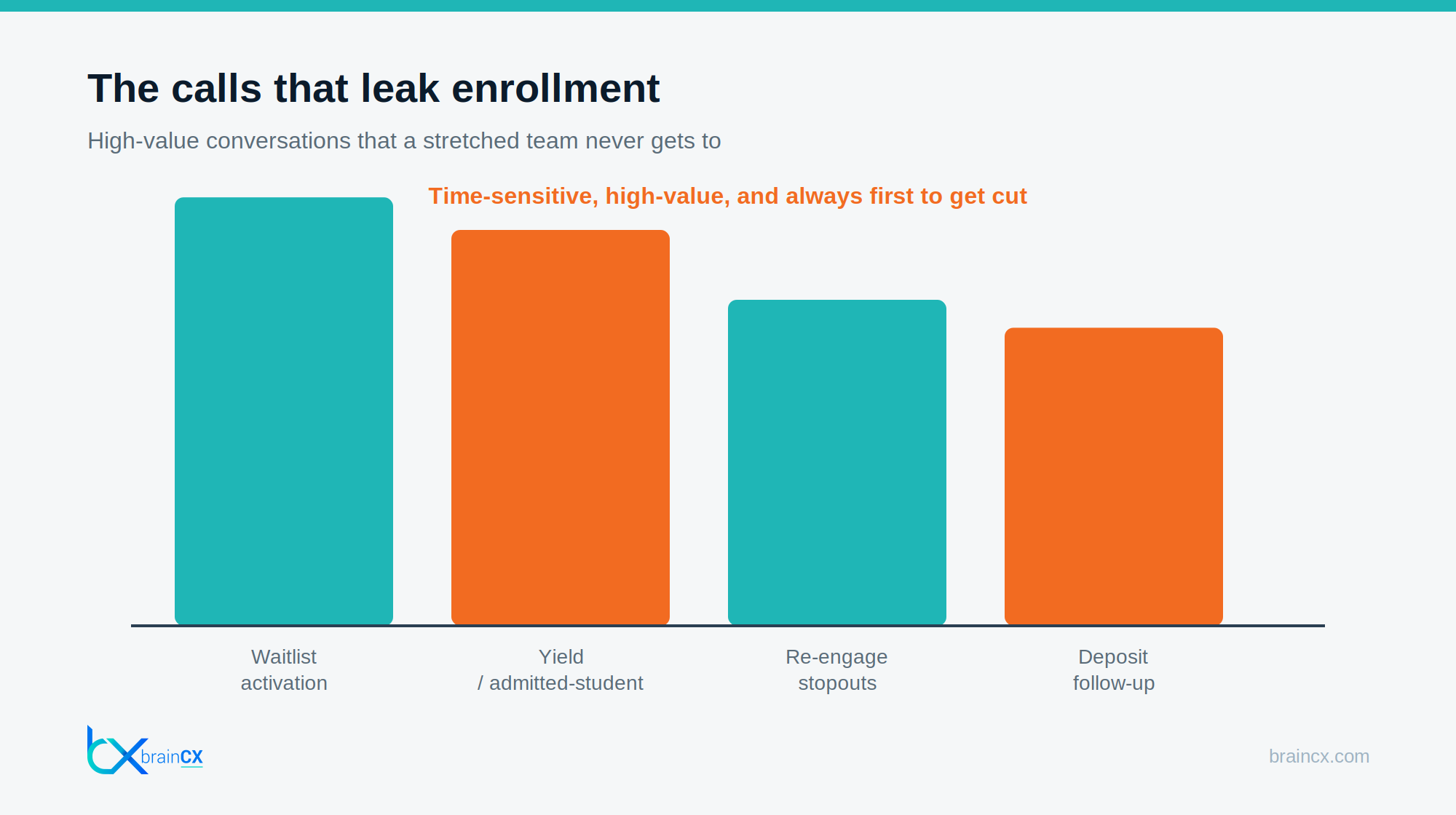
- They are outbound. Inbound calls announce themselves by ringing. Outbound calls require someone to decide to make them, and that decision loses to whatever is already on fire.
- They are time-boxed. A waitlist moves in days once seats open. A yield call matters most right after admission. Miss the window and the value is gone, not deferred.
- They are high-volume relative to staff. There are always more admitted and waitlisted students than counselors have hours, so the list never gets fully worked.
What is actually at stake now
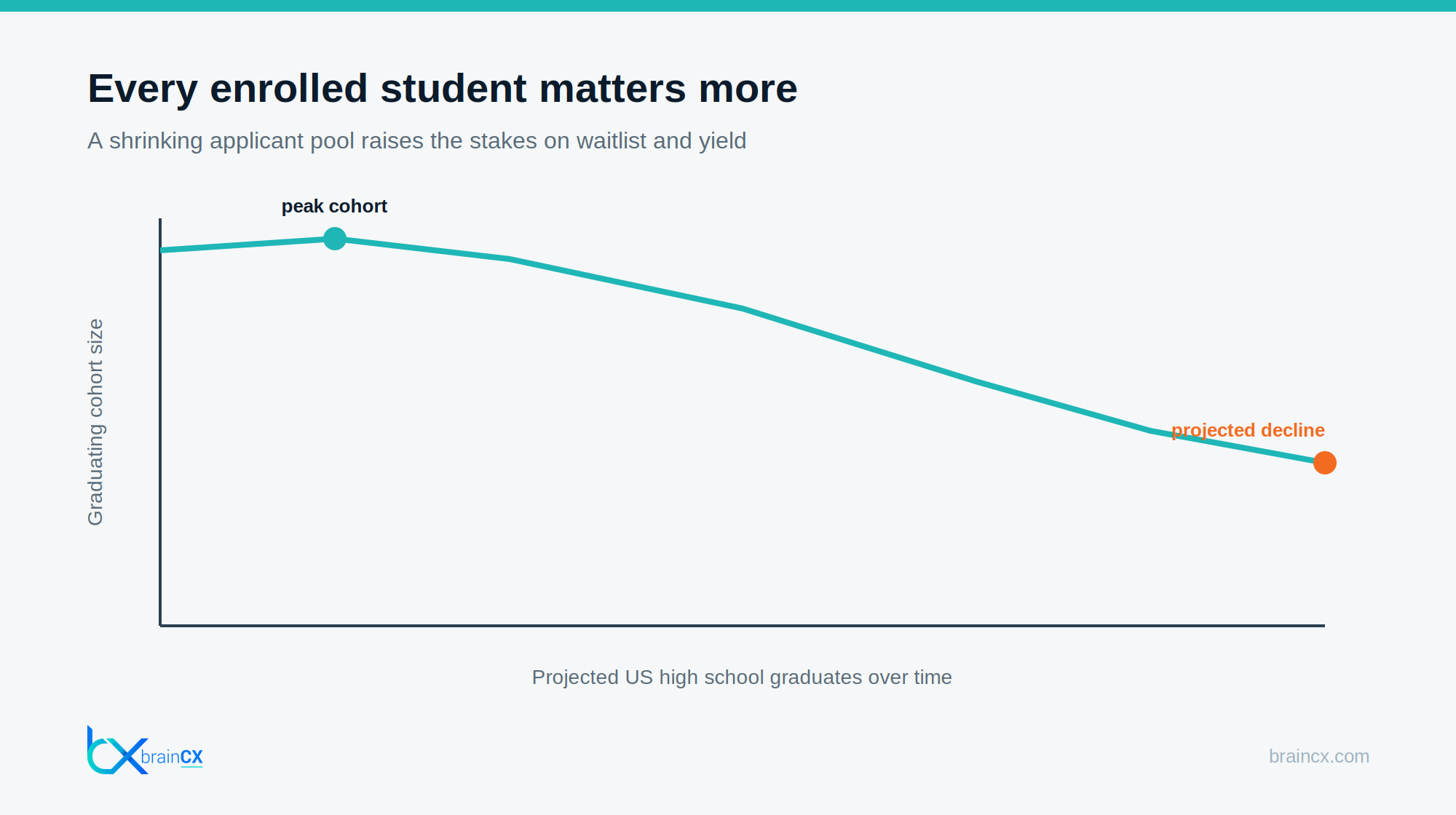
The cost of leaving these calls undone is rising, because the pool of traditional-age students is shrinking. The class of 2025 was among the largest US high school graduating cohorts on record, and projections point downward from here through the late 2030s and into the 2040s. You can see the underlying projections in the WICHE report on high school graduate projections. When the applicant pool contracts, every admitted and waitlisted student you already have is worth more, and every one you let drift is harder to replace.
What a voice agent does with waitlist calls
Activates the waitlist the moment seats open
When spots become available, the agent calls waitlisted students immediately, confirms continued interest, and moves the interested ones to the next step. Speed here is everything, because a waitlisted student is often holding another offer. Calling within hours instead of days is the difference between filling the seat and losing it.
Qualifies interest so counselors do not chase dead ends
Not every waitlisted student is still interested. The agent finds out quickly, so your counselors spend their time only on students who are genuinely in play rather than working down a stale list by hand.
Runs the whole list, not just the top of it
A human team gets through the first slice of a waitlist and runs out of hours. An agent calls all of it, so a student near the bottom of the list gets the same prompt, professional call as the student at the top.
What a voice agent does with yield calls
Yield is the stretch between admission and enrollment, and it is won by staying in contact. The agent runs the yield cadence, congratulating admitted students, answering the questions that decide their choice, and nudging the next step, in the same proactive way that voice follow-up stops summer melt between deposit and day one. Yield and melt are the same discipline applied at two points in the funnel: keep talking to the student so silence never makes the decision for them.
Answers the deciding questions fast
Admitted students compare offers on aid, program specifics, housing, and start logistics. The agent answers those immediately and consistently, so a question never sits unanswered long enough to become a reason to choose elsewhere.
Escalates the real conversations to counselors
When an admitted student is genuinely wavering or has a complex concern, the agent routes them to a counselor with the full context attached. The warm handoff in the BrainCX platform means the counselor picks up already knowing the situation and can focus entirely on winning the student, not on gathering background.
Why this belongs to automation, not more hiring
You could try to solve the waitlist and yield calls by hiring seasonal staff, but the volume is spiky and the window is short, so you would be training people right as the peak passes. A voice agent absorbs the spike without the hiring cycle, which is a core reason enrollment teams move to a managed voice AI service rather than a self-serve tool: the program is built and tuned for your cadence and simply runs when the window opens. This is also the BrainCX position in plain terms, the goal is to give your counselors capacity, not to replace them. The agent makes the calls nobody had time for so the humans can have the conversations that actually need them.
The math that makes this urgent
Put a simple frame on the loss. A waitlist that never gets fully worked leaves seats unfilled, and an unfilled seat is not a one-time miss; at a tuition-driven institution it is lost revenue across the entire time that student would have been enrolled. Multiply a handful of unfilled seats and a few dozen admitted students who drift by the lifetime value of each, and the annual cost of these uncalled conversations runs well into the millions at many institutions. None of that loss shows up as a line item, which is exactly why it persists: no one is billed for the call that never happened.
Against that, the economics of making the calls are straightforward. The inquiries and admits are already generated and already paid for. The only thing standing between them and enrollment is a timely conversation. Recovering even a fraction of the waitlist and yield conversions that currently go unmade is among the highest-return moves in the entire enrollment operation, because there is no new acquisition cost attached to it.
The one-to-many angle for systems and portfolios
If you run enrollment across several campuses or a system office, waitlist and yield calling multiplies, and so does the payoff. One deployment can run the cadence for every campus rather than one tool per office, the same portfolio logic that makes voice AI attractive for community colleges and multi-campus systems.
How to stand up a waitlist and yield program
Making these calls happen reliably is a matter of setup, not heroics. Decide the triggers first: the moment seats open for the waitlist, and the point after admission where yield contact begins. Tie the agent’s cadence to those triggers so calls fire automatically rather than waiting for someone to remember. Then define the escalation rules, in which wavering or complex students go to a counselor, and load the questions admitted and waitlisted students actually ask so the answers are accurate and consistent.
From there it runs on its own, with weekly reviews. The conversation data tells you which objections are costing you students and where the cadence needs adjusting, so the program gets sharper each cycle. The team’s role shifts from making hundreds of calls to reviewing what the calls surface and stepping in on the ones that need a human, which is a far better use of experienced counselors than working down a list by hand.
Frequently asked questions
1. Why do waitlists and yield calls get neglected?
They are outbound, time-boxed, and high-volume relative to staff. Inbound calls announce themselves; outbound calls require someone to choose to make them, and that choice loses to more urgent work. So the list never gets fully worked.
2. Can a voice agent handle waitlist activation fast enough?
Yes, that is its strength. When seats open, it calls waitlisted students within hours instead of days, confirms interest, and advances the interested ones, which is often the difference between filling a seat and losing it to another offer.
3. Does automating yield calls replace admissions counselors?
No. The agent runs the proactive cadence and answers routine questions, then escalates genuinely wavering or complex students to a counselor with full context, so counselors spend their time where judgment matters.
4. Why does this matter more now?
Because the pool of traditional-age students is projected to shrink after a peak around 2025. A smaller applicant pool makes every admitted and waitlisted student more valuable and every one you let drift harder to replace.
5. Can one deployment cover multiple campuses?
Yes. A single deployment can run a waitlist and yield cadences across an entire system or portfolio, rather than standing up a separate tool per campus.
Make the calls nobody has time for
Waitlist and yield calls move enrollment, and they are the first to get cut. Let a voice agent run them in the window while your counselors handle the conversations that need a person. Talk to the BrainCX solutions team about a waitlist and yield deployment, or see how the platform serves trust-dependent industries like higher education.