

What is a realistic admissions counselor capacity for inquiry follow-up?
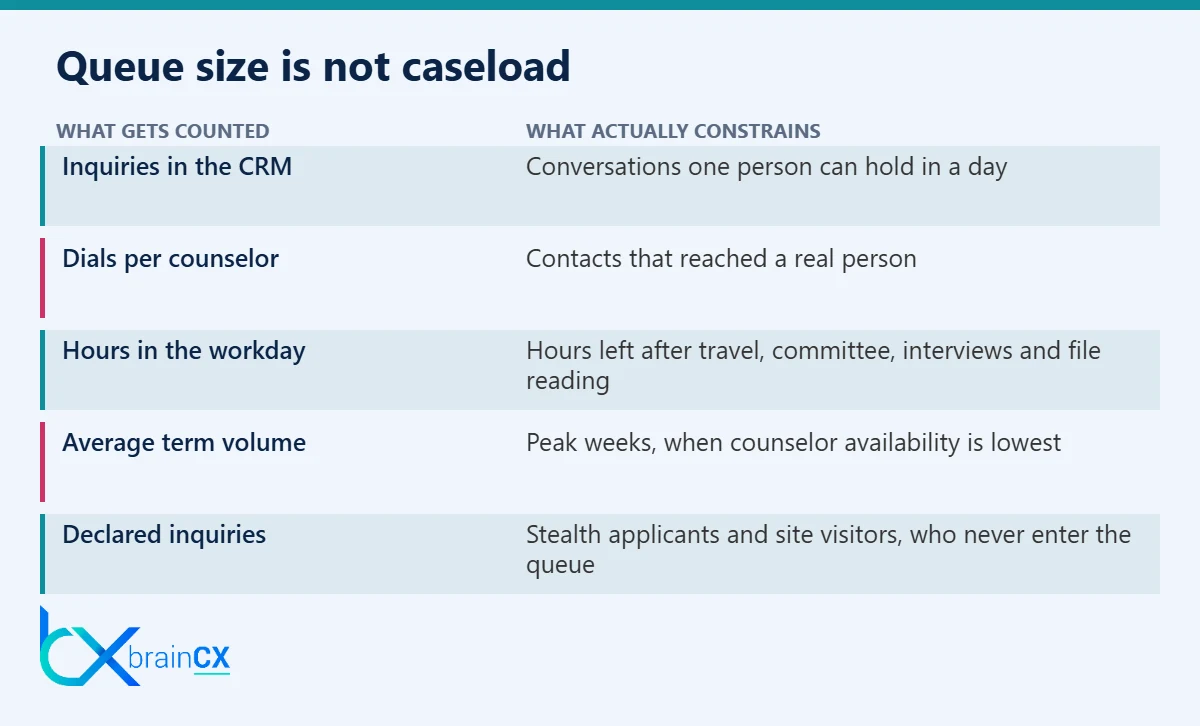
Admissions counselor capacity is set by how many meaningful conversations one person can have in a day, not by how many records sit in their queue. A counselor working a territory can hold a few dozen real conversations a day at most. Anything above that is a list, not a caseload.
The gap between those two numbers is where enrollment leaks, and it is almost always wider than the staffing plan assumes.
The arithmetic nobody writes down
Take the inquiry volume for a term, divide by the number of counselors, and divide again by the working days in the cycle. The result is the number of new inquiries each counselor receives per day on top of the ones already in progress.
Then subtract. Counselors travel for recruitment. They sit in committee. They run interviews, read files, answer parent email, and attend the events the institution has committed to. The hours left for outbound calling are a fraction of the workday, and in peak season they are the first hours to disappear.
What remains is a queue that grows faster than it drains. The counselor triages by instinct, which usually means working the inquiries that look most promising and the ones that called most recently. Everything else ages.
An aged inquiry is not neutral. Speed-to-lead research has been consistent for years that contact rates collapse as the interval between inquiry and first attempt grows, which is why speed-to-lead discipline in higher education is a capacity question rather than a motivation question. A counselor who calls on day six is not working less hard than one who calls in five minutes. They are working a worse list.
Capacity is a routing problem, not a headcount problem
The instinct is to hire. The instinct is usually wrong, because the thing that is scarce is not people, it is the first attempt.
A first attempt is almost entirely mechanical. Dial, reach the person or do not, confirm they inquired, find out what program and what term, find out whether they are ready to talk to someone, and book that conversation. None of that needs a counselor’s judgement. All of it needs to happen immediately, which is exactly what a human caseload cannot guarantee.
Move the first attempt to a voice agent and the counselor’s day changes composition rather than volume. They stop dialling numbers that do not answer and start taking conversations with people who have already said what they want. Their capacity measured in meaningful conversations goes up without their hours changing.
This is the argument for automating the student call center that holds up under scrutiny: not that the institution needs fewer counselors, but that counselors should not be spending their scarcest hours on the part of the funnel that requires none of their expertise.
BrainCX was built by CX operators, not AI tourists. The people who designed this ran enrollment and service floors before building software for them, which is why the platform’s default posture is that AI gives counselors superpowers and the counselor stays in the conversation that matters.
The inquiries that never declared themselves
Stealth applicants make the capacity problem worse in a way the queue does not show. A student who researches programs without filling in a form never enters the caseload at all, so the counselor’s queue looks manageable while a share of genuine interest sits entirely outside it.
Website visitors who start an application and stop, or who browse program pages repeatedly, are the same population. Reaching them is outbound work against a list the counselor did not build, which is the first thing to be dropped when the declared queue is already overflowing. Following up with stealth applicants only happens if the capacity to do it exists after the declared inquiries are handled, and at most institutions it does not.
What the counselor should get back
A booked conversation with context attached. The program, the term, the student’s stated question, whether they have applied, and whether financial aid is the blocker.
That last one matters more than it looks. A counselor who knows the question is about cost before the call starts handles it differently, and financial aid call volume is the single most common reason an inquiry stalls between interest and application.
Multilingual reach belongs in the same handoff. An institution recruiting international students cannot staff every language across every shift, and BrainCX covers 40+ languages inside the same workflow rather than through a separate transfer path.
What to measure instead of queue size
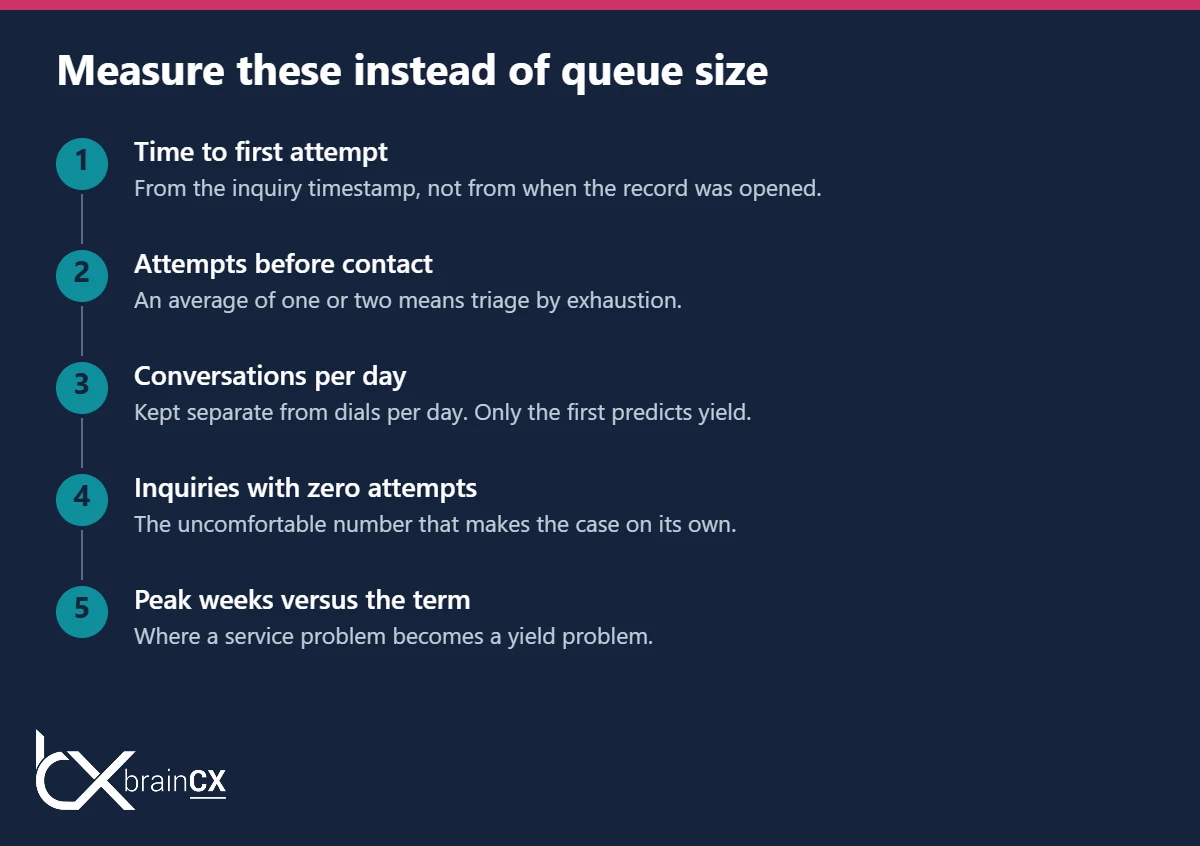
Time to first attempt, measured from inquiry timestamp rather than from when the counselor opened the record. This is the number that predicts contact rate and the one most CRMs report badly.
Attempts per inquiry before contact or abandonment. If the average is one or two, the queue is being triaged by exhaustion rather than by strategy.
Conversations per counselor per day, separated from dials per counselor per day. The two diverge sharply, and only the first one correlates with yield.
Share of inquiries that received zero outbound attempts. This is the uncomfortable number and the one that makes the capacity case to a provost without any further argument.
Then compare peak weeks against the rest of the term, because peak season enrollment volume is where the gap between queue and caseload becomes a yield problem rather than a service problem.
Where this lands
Counselor capacity is real and it is not elastic. The institutions that handle it well do not pretend otherwise; they take the mechanical first attempt off the counselor’s plate and spend the recovered hours on the conversations that change a decision.
The seasonal distortion
Admissions capacity is not constant across a year, and planning that treats it as constant will be wrong twice. Volume concentrates into application deadlines, decision releases, and the weeks after financial aid packages land, and counselor availability moves in the opposite direction during travel season.
So the worst capacity gap occurs precisely when inquiry quality is highest. An institution that staffs to average volume is understaffed during every moment that matters and overstaffed in February.
Hiring cannot solve a four-week peak. Temporary staff cannot either, because by the time they are trained on programs and CRM the peak has passed, and the cost of training them falls on the counselors who are already overloaded.
A voice agent has no seasonal capacity. It makes the same first attempt in the first week of a deadline rush as it does in a quiet week, which is the structural answer to a problem that headcount cannot address. Peak season volume is where this becomes visible on a wallboard rather than in a post-mortem.
Waitlist and melt are the same capacity problem
Two other populations compete for the same hours and usually lose. Waitlist conversion requires fast outbound work in a narrow window, as waitlist and yield calling sets out, and it arrives exactly when counselors are closing the admitted class.
Summer melt is the other one. A deposited student who quietly disappears over the summer is the most expensive loss in the funnel, because the institution has already spent the full acquisition cost. Melt follow-up is pure outbound, it happens when counselors are on leave, and it is almost never resourced.
Neither of those is a strategy failure. Both are the predictable result of a caseload that was already above capacity before the extra population arrived.
Contact-rate and speed-to-lead dynamics described here reflect widely reported industry research rather than BrainCX client data. Institution-specific figures should be validated against your own CRM before use in planning.
Frequently asked questions
What is a realistic admissions counselor capacity?
A few dozen meaningful conversations a day is the practical ceiling for one counselor working a territory, once travel, committee work, file reading, and events are subtracted. Queue size above that is backlog, not caseload.
Does voice AI replace admissions counselors?
No. It takes the first attempt, which is mechanical, and hands the counselor a booked conversation with program, term, and stated question attached. The counselor stays in the conversations that influence a decision.
How does this affect speed-to-lead?
A voice agent can make the first attempt immediately rather than whenever a counselor’s calendar allows, which is the variable that drives contact rate.
Can it reach stealth applicants and website visitors?
Yes, as outbound work against lists the counselor did not build. That work is usually the first thing dropped when the declared inquiry queue is already full.
What should we measure to prove the capacity gap?
Time to first attempt from the inquiry timestamp, attempts per inquiry, conversations per counselor per day as distinct from dials, and the share of inquiries that received no outbound attempt at all.
Is BrainCX FERPA certified?
FERPA is planned, not certified. FERPA binds the institution rather than the vendor, and a vendor enters the framework through the school official exception, which is a contractual and architectural arrangement rather than a certificate.
Why does hiring not solve a seasonal capacity gap?
A four-week peak cannot be hired for. Temporary staff need training on programs and the CRM before they are useful, and that training is delivered by the counselors who are already overloaded.
How long does deployment take?
4 to 6 weeks for a managed deployment, and as little as 3 weeks in simpler environments.