

Can AI handle pharmacy refill calls without a pharmacist on the line?
Yes, for the parts of the call that are administrative. AI for pharmacy refill calls can take the request, confirm identity, check the prescription record, tell the patient when the order will be ready, and route anything clinical to staff. What it must not do is answer a question about the medication itself.
That line is the whole design problem, and it is worth being precise about where it sits.
The call that arrives every morning
A refill call is mostly data entry wearing a conversation. The patient gives a name, a date of birth, a prescription number or a drug name, and a pickup preference. A technician types those into the pharmacy system, checks whether refills remain, checks whether the prescriber has to be contacted, and gives a time.
None of that requires clinical judgement. All of it requires a person to be free, and at a multi-site pharmacy group the person is usually not free. Refill requests cluster into the opening hour and the hour after work ends, which are the same hours the counter is busiest with people physically present.
So the call goes to hold, then to voicemail, then to a callback queue that someone works through between customers. The patient who could not get through calls again the next morning, which adds volume to the hour that was already the problem.
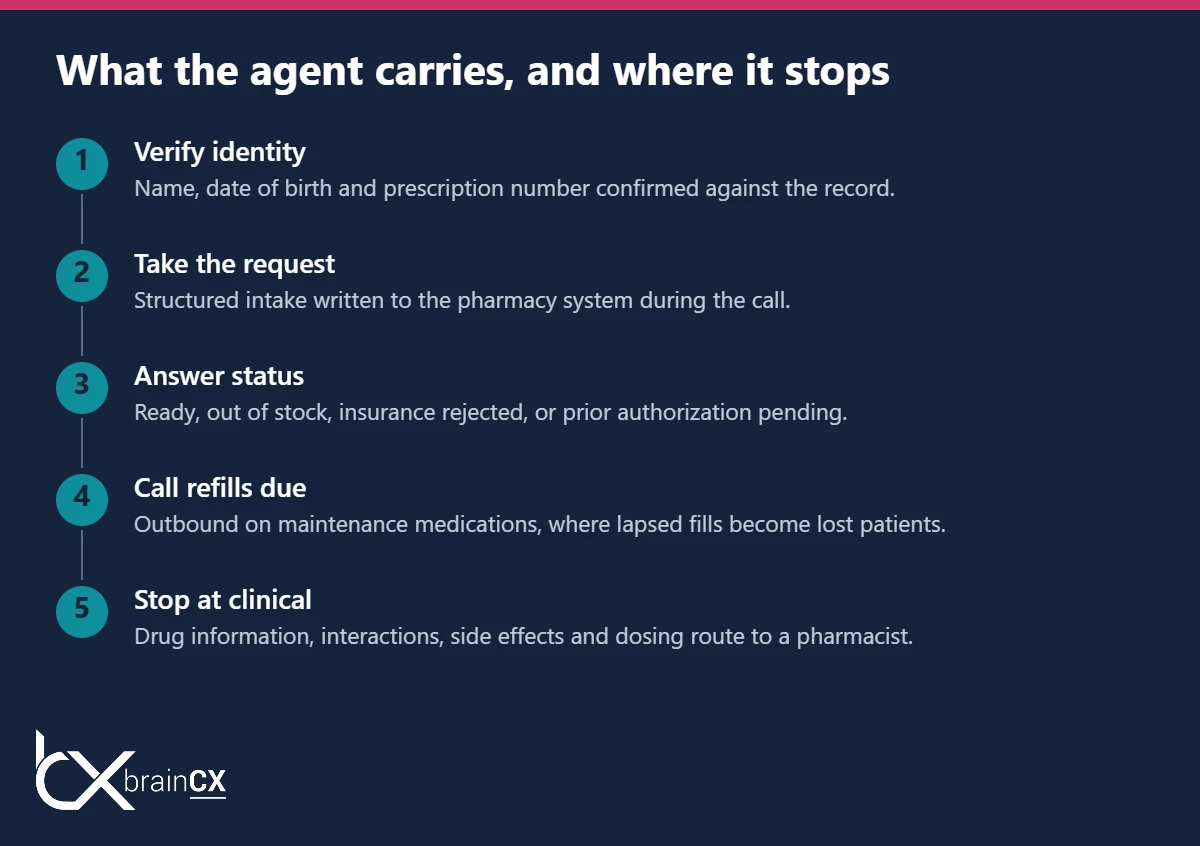
What AI for pharmacy refill calls can carry
Identity verification comes first, and it is ordinary. Name, date of birth, and a prescription number or address confirm who is calling against the record.
Intake is next. The request itself is structured data, and a voice agent that writes to the pharmacy system during the call rather than after it leaves the technician nothing to retype. This is the same real-time write-back pattern that makes eligibility capture work during intake rather than in a queue afterwards.
Status is the third piece, and it is the one patients call about most. Whether a prescription is ready, whether it is out of stock, whether the insurance rejected it, whether a prior authorization is pending. Those are record lookups, and a voice agent reading from the system is faster than a technician who has to walk to a terminal.
Refill-due outbound is the fourth, and it is the one that moves revenue rather than cost. A maintenance medication that lapses is a patient who stops filling at your pharmacy and eventually fills somewhere else.
Where it has to stop
A question about what a medication does, whether two prescriptions interact, what a side effect means, or whether a dose should change is a clinical question. Those route to a pharmacist, with the context already captured so the patient does not start over.
This is not a capability limit, it is a scope decision, and it should be written into the call flow rather than left to the model. BrainCX does not position voice AI as a clinical or coverage decision-maker in any setting, which is the same boundary that governs prior authorization work: the agent handles status, documentation, and queue management, and never makes the determination.
The counselling requirement is the clearest case. Where a pharmacist offer-to-counsel obligation attaches under state practice rules, an automated call does not satisfy it and should not be built as though it might.
Multi-site is where the economics change
A single pharmacy can staff around its phone problem by having someone answer between customers. A group of forty cannot, because the problem is forty front counters with the same peak hours and no shared queue.
Voice AI changes the unit of staffing from the location to the group. One deployment answers every line, and a call that needs a human routes to whoever is free across the network rather than to whoever is standing at that specific counter. The pattern is the same one that makes multi-site clinic groups and multi-site dental organizations worth deploying against.
Language coverage compounds the same way. A pharmacy group serving a Spanish-speaking population needs that coverage at every counter during every shift, which is a staffing impossibility and a routine platform capability. BrainCX supports 40+ languages, and language access inside patient-facing workflows works the same way here as it does at a clinic front desk, with the employee staying on the call rather than being replaced by it.
BrainCX was built by CX operators, not AI tourists. The scope boundary above is an operator’s instinct, not a legal review finding: people who have run pharmacy and health system phone queues know exactly which calls a technician should never have been taking and which ones a pharmacist must always take.
The compliance frame, briefly
Protected health information is in scope from the first sentence of a refill call. A vendor handling it is a business associate, and the arrangement needs a business associate agreement under the HIPAA Privacy Rule at 45 CFR 164.502(e) before any call is taken.
BrainCX operates under a signed BAA and is HIPAA compliant. SOC 2 Type II is in process. Those are two different statements and procurement will read them as two different statements, which is the right way to read them; what to ask a voice AI vendor during procurement covers the rest of that list.
Data residency is worth settling early. Where it is possible, call data sits in the client’s own infrastructure rather than the vendor’s.
Outbound refill reminders add the TCPA to the picture. An AI-generated voice is an artificial or prerecorded voice under FCC Declaratory Ruling 24-17, so prior express consent applies to covered calls, and the consent revocation rules changed on November 25, 2026 under FCC 26-67. A pharmacy group running refill reminders, billing notices, and promotional outreach from one consent record should be able to tell those categories apart before relying on the new scoping rules.
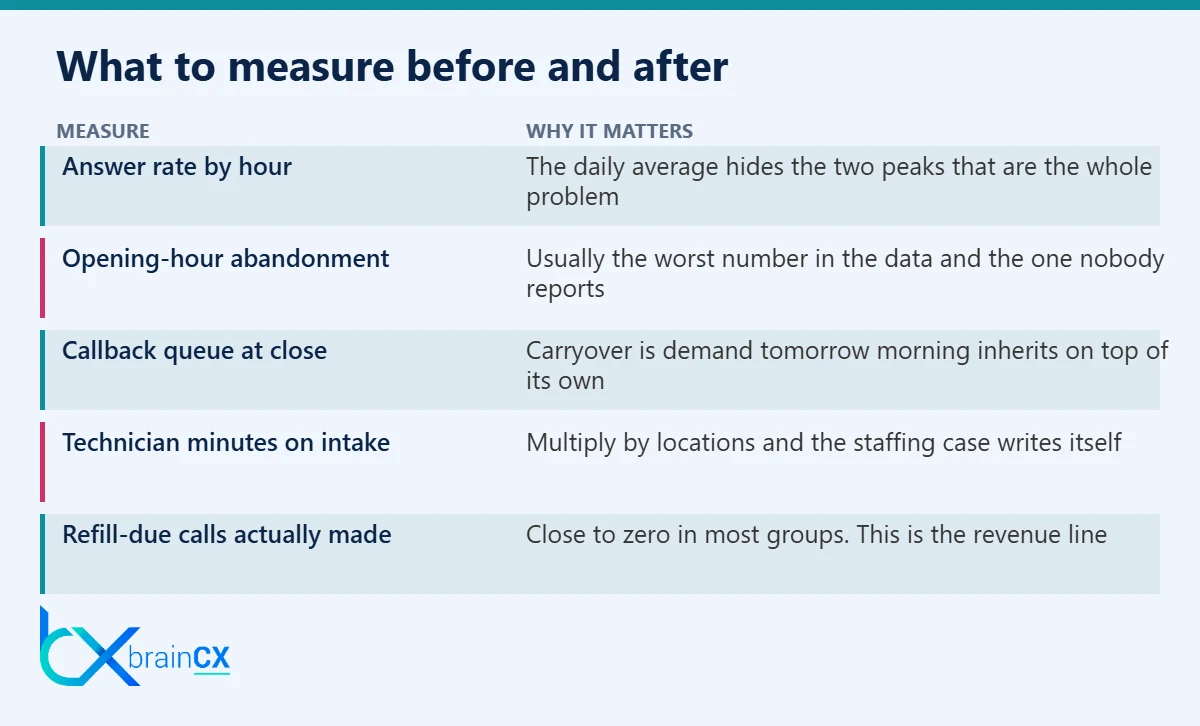
What to measure before and after
Answer rate by hour, not by day. The daily average hides the two peaks that are the entire problem, and a group that cannot see the peaks cannot size the fix.
Abandonment during the opening hour, measured separately from the rest of the day. This is usually the single worst number in a pharmacy group’s telephony data and the one nobody reports.
Callback queue depth at close of business. A queue that carries over is demand the next morning inherits on top of its own.
Technician minutes spent on refill intake. Multiply by locations and the staffing argument writes itself without any vendor assistance.
Share of refill-due outbound that actually got made. In most groups this is close to zero, and it is the revenue line rather than the cost line.
Then look at language. Count the share of calls arriving in a language the counter cannot serve during the hours it is open, and compare it against the patient population the group is supposed to be serving.
Where it fits in a wider deployment
Refill handling is rarely the first thing a health group automates, and it should not be the last. It sits naturally alongside appointment work, because the same patients call about both and the same counter staff handle both.
For a pharmacy inside a larger health system, the refill line and the patient access line are usually separate numbers with separate queues and the same underlying constraint. Consolidating the conversational layer while leaving the fulfilment rules with each department is what makes a group-wide deployment tractable rather than a sequence of forty projects.
This article describes operational practice and published federal requirements as of November 2026 and is not legal advice. State pharmacy practice rules vary, and counselling and automation requirements in your states should be confirmed with counsel before deployment.
Frequently asked questions
Can AI for pharmacy refill calls verify patient identity?
Yes. Name, date of birth, and a prescription number or address are structured confirmations against the pharmacy record, and a voice agent handles them the same way a technician does.
Will the AI answer questions about the medication?
No. Drug information, interactions, side effects, and dosing are clinical questions that route to a pharmacist with the call context already captured, so the patient does not repeat themselves.
Does it work for refill reminders as well as inbound requests?
Yes. Outbound refill-due calls on maintenance medications are one of the clearer revenue cases, because a lapsed maintenance fill usually means the patient eventually fills elsewhere.
Does it write to our pharmacy system?
BrainCX writes captured data back to downstream systems during the call rather than afterwards, which is what removes the technician’s retyping step rather than relocating it.
Is a BAA required?
Yes. Refill calls involve protected health information, so the vendor is a business associate and a business associate agreement is required under 45 CFR 164.502(e). BrainCX operates under a signed BAA.
What languages are supported?
40+ languages, including real-time Spanish, inside the same workflow rather than through a separate transfer path.
How long does deployment take?
4 to 6 weeks for a managed deployment, and as little as 3 weeks in simpler environments. BrainCX is delivered as a managed service rather than a platform handed over at signing, so the pharmacy group is not configuring call flows itself.
Do outbound refill reminders need TCPA consent?
Covered calls do. An AI-generated voice is treated as an artificial or prerecorded voice under FCC Declaratory Ruling 24-17, and the consent revocation rules changed on November 25, 2026, so reminder programs should be able to distinguish their informational categories.